
Agras T50 for High-Altitude Wildlife Tracking: What the Low
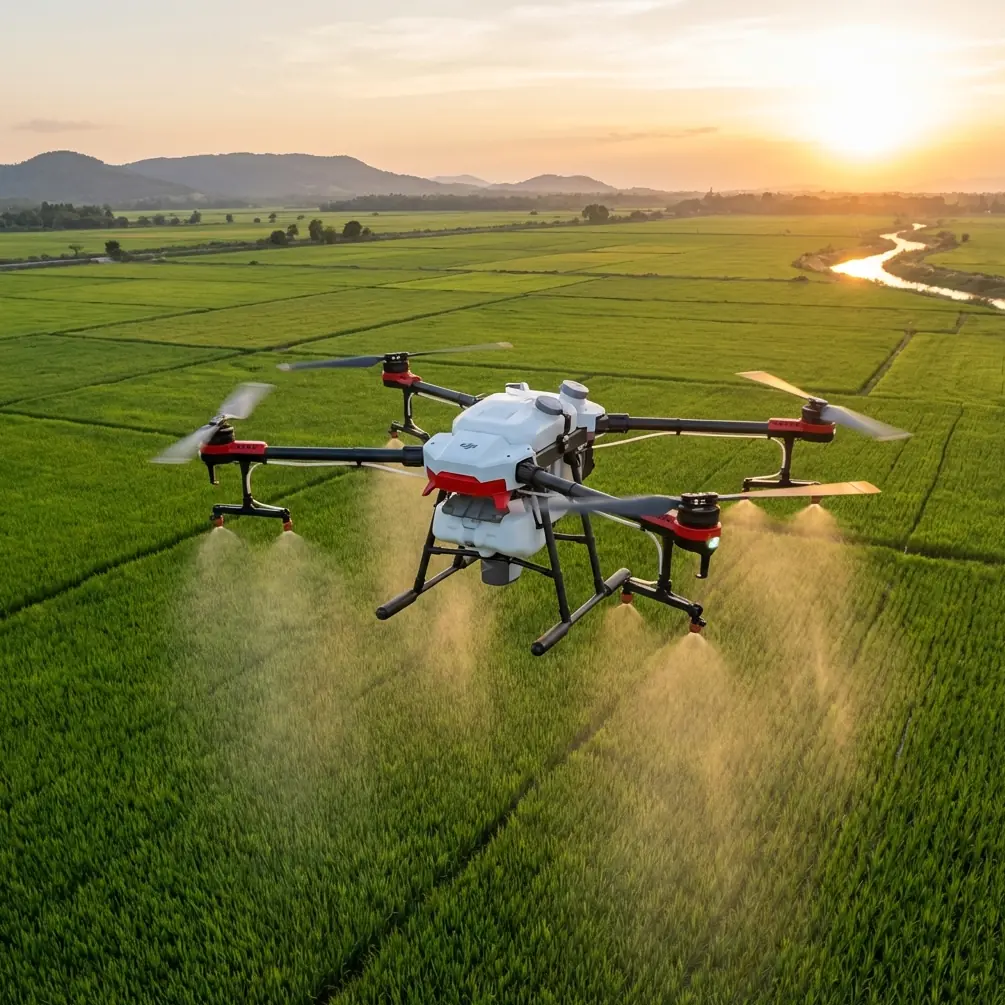
Agras T50 for High-Altitude Wildlife Tracking: What the Low-Altitude Economy Is Really Telling Us
META: A field-driven case study on using the DJI Agras T50 mindset for high-altitude wildlife tracking, with lessons from 2025 low-altitude financing, drone economics, inspection efficiency, RTK precision, battery handling, and real operational constraints.
I spend a lot of time around operators who ask the wrong first question about the Agras T50.
They ask about payload, coverage, or speed.
Those matter. But for high-altitude wildlife tracking, the more revealing question is this: why are investors, infrastructure planners, and industrial operators all pouring attention into the same low-altitude ecosystem that machines like the T50 sit inside?
Because the real story is no longer the drone by itself. It is the operating model around it.
That matters for anyone evaluating the Agras T50 beyond standard farm work, especially in mountainous terrain where wildlife monitoring, habitat edge mapping, bait exclusion surveys, and corridor observation demand repeatable flights, stable low-speed performance, and disciplined field logistics.
The signal behind the machine
A recent financing roundup from China’s low-altitude economy offers a useful clue. In the first quarter of 2025 alone, multiple companies announced funding rounds ranging from tens of millions of yuan to more than 100 million yuan. The covered segments were not narrow. They stretched across eVTOL, hydrogen control systems, large unmanned cargo aircraft, and other unmanned technologies. One company, Zhidao Technology, announced on March 28, 2025 that it had completed a Series A+ round worth tens of millions of yuan and would add a new base in Rizhao, Shandong.
That sounds far removed from an Agras T50 in alpine grassland or forest fringe work. It isn’t.
When capital flows into adjacent low-altitude sectors, three practical things usually follow for field operators:
Supply chains get stronger
Parts availability, batteries, transport systems, and support infrastructure improve.Operational expectations rise
Clients stop treating drones as experimental and start expecting consistency.Use cases widen
A platform once seen as single-purpose starts getting evaluated for crossover missions.
That is exactly where the T50 becomes interesting in wildlife-related work at elevation. Not as a generic “do everything” aircraft, but as a serious industrial platform whose surrounding ecosystem is maturing fast enough to support nontraditional deployment patterns.
Why a crop drone enters the wildlife conversation
The Agras T50 is built for agricultural productivity, not wildlife biology. Let’s get that straight.
But high-altitude wildlife tracking often borrows methods from agriculture and utility inspection more than people realize. You are flying repeated routes over difficult ground. You need stable altitude behavior, dependable GNSS performance, predictable swath planning, and enough lifting and power architecture to carry the job through thin-air conditions and short weather windows.
That is where the older industry data becomes surprisingly relevant.
A Chinese drone development summary makes a blunt point about inspection efficiency: a traditional inspector can typically check 6 to 10 poles or towers in a day, while a drone can complete the equivalent of that daily manual workload in 20 to 30 minutes. The source was discussing powerline inspection, particularly in mountains, lakes, and mining areas where terrain slows human access and reduces inspection completeness.
Swap towers for ridgelines, water access points, migration edges, or hillside transects, and the operational logic barely changes.
High-altitude wildlife tracking is often less about chasing animals and more about collecting complete, repeatable aerial evidence over terrain that punishes foot access. The drone’s value is not only speed. It is the aerial angle and the data consistency. The same source notes that aerial imaging from different angles makes inspection records more complete. In wildlife work, that can mean better visibility into grazing pressure, trampling paths, den approach routes, edge encroachment, or post-storm habitat disturbance.
The T50’s significance here is not that it replaces specialized survey drones. It is that it belongs to a class of workhorse aircraft built for repetitive field operations where uptime and route discipline matter more than novelty.
The Phantom lesson still applies
If you want to understand why DJI platforms continue to shape industrial expectations, look backward for a moment.
DJI was founded in 2006 in Shenzhen and, according to industry reporting, serves customers in more than 100 countries. By 2012, the Phantom 1 had ignited broad demand for quadcopters. By 2015, DJI had entered agricultural spraying with the MG-1. By 2016, the company had reportedly filed more than 1,500 patent applications worldwide and secured over 400 granted patents, spanning structural design, circuits, flight stability, wireless communication, and control systems.
Those facts matter because the Agras T50 does not appear out of nowhere. It sits on top of a long design culture built around control, stability, and scale.
For wildlife operations in high-altitude environments, that heritage shows up less in marketing language and more in field confidence. RTK fix rate, route repeatability, obstacle behavior, and aircraft responsiveness all become magnified when the mission area includes steep elevation changes, gust channels, and cold morning launches.
If the aircraft misses its line by a little in flat farmland, the result may be overlap inefficiency.
If it misses its line on a mountain shoulder during a tracking run, the result may be incomplete habitat evidence.
That is why centimeter precision matters. Not as a buzzword. As the difference between a useful repeat pass and a pretty but untrustworthy one.
A case from the plateau edge
Last season I advised on a non-farm project in upland terrain where the client initially thought they needed a lightweight camera drone only. Their goal was wildlife-related observation around grazing interfaces at altitude: identify repeat movement corridors, assess water access disturbance, and document vegetation pressure after a dry stretch.
The first few flights with a small platform looked clean on paper. In practice, the aircraft spent too much of the day fighting the environment rather than working through it. Battery turnover became chaotic. Wind at ridge saddles was more erratic than expected. Repeat lines drifted enough to make side-by-side comparisons frustrating. The data was not useless, but it lacked operational rhythm.
What changed the outcome was not simply moving to a larger machine class. It was adopting the discipline common in agriculture and utility operations.
We rebuilt the mission around five principles:
1. Route repeatability before image beauty
Wildlife teams often get seduced by cinematic imagery. That is a mistake. A clean repeat line with solid RTK behavior is worth more than a dramatic angle. When you are comparing hoof pressure, bedding zones, or movement paths over time, consistency wins.
2. Swath width must match the question
Wide coverage sounds efficient until you realize you are gathering more terrain than interpretation capacity. In wildlife edge studies, swath width should reflect the biological problem. Too wide, and details vanish. Too narrow, and battery cycles multiply.
3. Weather windows are short at elevation
In high-altitude environments, you often get one stable block in the morning and a smaller recovery period in late afternoon. Planning around that is not optional.
4. Battery management is part of data quality
This is where many teams fail.
5. Airframe durability matters more than brochure language
Dust, moisture, rough transport, and cold starts punish equipment. Industrial protection standards such as IPX6K matter because highland work rarely happens under gentle conditions.
The battery tip I wish more T50 operators followed
Here is the field habit that saves more bad missions than any app setting: do not rotate packs by simple sequence alone; rotate them by thermal behavior and voltage consistency.
At altitude, batteries can fool you.
A pack that looks fine in the case may sag earlier under load if it cooled unevenly after the previous sortie or sat in direct sun on one turnaround and cold shade on the next. Teams that just label packs 1, 2, 3, 4 and cycle blindly eventually get one sortie with a shorter safe margin than expected. That is usually the sortie launched because “we only need one quick pass.”
That quick pass becomes the one that lands with less buffer than anyone wanted.
My rule in mountain work is simple:
- log pack temperature feel and recent exposure, not just charge status
- group packs by similar turnaround conditions
- avoid sending your “fully ready” pack immediately after rapid charging if the ambient air is cold and the mission starts with an aggressive climb
- if one pack shows weaker behavior, remove it from the day’s primary rotation fast instead of giving it one more chance
This is not glamorous advice. It is the kind that keeps the aircraft predictable.
For T50-style operations, that predictability matters even more because the machine is meant to work, not just fly. A stable power profile supports accurate line holding, cleaner nozzle calibration checks in agricultural use, and better mission confidence in crossover applications like habitat observation or terrain-linked survey passes.
What spray drift and nozzle calibration teach wildlife operators
Even if your wildlife mission is not a spraying job, agricultural discipline transfers well.
Two examples:
Spray drift mindset
Agricultural pilots obsess over drift because small atmospheric changes ruin application quality. Wildlife operators should borrow that mindset. If crosswind is enough to move droplets off target, it is also enough to alter low-altitude track stability, visual interpretation conditions, and route consistency along ridge contours. Drift awareness trains you to respect microclimates rather than relying on broad weather forecasts.
Nozzle calibration mindset
Nozzle calibration is really about system honesty. You verify what the machine is actually doing, not what you assume it is doing. In wildlife tracking, the equivalent is validating sensor alignment, georeferencing consistency, and mission spacing before the important sortie. The process mentality is the same.
This is one reason the Agras category deserves more respect outside spraying. It comes with a culture of preflight rigor. And in demanding terrain, rigor beats improvisation.
Inspection logic is the bridge
The most useful reference in the source material may be the inspection example, not the financing news.
The source explains that multirotor drones are flexible, easier to operate, stable in hover, and well suited to image acquisition on line structures and components. It also points out that they are especially valuable before major maintenance work because they can survey conditions in advance and help technicians build a better plan.
Translate that directly into high-altitude wildlife projects.
Before a field team hikes into a valley or sets up observation infrastructure, a T50-style mission profile can help:
- map access barriers
- identify unstable ground or washout zones
- verify water source conditions
- inspect edge disturbance after livestock movement
- establish repeatable reference imagery for later comparison
That pre-entry aerial pass often saves a day of guesswork on foot.
And the significance of the “20 to 30 minutes equals a day of manual inspection” figure is not just speed. It is decision compression. The drone shortens the time between question and evidence. In mountain wildlife work, that can mean the difference between responding while signs are fresh and arriving after the landscape has already changed.
Economics still matter, even in specialist work
One older reference estimates that a drone with a 5-year operating life and annual maintenance equal to 20% of its initial cost can work out to roughly 4 yuan per day, and at 10 tasks per day the amortized cost per package falls to about 0.4 yuan, or under 0.5 yuan per delivery in that example.
Those are not T50-specific numbers, and they describe logistics. Still, the underlying lesson applies.
If a drone can spread its fixed costs across frequent, repeatable tasks, its economic case improves rapidly.
That is relevant for wildlife and upland monitoring teams that only look at upfront equipment burden and ignore mission density. A T50 makes the most sense when it is not treated as an occasional experiment, but as part of a scheduled operating program: corridor checks, seasonal habitat edge passes, post-weather assessments, grazing conflict documentation, and repeat mapping cycles.
Use it once a quarter and it feels heavy.
Use it as a structured field asset and the math changes.
Where the T50 fits, and where it does not
The Agras T50 is not a substitute for every wildlife drone workflow. If your mission depends on compact deployment, highly discreet visual observation, or specialized multispectral payload integration, another platform may fit better.
But if your environment is harsh, your routes are repeatable, your workload is industrial rather than cinematic, and your challenge is terrain more than pure optics, the T50 becomes part of a serious conversation.
Especially at altitude.
Its relevance comes from the broader pattern visible in the source material: the low-altitude economy is attracting real capital, DJI’s industrial foundation is deep, and the strongest drone use cases continue to be the ones that remove friction in places where foot access is slow, incomplete, or unsafe.
That is exactly the kind of environment where wildlife tracking turns from an observational hobby into an operational problem.
And operational problems reward operational aircraft.
If you are trying to assess whether the T50 can be adapted intelligently for your own mountain wildlife or upland survey workflow, send the mission profile, terrain notes, and altitude range through this WhatsApp line. That usually reveals suitability faster than a spec-sheet debate.
Ready for your own Agras T50? Contact our team for expert consultation.