
Agras T50 Tracking Tips for Vineyards in Dusty Conditions
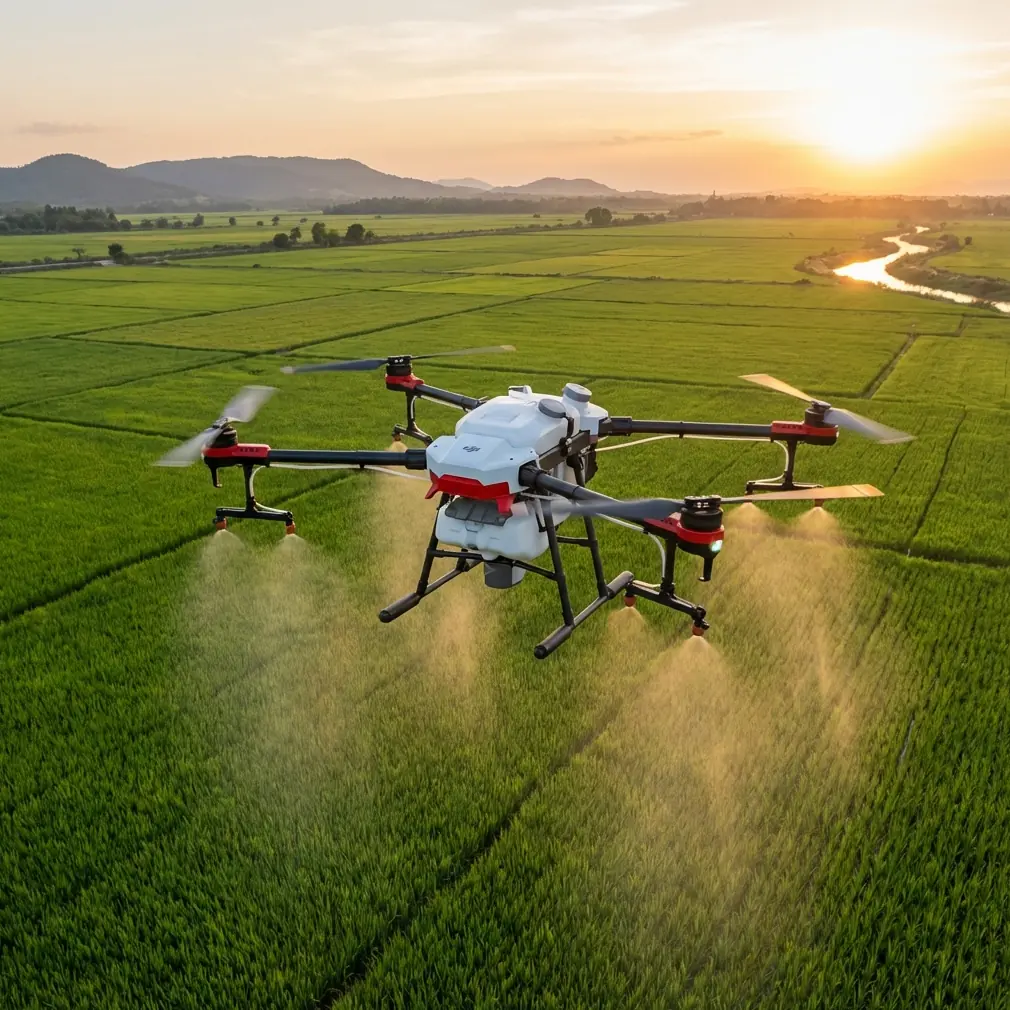
Agras T50 Tracking Tips for Vineyards in Dusty Conditions: A Technical Review
META: Expert Agras T50 vineyard tracking advice for dusty field conditions, covering obstacle logic, precision flight behavior, spray drift control, nozzle calibration, and operational reliability.
Dust changes everything in a vineyard.
It reduces contrast, softens visual cues, coats sensors, and turns a clean guidance line into an uncertain one by midday. For operators running an Agras T50 between vine rows, that matters more than spec-sheet bragging rights. Tracking quality in dusty conditions is not just about whether the aircraft can stay airborne and complete a route. It is about whether it can hold a predictable path, maintain clean application geometry, and make sound decisions when the environment becomes less readable.
That is where the T50 deserves a closer look.
A lot of discussions around agricultural drones stay too broad. They drift into generic claims about efficiency, capacity, or automation. Vineyards are less forgiving than open-field work. The rows are tighter. The canopy profile changes faster. Dust can hang in the corridor between vines, especially in dry weather or after repeated equipment passes. In that setting, the real question is this: how well can the aircraft keep its logic when visibility and sensor conditions are less than ideal?
Why tracking discipline matters more in vineyards
In orchards and vineyards, the drone is not simply moving from point A to point B. It is repeatedly solving a corridor-navigation problem. The aircraft has to hold a usable swath width, preserve distance from the canopy, and avoid overcorrecting when the flight path gets visually messy. If tracking becomes unstable, application quality suffers first.
That can show up in several ways:
- uneven coverage along the edge of the vine wall
- inconsistent penetration into the canopy
- higher spray drift from poor alignment or unnecessary lateral corrections
- missed patches when the aircraft breaks pattern after a momentary sensor uncertainty
The Agras T50 stands out here because operators are not relying on a single cue. In practical field use, what matters is the combination of centimeter precision, stable RTK fix behavior, and robust aircraft logic when local conditions become noisy. In dusty vineyards, this layered approach is often where better-performing platforms separate themselves from weaker ones.
Dust is not just a visibility issue
People often treat dust as if it only affects the camera view or line of sight. In reality, dust creates a more complicated operational problem. It can interfere with range confidence, obscure fine terrain contrast, and increase the need for conservative obstacle behavior. That is why an aircraft’s decision-making architecture matters as much as its raw payload capability.
One of the most useful reference points comes from a DJI educational flight logic example. In that source, a drone advances in 20-centimeter increments, then checks whether an obstacle appears within 60 centimeters ahead. If the distance threshold is breached, the aircraft stops the forward loop, flashes a warning, turns around, flies 100 centimeters back, and lands. That example was built for training, not vineyard spraying, but the operational lesson is highly relevant: safe autonomous behavior starts with repeated short-step verification rather than blind continuous movement.
Why does this matter for the T50 in vineyards?
Because dusty row work rewards platforms that can make stable, incremental corrections instead of dramatic late reactions. A drone that effectively “samples the corridor” and preserves path discipline is more usable in real agriculture than one that looks strong on paper but becomes jumpy in cluttered or dirty environments.
The same reference also describes a bypass logic in which the drone moves forward until TOF distance drops below 500 millimeters, then shifts laterally in 20-centimeter steps until the path opens beyond 1000 millimeters. Again, the significance is not that a vineyard operator should copy those exact distances. The significance is the principle: obstacle handling should be measurable, repeatable, and based on verified clearance margins. In a vineyard, where trellis posts, end-row structures, hoses, and localized dust clouds can all affect the sensing environment, that kind of structured decision process is far more valuable than vague claims of “smart avoidance.”
What the T50 does well compared with weaker platforms
This is where the Agras T50 tends to excel against lesser agricultural drones and even some competing systems positioned for permanent crop work.
Many aircraft can follow a route when conditions are clean. Fewer can maintain composure when the environment becomes visually degraded and physically messy. A vineyard in dry season is a hard test because the aircraft has to preserve application geometry while absorbing sensor noise and environmental contamination. The T50’s advantage is not one miracle feature. It is the way core field features support each other:
1. Centimeter precision matters more than marketing language
In vineyard lanes, a small lateral error can create a visible change in coverage. Centimeter-level positioning is not about abstract accuracy. It affects whether the aircraft repeats the same corridor line on subsequent passes and whether the nozzles remain aligned to the intended canopy face. If RTK fix rate drops or wanders, the operator sees it first in edge inconsistency and overlap variation.
That is why the T50’s precision stack matters more than a lighter-duty machine trying to do the same work with less reliable positioning discipline. In dusty environments, where visual cues degrade, high-confidence positional correction becomes even more important.
2. Spray drift control starts with flight stability
A surprising number of operators discuss spray drift as if it begins and ends with droplet size. It does not. Drift risk rises when the aircraft makes unnecessary lateral movements, abrupt braking inputs, or unsteady height corrections around the canopy. Stable tracking reduces these disturbances.
For the T50, that means nozzle calibration and route discipline should be treated as one system. If the nozzles are calibrated but the aircraft is wandering, your application will still suffer. If the path is excellent but flow behavior is inconsistent, the result is equally flawed. The better result comes from pairing a clean RTK solution with properly tuned spray output and practical speed settings for the row geometry.
3. IPX6K-class protection is not a side note in dusty vineyards
Dusty vineyards are usually dry vineyards, but dust rarely arrives alone. Operators still wash equipment, work around residue, and expose aircraft to fine particulate contamination. A platform with strong ingress protection is easier to keep operational over time because it is built for hard field realities, not showroom conditions. IPX6K-level resilience matters operationally because cleaning and repeated exposure are part of ownership, not exceptions.
That makes the T50 a better fit than aircraft that perform acceptably in ideal demos but start to feel fragile under repetitive farm use.
The overlooked lesson from educational obstacle logic
The training material in the reference set includes another detail that is easy to miss but highly useful for T50 operators. In one exercise, the drone first climbs to 1.5 meters, measures its height from the ground, then moves to a table and compares the difference in measured height to calculate the object’s elevation.
That may sound basic, yet it points to a sophisticated field truth: relative measurement is often more valuable than absolute assumption.
In vineyards, dusty conditions can distort the operator’s visual judgment of clearance, especially near uneven terrain, berms, irrigation lines, or variable canopy height. The practical takeaway for T50 users is to think in terms of verified relative spacing rather than intuition alone. If your aircraft can maintain dependable altitude behavior and your route planning respects canopy variability, you reduce the chance of poor deposition or excessive disturbance near the vines.
This is also why multispectral data, while not always part of the spraying mission itself, can be strategically useful in a broader program. If you map vigor variability and canopy structure separately, you can make better decisions about where the T50 should fly slower, adjust swath assumptions, or receive special attention during application planning. The drone’s spraying performance improves when the agronomy context is stronger.
Practical T50 tracking tips for dusty vineyard work
A technical review should lead to field decisions, so here is where the Agras T50 can be used more intelligently.
Prioritize RTK fix quality before the first row
Do not treat RTK as a background feature. In vineyards, path repeatability is central to application quality. If the fix is unstable, your overlap and row alignment will reveal it quickly. A good operator checks fix confidence before committing to production passes, not halfway through them.
Tighten nozzle calibration discipline
Dusty environments can tempt crews to rush setup because the visible challenge seems to be navigation. That is a mistake. Nozzle calibration is where application credibility begins. If the T50 is tracking precisely but delivering uneven output, the mission still fails agronomically.
Be conservative with swath width in difficult corridors
A theoretical swath width is not always the right swath width. In dusty vineyards, reducing the operating assumption slightly can improve consistency and lower drift risk. The best result is often the repeatable one, not the widest one.
Watch for false confidence in open end rows
The row itself may be constrained, but end rows can create a temporary sense of freedom. This is where some aircraft begin overcorrecting before reentering the next corridor. The lesson from the training logic is useful here: measured transitions beat aggressive ones. Short, stable corrections maintain route integrity better than dramatic repositioning.
Use obstacle logic as a mindset, not only a feature
The reference material describes deliberate checks at 20-centimeter intervals and obstacle thresholds at 60 centimeters, 500 millimeters, and 1000 millimeters. Those exact values belong to training scenarios, but the mindset belongs in commercial operations: define your safety margins, respect verified clearance, and avoid improvising in low-visibility dust conditions.
A broader industry point: why this matters now
One news reference notes that drone safety became a major topic as drone numbers and capabilities increased, and that the FAA reported 600,000 drones in the United States in 2016. That figure is not about vineyards specifically, but it frames the environment the T50 operates in. As drones moved from elite or specialized use into mainstream civilian tools, expectations changed. Reliability, predictability, and safety stopped being optional refinements. They became baseline requirements.
For agricultural operators, that shift has a direct consequence. The best aircraft are no longer judged only by how much they can carry or how fast they can finish a task. They are judged by how controllably they behave in imperfect conditions.
Dusty vineyards are exactly that kind of test.
The T50 earns its place because it is strong where real work gets difficult: maintaining precise path behavior, supporting stable spray performance, and tolerating the rough physical reality of agricultural operations. Competitor platforms may match individual metrics, but many struggle to combine tracking discipline, field durability, and dependable application control in a way that remains convincing after repeated use.
If you are refining route settings or trying to solve a specific vineyard tracking issue, this direct Agras workflow contact can help: message a T50 field specialist here.
Final assessment
The Agras T50 is not impressive because it can fly through a perfect demo route. Plenty of aircraft can do that. Its real value in vineyards appears when the conditions get uglier: suspended dust, inconsistent visual references, narrow rows, and the constant pressure to preserve application quality instead of merely finishing the mission.
The reference materials point to two operational truths that fit the T50 especially well. First, precise autonomous flight depends on repeatable obstacle and distance logic, not guesswork. Second, safe and effective drone use becomes more critical as adoption scales, which is exactly what the industry has experienced. When you connect those ideas to vineyard spraying, the T50’s strengths become clearer.
For dusty tracking work, the winning formula is simple but not easy: dependable RTK fix rate, conservative swath judgment, disciplined nozzle calibration, and an aircraft robust enough to keep performing after long farm days. That is where the Agras T50 separates itself.
Ready for your own Agras T50? Contact our team for expert consultation.