
Agras T50 in Complex Terrain: A Field Report on Manual
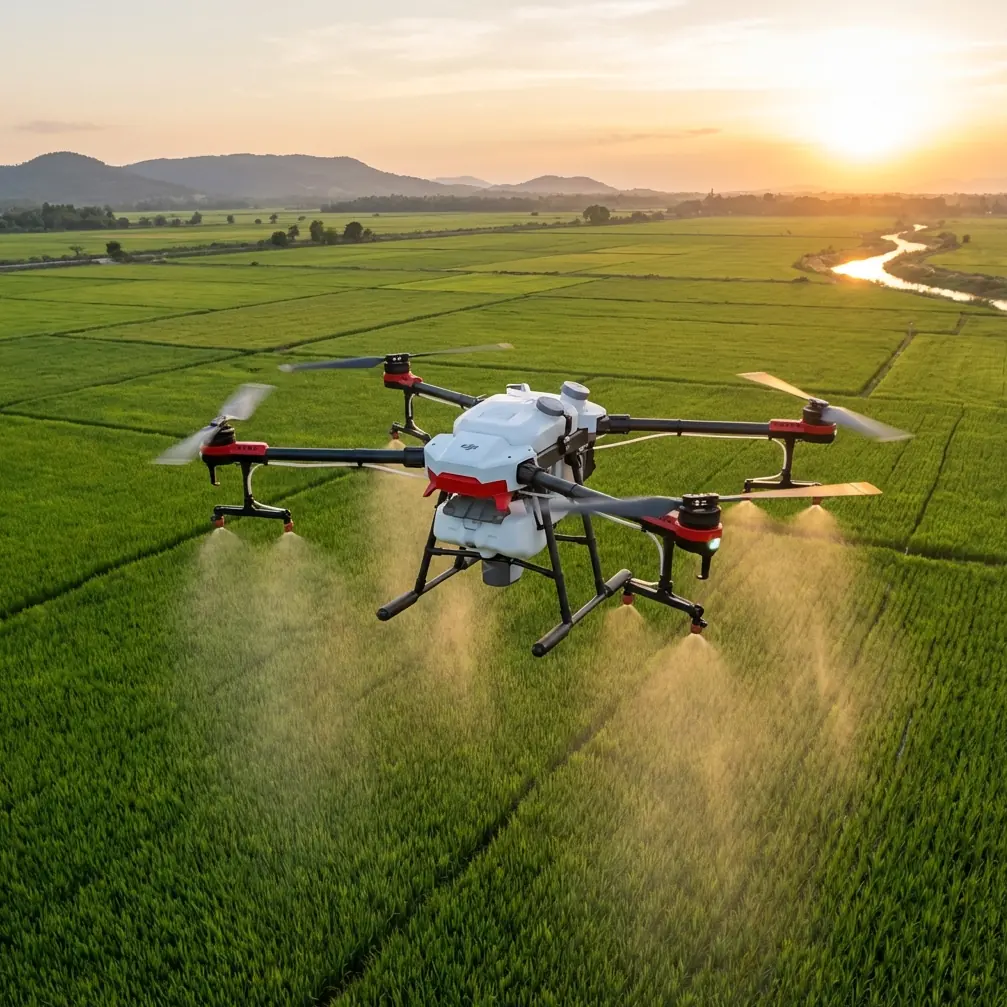
Agras T50 in Complex Terrain: A Field Report on Manual Control, Precision Tracking, and Why Auto Isn’t Always Enough
META: A field report on using the Agras T50 for highway-adjacent agricultural work in complex terrain, with practical insight on manual control, RTK precision, spray drift, nozzle calibration, and why operators should move beyond full auto.
By Dr. Sarah Chen
Most operators do not struggle with the Agras T50 because the aircraft is too advanced. They struggle because modern drone systems are so capable in automatic modes that manual thinking gradually atrophies.
That pattern is not unique to agriculture. A recent discussion in the imaging world captured the problem perfectly: many camera owners spend heavily on capable equipment, then stay in Auto or Program mode because full manual feels intimidating. The sticking point is always the same. Once the user is asked to balance three variables at once—aperture, shutter, and ISO—confidence disappears. The author of that piece even reflected on learning photography a decade earlier and having the same fear. The larger point was sharp: manual mode looks harder than it is, and after a few key principles, it becomes the clearest route to better results.
That lesson applies directly to the Agras T50, especially when the mission is highway tracking in complex terrain.
I do not mean “tracking” in the cinematic sense. I mean something operationally demanding and very real: following long, irregular corridors of land along roads, embankments, drainage edges, slopes, medians, and service-access strips where terrain changes fast, airflow is unstable, and obstacle geometry is rarely forgiving. This is where the T50 stops being just a large agricultural platform and becomes a test of operator judgment.
And this is where too much trust in automation starts to cost you.
The hidden weakness of full-auto thinking
The common assumption is that the more advanced the drone, the less the pilot needs to understand. On a clean rectangular field, that idea survives. Along highways, it breaks.
Complex terrain creates micro-decisions every minute. Wind funnels through cuttings. Slopes change canopy exposure. Retaining walls alter rotor wash behavior. Traffic corridors can generate turbulence and dust. Linear jobs exaggerate every small calibration error because the aircraft repeats the same pattern over distance. If nozzle output is even slightly off, or the RTK fix rate drops intermittently, inconsistency compounds row after row, strip after strip.
This is why the photography analogy matters. In the camera article, users freeze when they see three parameters together. In agricultural drone work, the equivalent trio is not aperture, shutter, and ISO. It is application rate, flight behavior, and positioning integrity.
For the Agras T50, that means the operator has to think beyond simple route execution. You need to understand spray drift, nozzle calibration, swath width, and centimeter precision as parts of one system, not as menu items.
Once you do, the aircraft becomes much easier to use well.
Why the T50 stands out on highway-edge work
The Agras T50 earns its reputation when conditions are less than ideal. In corridor operations, raw payload only tells part of the story. The real differentiator is how well the platform preserves consistency while terrain, surface conditions, and route geometry change underneath it.
Compared with lighter or less robust competitors, the T50 has a practical edge in two areas that matter immediately in roadside and sloped work.
First, structural confidence. An IPX6K protection rating is not just a spec-sheet flourish. In field reality, highway-adjacent agricultural work often exposes the drone to water, residue, mud splash, and repeated cleaning cycles. When the platform is being deployed in dirty, exposed environments, durability affects uptime directly. A machine that tolerates harsh washdown and contaminated field conditions better is a machine that returns to work faster and with fewer nagging reliability questions.
Second, positioning stability. In long corridor operations, centimeter precision is not a luxury. It is what separates an even application from a creeping overlap problem. If the T50 holds a strong RTK Fix rate through variable topography, the operational payoff is immediate: cleaner pass-to-pass alignment, more dependable swath placement, and less guesswork when returning to partially completed sections. Along highways, where job boundaries are narrow and errors are highly visible, that level of placement control matters more than it does in broad-acre work.
Many competing systems can fly the route. Fewer maintain confidence when the route is narrow, elongated, exposed, and topographically inconsistent.
Manual control is not the opposite of automation
This is where many operators get the concept wrong.
Learning manual control on the T50 does not mean abandoning automated routes or insisting on hand-flying every meter. It means understanding the variables well enough to intervene before the aircraft gives you a technically successful but agronomically mediocre result.
The camera article argued that M mode becomes manageable once the user understands a few key points. The same is true here. You do not need to “fight” the T50’s automation. You need to know what to watch and what to tune.
For highway corridor work, I teach teams to focus on four control layers.
1. Swath width is a field decision, not a brochure number
A nominal swath width can look excellent in ideal conditions. Highway-side work is rarely ideal. Crosswinds, slope-driven airflow, uneven vegetation density, and variable target height all shrink the effective swath. If the operator blindly trusts the maximum value, undercoverage appears first at the edges, then in the transitions between terrain types.
The T50 performs best when swath width is treated as a variable to be validated on site. Competent operators narrow expectations before the field forces them to. That is not caution for its own sake. It is how you maintain a stable deposition profile when the environment is trying to distort it.
2. Nozzle calibration is where precision becomes real
People like to talk about RTK because it sounds advanced. But a perfectly positioned aircraft with poorly calibrated nozzles is still delivering inconsistent work.
Along highways, this becomes particularly visible because corridor jobs highlight striping and overlap errors. If one nozzle is trending high or low, the linear geometry of the task makes the flaw obvious. The T50’s capability deserves equally disciplined setup. Calibration should not be treated as a pre-season ritual. It belongs in routine checks, especially when changing formulations, target vegetation, or operating conditions.
Operationally, this is one of the strongest arguments for moving beyond “set and forget” behavior. The drone can only be as precise as the fluid system allows.
3. Spray drift control is mission planning, not post-job explanation
Spray drift is often discussed after a problem. That is too late.
On highway-adjacent jobs, drift risk is not just about wind speed in the broad sense. It is about airflow behavior around cut slopes, barriers, drainage channels, signage, and vehicle movement corridors. Rotor wash interacts with those conditions in ways that can carry fine droplets farther than expected.
The T50 gives the operator a platform capable of disciplined application, but that discipline begins in setup choices: droplet strategy, route direction relative to terrain, working height, and realistic swath expectations. In these environments, “auto” can execute a path perfectly and still produce a result that a skilled operator would have modified before takeoff.
4. RTK Fix rate should be monitored like a live health metric
A highway corridor can be deceptively difficult for positioning. Tree lines, elevation changes, adjacent infrastructure, and partial signal obstruction can all degrade consistency. The difference between occasional correction and true operational confidence often comes down to whether the aircraft is maintaining a strong RTK Fix rate through the whole run.
Why does this matter so much? Because corridor work magnifies every lapse. A slight deviation in a broad field may vanish into the larger pattern. Along a narrow roadside strip, the same deviation can place product where it should not go or leave untreated gaps exactly where visibility is highest.
On the T50, strong RTK-backed, centimeter-precision performance is one of the strongest reasons to choose the platform for this type of work. But the value appears only when the operator treats positioning as a live variable rather than a background assumption.
A field mindset that actually works
My own recommendation for T50 operators tackling complex highway terrain is simple: treat the mission like a technical survey first, an application job second.
That means walking or reviewing the corridor in segments rather than imagining it as one continuous line. Identify where embankments steepen, where airflow will likely change, where vegetation height shifts, where obstacles alter route geometry, and where GNSS confidence may fluctuate. If you have multispectral data or prior mapping layers, use them to identify treatment variability rather than applying a single logic across the entire corridor.
This is another area where the T50 can outperform less capable competitors. A stronger platform is not just one that carries and sprays. It is one that integrates cleanly into a broader precision workflow. If your operation already uses mapping, corridor zoning, or vegetation condition analysis, the T50 benefits from that context because it has the control fidelity to act on it.
That is the practical difference between owning advanced hardware and operating an advanced system.
The real lesson from the camera analogy
The most useful idea from that photography discussion is not that manual mode exists. It is that fear of manual mode is usually psychological, not technical.
The author described a reaction that many beginners know well: switch into M mode, see three parameters, freeze. Ten years earlier, they had felt exactly the same. But after understanding a few fundamentals, manual mode stopped being a threat and became the most direct way to get the image they wanted.
I see the same shift in T50 teams. At first, operators want the aircraft to decide everything because intervention feels risky. Later, once they understand the relationships among nozzle calibration, spray drift, swath width, and RTK reliability, they stop seeing the system as overwhelming. The machine becomes legible. They know what each adjustment changes. They understand why one corridor segment needs different treatment from the next.
That is when results improve fastest.
And notably, that is also when operators become safer and more efficient. They stop improvising mid-job. They anticipate conditions. They recognize when “automatic” is appropriate and when it needs supervision.
Where the T50 earns trust
Trust in a platform does not come from marketing claims. It comes from repeatability under stress.
The Agras T50 earns trust in highway tracking scenarios because it combines physical robustness, precision-oriented operation, and enough system maturity to support informed manual decision-making. The IPX6K rating matters because these are dirty, exposed jobs. Centimeter precision matters because the work is narrow and visible. RTK Fix rate matters because long corridor alignment is unforgiving. Nozzle calibration matters because fluid inconsistency becomes obvious over linear distance. Spray drift matters because roadside airflow is rarely neutral.
Tie those together and the T50’s advantage over weaker competitors becomes clear. It is not simply that it can fly the mission. It is that it can hold quality when the mission refuses to stay simple.
If you are planning a corridor workflow and want to compare setup logic for complex terrain, I usually suggest teams start with a direct operational discussion rather than a generic product sheet. You can share route conditions here: message our field applications desk on WhatsApp.
Final assessment
The best T50 operators I know are not the ones who rely least on automation. They are the ones who understand it well enough not to hide behind it.
That is the real parallel with professional photography. Expensive equipment and intelligent automatic modes can produce acceptable work. But when the scene becomes difficult—whether it is a camera facing hard light or a drone following a highway through uneven ground—the operator who understands the manual layer has the advantage.
So if you are using the Agras T50 in complex terrain, especially for highway-adjacent agricultural corridors, the central lesson is straightforward. Do not ask only whether the drone can run the route. Ask whether you can read the route, tune the system, and preserve quality when conditions deviate from plan.
Once you approach the T50 that way, the aircraft becomes less intimidating, not more. Just like manual mode on a camera, the complexity starts to resolve into a few controllable principles. And once that happens, better results stop looking mysterious.
Ready for your own Agras T50? Contact our team for expert consultation.