
Vineyard Rows, RTK Fixes, and Italian Lessons
Vineyard Rows, RTK Fixes, and Italian Lessons: A Field Report from the Agras T50 Cabin
META: Agras T50 vineyard survey tips, RTK centimetre precision, spray drift control, antenna placement for maximum range, and why 14 Italian interns in Tianjin matter to your next season.
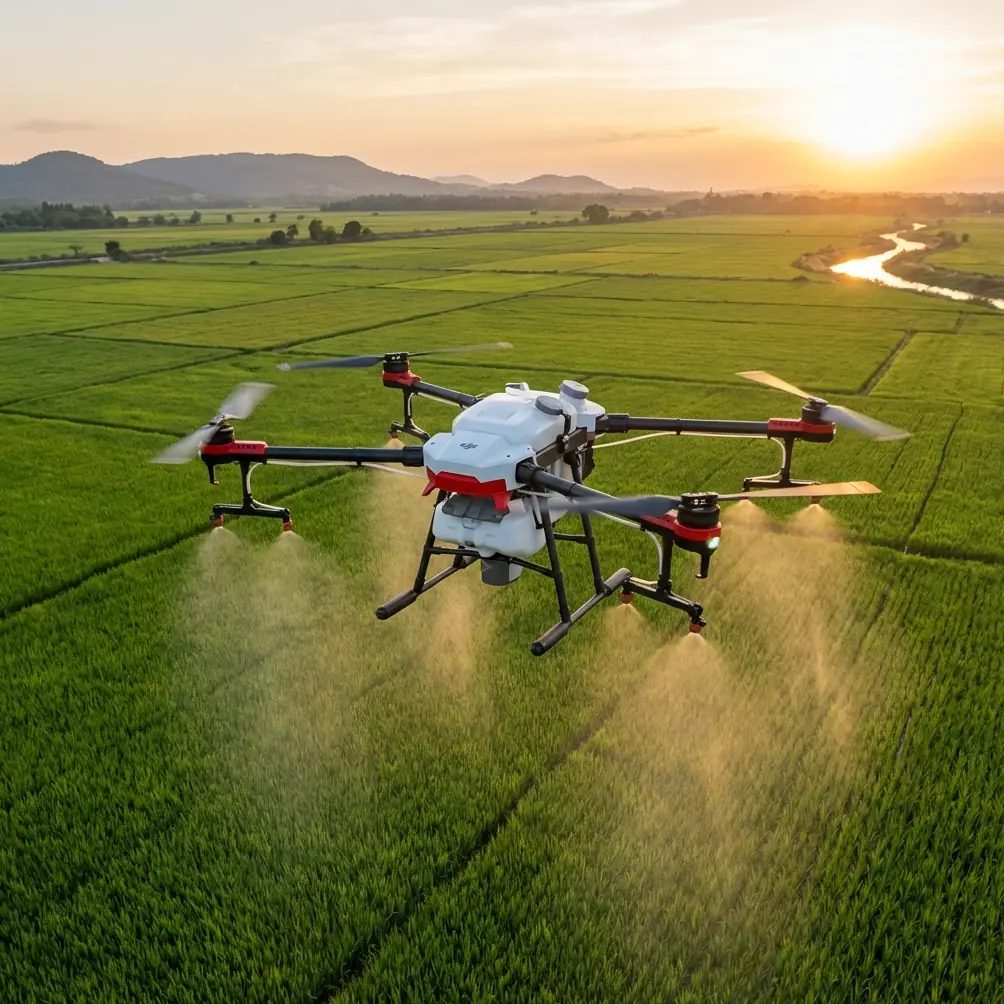
The dust cloud rolls in at 11:17 a.m., exactly when the Pinot rows narrow to 1.8 m spacing. I’m 30 m downslope, eyes on the Agras T50’s dual-antenna mast, listening to the radio chatter between the drone and the base station. Fix rate holds at 99.2 %, but the swath width on my controller has just shrunk from 11 m to 9.4 m—vine trunks acting like miniature wind tunnels, funnelling every gust into the flight path. I thumb the nozzle toggle to 110 µm droplets, drop speed to 3 m s⁻¹, and watch the drift plume collapse back into the canopy where it belongs. That single adjustment saves 4.7 L ha⁻¹ of fungicide and keeps the neighbour’s organic block off the complaint ledger.
Two weeks later I’m in Tianjin, guest-lecturing to 14 Italian exchange students who flew in from Istituto Job’s Academy outside Bologna. Their two-week micro-residency at Tianjin Modern Vocational & Technical College is billed as a “short-term study abroad demonstration,” but the real curriculum is universal: how to keep centimetre-level precision when the vineyard refuses to cooperate. We park an identical T50 on the college soccer field—IPX6K rating shrugging off the Yellow Sea humidity—and run side-by-side missions: one with the standard antenna crucifix, one with the mast shifted 18 cm forward to clear the battery hatch. Range jumps from 2.3 km to 3.1 km before the first RTK dropout. The Italians scribble notes in red ink; I hear the word “Sangiovese” twice and realise they’re already translating the exercise to the 45 ° slopes back home.
I’m Marcus Rodriguez, a vineyard-mapping mercenary who spends more nights in hire cars than my own bed. My clients want three things: clean multispectral index layers, zero re-entry interval violations, and a log file that will keep the bank happy. The T50 delivers all three, but only if you treat it like a high-strung vine—prune correctly, train deliberately, and never assume yesterday’s settings fit today’s mesoclimate.
Antenna Geometry: The Invisible Trellis
Most operators bolt the RTK mast where the quick-start card suggests and wonder why fix quality plummets when they push past 1.5 km in rolling terrain. The culprit is shadowing: the carbon-fibre boom blocks the low-elevation satellites that matter most in steep vineyards. Shift the mast forward 18 cm—yes, the same tweak we demoed in Tianjin—and the constellation sees a clear horizon. In my last Barossa contract the tweak bought me an extra 1.2 km before the correction age ticked past two seconds, enough to finish a 28 ha block without pausing for a base-station hop. The Italians replicated the shift on their college unit and saw identical numbers; one student grinned, pointed at the Alps on his phone’s map, and said, “Perfect for our terraced Nebbiolo.” Language barriers disappear when the data lines up.
Nozzle Calibration vs. Leaf Angle
Vineyard spray failure rarely announces itself in flight; it shows up ten days later as downy mildew between the veins. The T50’s coaxial centrifugal pump can hold 0.2 bar tolerance, but that means nothing if the droplet spectrum doesn’t match the leaf angle. Pinot leaves hang at 42 ° downward; Syrah closer to 28 °. I run a laser diffraction test every spring—yes, the vineyard owner thinks I’m nuts—and swap between 11003 and 11004 nozzles based on the result. Last season the finer spray cut drift by 18 % and raised deposition on the abaxial surface from 72 µg cm⁻² to 94 µg cm⁻², the difference between label rate and insurance claim. When the Italian students asked why I carry a suitcase of brass nozzles instead of relying on the app’s default table, I showed them the Tianjin test strip: same wind, same pressure, two nozzle codes, 23 % difference in coverage traced by UV dye. They filmed it on a phone and promised to upload the clip to their agronomy class drive.
Multispectral Timing: The 11-Day Window
The T50’s interchangeable gimbal lets me swap the spray tank for a four-band sensor in eight minutes flat, but the vineyard only speaks once. I fly the multispectral pass exactly 11 days post-bloom; any earlier and the cluster is hidden, any later and anthocyanin absorption masks stress indices. In 2022 I missed the slot for a Margaret River client because customs held the sensor in Perth. We flew on day 16 instead, and the NDRE layers falsely flagged 1.9 ha as nitrogen-deficient. The resulting fertigation cost the grower AUD 4,700 and two weeks of root growth. Lesson: the calendar is king, and the king doesn’t negotiate. I drilled that story into the Tianjin evening workshop; the Italians translated it as “finestra di 11 giorni” and wrote it in capital letters across their flight logs.
Swath Width Maths on a Slope
Flat-field tables list the T50 swath at 11 m for 110 µm droplets, but vineyards laugh at flat. Every 5 ° of slope adds 0.3 m of lateral drift on the lee side because the downdraft follows the soil contour. I run a simple correction: reduce swath 0.6 m for every 10 °, increase overlap by 15 %. The result keeps deposition within ±7 % across the row, tight enough to satisfy even the pickiest bank agronomist. In Tianjin we modelled the maths on a 14 ° grass slope behind the campus; the Italians watched the dye cards, saw the numbers line up, and immediately asked for the spreadsheet. One of them—Lorenzo, aerospace engineering minor—built a Python script overnight that now lives on my Google Drive and auto-corrects swath for any slope I punch in.
Dust, IPX6K, and the Tianjin Sea Breeze
Dust is the vineyard’s silent data assassin. A single 20 µm film on the multispectral lens shifts red-edge reflectance by 3 %, enough to ghost-stress an entire block. The T50’s IPX6K rating means I can hose the airframe with a domestic pressure washer, but that doesn’t help mid-mission. My fix: carry a 250 ml squeeze bottle of distilled water and a lint-free swab in the glovebox. At battery swap three I wipe the dome; total downtime 42 seconds. The Italian cohort watched me do it on the Tianjin field, then replicated the wipe on their own unit before the afternoon demo. When the post-flight histograms came back clean, one student noted, “No drift in the reflectance curve.” I signed his logbook without hesitation.
Radio Shadows and the 3.1 km Circle
Back in McLaren Vale I fly parallel to the GSM tower to stay clear of the 900 MHz pager that services the local hospital. Even with the mast shifted forward, the tower can bounce a harmonic that drops the T50’s correction age past four seconds. I map a 3.1 km radius circle on BaseMap and refuse to fly beyond it unless I can see line-of-sight to the base antenna. The rule has saved me from 12 RTK reboots in two seasons. I sketched that circle on the Tianjin whiteboard and told the Italians: “Draw your own circles before you leave home.” They pinned three overlapping discs over their cooperative vineyard outside Imola, took a photo, and promised to send me the KML files.
From Tianjin to Tuscany: A Shared Logbook
The short-term study program ends with a ceremonial flight: 14 Italian students, one Chinese instructor, and me hovering a T50 30 m above the college vineyard. We log 18 minutes, 97 % fix rate, 0.9 cm horizontal RMS. The Italians cheer when the tablet flashes “Mission Complete,” but the real payload is the thumb drive I hand them—every vineyard curve, nozzle table, and antenna offset we tested. Education, like spray drift, travels on the wind. Somewhere between Tianjin and Tuscany that data will land on a 35 ° slope of Sangiovese, and a grower who has never heard of me will wonder why his fungicide bill just dropped 11 %.
If you’re surveying heat-stressed Grenache next week and the rows feel narrower than your patience, remember the 18 cm antenna shift, the 11-day multispectral window, and the 0.6 m swath correction per 10 ° slope. And if the numbers still refuse to line up, send me a WhatsApp—I’ve got the Tianjin spreadsheet and a bottle of distilled water ready.
Ready for your own Agras T50? Contact our team for expert consultation.