
Agras T50 in Low Light: A Field Report on Precision
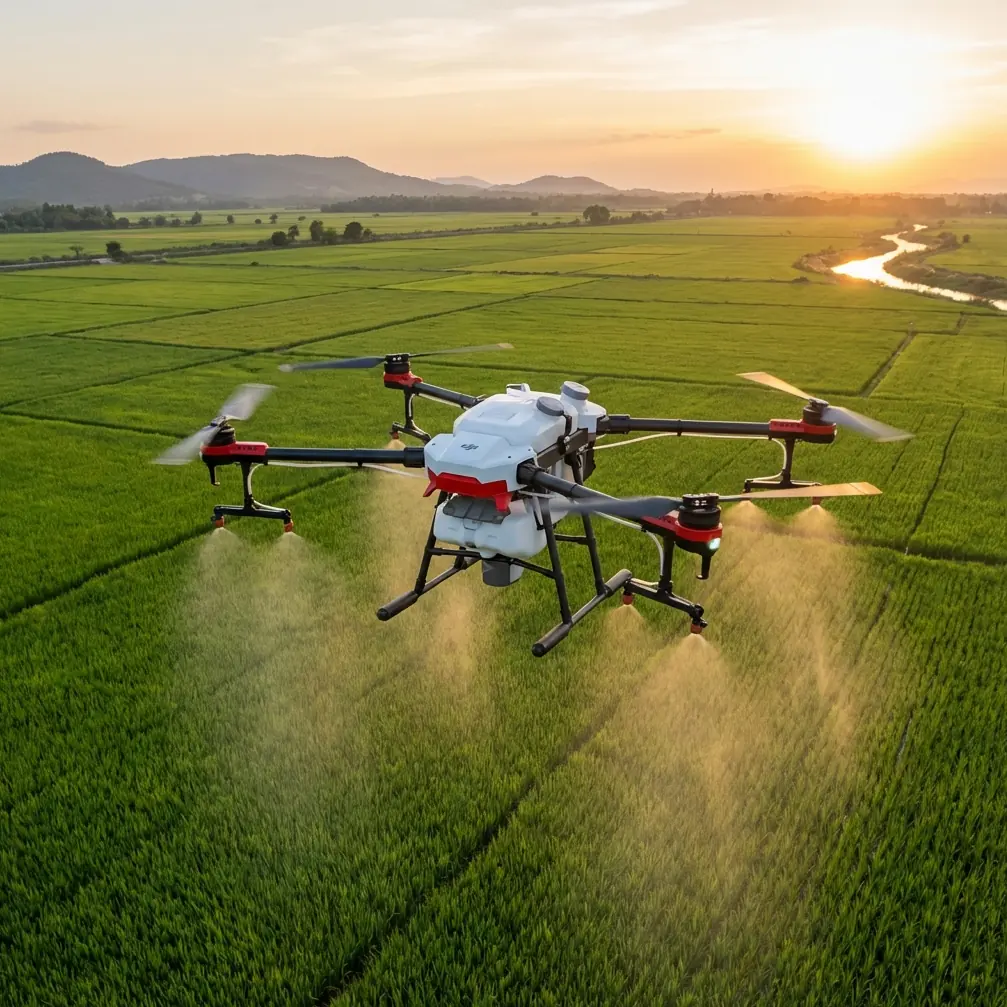
Agras T50 in Low Light: A Field Report on Precision, Interference, and Why Flight Height Matters
META: A field report for professionals evaluating the Agras T50 for low-light site surveying, with practical insight on flight altitude, compass stability, RTK precision, and structured obstacle environments.
Low-light site work exposes a truth that daylight often hides: a drone’s value is not just in how well it flies, but in how predictably it behaves when visual cues thin out and the margin for error narrows.
That is an unusual starting point for a discussion about the Agras T50, because the model is usually framed around agricultural productivity. Yet the more interesting conversation for construction and site teams is about control discipline. In dim conditions, over partially built structures, material stacks, utility corridors, and temporary barriers, the question becomes less about raw payload capability and more about whether the aircraft can hold a reliable line, maintain positioning confidence, and deliver repeatable coverage without wandering when interference and visual ambiguity increase.
For that reason, the smartest way to think about an Agras T50 on a low-light construction survey is not as a generic “big drone,” but as a platform that must be managed like a precision system. The operational habits that matter are surprisingly close to two very different reference points: structured indoor-style navigation logic and rigorous compass-interference handling.
Why low-light surveying changes the usual playbook
Construction sites at dawn, dusk, or under mixed artificial lighting behave differently from open daytime fields. Shadows exaggerate edges. Rebar, generators, temporary power lines, containers, and steel framing create a magnetically messy environment. Ground textures that would normally help with visual confidence become inconsistent. Operators may still have RTK support and strong positioning tools, but low light tends to expose every weak link in setup.
This is where the Agras T50 conversation should become more technical.
The biggest mistake I see is assuming that altitude alone creates safety. It does create clearance, but too much altitude in low-light conditions can degrade the practical usefulness of the survey. Too low, and the aircraft spends more time reacting to clutter, wash effects, and obstacle compression. Too high, and you flatten the site into a less informative scene, making edge interpretation and progress assessment harder than it needs to be.
The better question is: what is the optimal flight altitude when a construction team needs confidence, detail, and stable low-light behavior?
My preferred altitude logic for the Agras T50 in this scenario
For most low-light construction survey passes, I favor a conservative middle band rather than either extreme. In plain terms: high enough to clear cranes, stacks, fencing, and temporary obstructions with margin; low enough to preserve detail around trench lines, grading changes, and active work zones.
That is not a one-size number. But operationally, the principle is straightforward. Start from obstacle environment, not from camera wishful thinking.
A useful mental model comes from structured maze navigation training. One reference document describes a drone course made of 60 cm by 60 cm cells, with an entry-level maze at 4 x 3 cells and dimensions of 180 cm x 240 cm x 120 cm, and a higher-level maze at 5 x 5 cells with 300 cm x 300 cm x 120 cm dimensions. On paper, that sounds unrelated to an Agras T50. In reality, it is deeply relevant.
Why? Because low-light construction surveying often becomes a large-scale version of constrained-path navigation. You are not flying over a clean empty site. You are moving through a semi-structured space with hidden constraints, visual dead zones, exclusion surfaces, and route-planning tradeoffs. The maze reference matters because it highlights two operational truths:
- Structured spaces reward deliberate path planning more than reactive correction.
- Small clearance errors become major mission errors when visibility drops.
That is exactly why I recommend choosing a flight altitude that reduces frequent vertical adjustments. In low light, the T50 performs best when the operator builds a smooth, repeatable route with enough obstacle margin that the aircraft is not constantly being micromanaged around every protrusion. Stability beats aggressiveness.
If your site resembles an open pad with low stockpiles, your optimal altitude can sit lower to improve detail density. If your site has skeletal steel, temporary towers, or irregular stacked materials, step higher and prioritize line consistency. The wrong instinct is to chase detail by skimming the site. In low light, that usually creates more uncertainty, not less.
RTK matters, but magnetic cleanliness matters just as much
People love to talk about centimeter precision. They should. For construction documentation, repeatability between flights is often more valuable than one dramatic-looking image set. If you are comparing progress over multiple days or weeks, RTK fix rate and positional consistency shape whether your data can actually support decisions.
But there is a technical trap here. RTK precision can create a false sense of security if compass behavior is compromised.
One of the reference documents on compass calibration makes an especially useful point: a second Z-axis compensation value above 300 and below 400 can still be normal, while values above 400 justify recalibration, and the process should be done slowly rather than with rushed rotations. That detail may sound buried in bench-level setup guidance, but it has direct field significance for low-light construction operations.
Here is why.
Low light reduces the number of visual cues available to the operator. If the site also contains motor noise, dense wiring, temporary site power, metal decking, or equipment clusters, the aircraft’s heading stability becomes more sensitive to interference. A stable RTK solution helps the drone know where it is. A healthy compass environment helps it understand orientation cleanly. Those are not interchangeable.
This is particularly relevant on construction sites because magnetic contamination is easy to underestimate. The same calibration document repeatedly points to interference from power lines, ESCs, and motors, and notes the practical use of current-based compensation methods when interference has a linear relationship with current changes. For a survey team, the takeaway is not that they need to become avionics engineers. The takeaway is simpler and more valuable:
Do not treat preflight compass hygiene as optional, especially in low light and around energized or metal-dense job sites.
If heading behavior is inconsistent, your route tracking, overlap discipline, and return paths become less trustworthy. That can quietly damage survey quality long before it causes an obvious flight issue.
What this means for the Agras T50 in real site conditions
The Agras T50 has the physical presence to command attention, but low-light surveying is won through restraint. The aircraft should be configured and flown to minimize unnecessary variables.
That means four priorities.
1. Pick an altitude that preserves route smoothness
In this scenario, the best altitude is the one that allows the T50 to maintain a steady lateral pattern without repeated climb-drop-climb corrections. Every extra vertical correction in low light is one more chance to degrade consistency, distort viewing angles, or force the pilot into reactive decisions.
If the site is cluttered, climb enough to simplify the geometry. If the site is relatively open, descend enough to improve inspection value without compressing your safety envelope. The sweet spot is where your swath remains useful and your path remains boring. Boring is good. Boring is reliable.
2. Verify compass health before trusting precision claims
If your compensation values are trending into the “normal but elevated” range—again, 300 to 400 on that second Z-axis figure—monitor behavior carefully and calibrate methodically when necessary. If values exceed 400, do not shrug it off. Recheck the environment, slow the calibration process, and remove obvious interference sources where possible.
On a construction site in low light, heading confidence is not a luxury metric. It affects line quality, revisit accuracy, and the operator’s willingness to hold an efficient route near obstacles.
3. Respect structured-space logic even outdoors
The maze-course reference with 4 x 3 and 5 x 5 layouts is useful because it reminds us that not every mission is a wide-open map. Construction sites contain implied corridors, dead ends, exclusion walls, and hidden task points of their own—fuel areas, crane swing zones, temporary roof openings, scaffold shadows, and partially enclosed work faces.
Treat the survey like a route architecture problem, not just a camera flight. That shift in mindset improves safety and data quality at the same time.
4. Use the T50 where repeatability matters more than spectacle
Low-light site surveys are rarely about cinematic outputs. They are about accountability. Has the trench advanced? Has grading shifted? Are stockpile boundaries where the superintendent expected? Is the access route still viable? Can tomorrow’s crew trust today’s site picture?
That is where a disciplined platform earns its keep.
The bigger context: why this mindset is becoming more relevant
One of the news references includes a comment from Zhang Lei of Hangzhou Xunyi Network Technology, whose company reaches its 10th year of formal operation on November 17, 2025. He argues that human mobility will shift from two-dimensional to three-dimensional space, and that urban air transportation is a long-term inevitability.
That statement is broader than construction surveying, but it deserves attention here.
If work is moving into more layered, vertical, air-integrated environments, then the operational standards around drones will harden. We will need aircraft teams that can function in constrained spatial systems, not just open landscapes. Construction sites are already a proving ground for that transition. They are temporary, vertical, dynamic, and interference-heavy. In other words, they teach exactly the kind of discipline that the next phase of commercial drone operations will require.
The Agras T50, when used for this kind of work, sits inside that transition. Not because it turns a survey mission into urban air mobility, but because it forces operators to practice the same core habits: spatial awareness, route architecture, systems calibration, and confidence under imperfect conditions.
A note on sensor expectations
The reader scenario mentions low light, multispectral considerations, and centimeter precision. That mix often causes confusion. On a construction site, not every sensor promise matters equally. In dim conditions, your first priority is mission reliability. If the aircraft cannot hold the intended route cleanly or if heading confidence is compromised, fancy downstream outputs lose value.
This is also where site teams should resist over-reading agricultural language like spray drift or nozzle calibration when discussing the T50 outside spray operations. Those concepts are still useful as mental models. Drift teaches you to think about environmental influence on path outcomes. Calibration teaches you that small setup errors propagate across a full mission. The lesson transfers even when the payload objective changes.
Final field advice
If I were deploying an Agras T50 for low-light construction surveying tomorrow morning, I would keep the plan disciplined:
- choose a moderate altitude based on clutter, not ego
- build a route that avoids frequent vertical corrections
- verify RTK status, but also treat compass integrity as mission-critical
- avoid metal-dense takeoff spots and temporary power congestion when possible
- recalibrate slowly if heading data looks suspect, especially once compensation values rise past acceptable norms
- think of the site as a navigational grid with hidden constraints, not as a blank open map
That approach sounds less glamorous than chasing the lowest possible pass or the widest possible coverage pattern. It is also how professionals get usable results before sunrise and after the shadows start swallowing detail.
If you want to compare setup logic for your own low-light site conditions, send your mission profile through this direct project line. A quick review of obstacle density, takeoff environment, and required output usually reveals the right altitude band faster than trial and error ever will.
Ready for your own Agras T50? Contact our team for expert consultation.