
Agras T50 in Mountain Wildlife Spraying: A Field Case
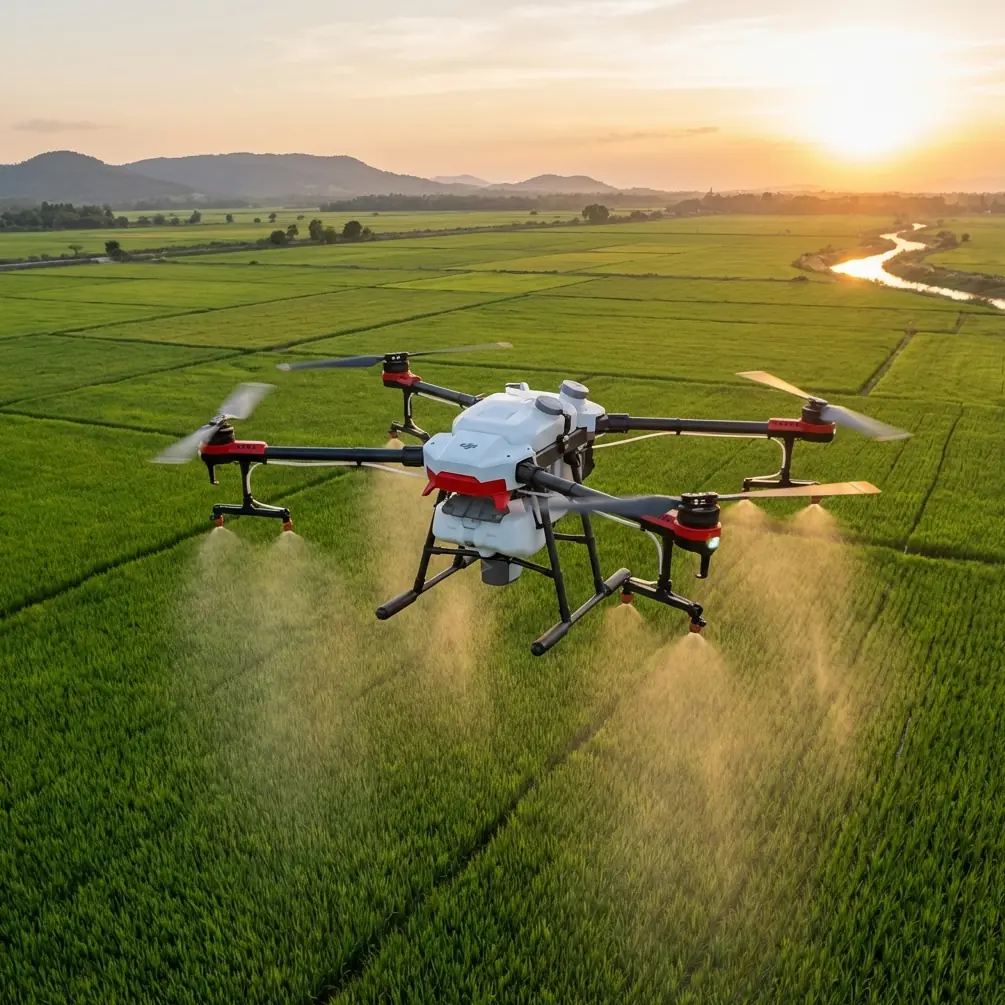
Agras T50 in Mountain Wildlife Spraying: A Field Case from Mango Bloom Country
META: A practical Agras T50 case study for mountain wildlife spraying, using lessons from Guangxi mango terrain, altitude sensing, drift control, nozzle calibration, and pre-flight safety discipline.
When people talk about aerial spraying in mountain environments, they usually jump straight to payload, speed, or area coverage. That misses the real problem. In steep orchards and wildlife-sensitive terrain, success starts much earlier: with what the aircraft knows about height, how clean its sensing surfaces are before takeoff, and whether the operator understands the landscape well enough to avoid turning a capable machine into a drift risk.
The Agras T50 is often discussed as a high-throughput agricultural platform. That is true, but it is not the most interesting part of the aircraft in difficult terrain. The more useful conversation is about control discipline. In a mountain spraying scenario near flowering crops or habitat edges, control discipline determines whether the mission is precise, repeatable, and safe for surrounding ecology.
A good way to understand that is to look at a landscape that already tells us what is at stake.
In Baise, Guangxi, the Youjiang River valley is known as one of China’s three major “natural greenhouses.” That south subtropical monsoon climate helps support one of the country’s most important mango production areas. In Liuhe Village, Sitang Town, more than 17,800 mu of mango trees were recently reported in bloom at a national “One Village, One Product” mango demonstration base. Across Youjiang District, mango plantings have reached 388,600 mu, with an estimated output of 390,000 tons and production value of 1.73 billion yuan.
Those numbers matter for one reason: they show what dense, flowering, economically important mountain agriculture looks like at scale. If you are operating an Agras T50 for wildlife-related spraying around mountain orchards, buffer zones, pest corridors, or ecological management areas, you are not flying over abstract terrain. You are flying over a living production system during sensitive phenological stages. Pale yellow mango blossoms across thousands of mu are not just scenic. They are a reminder that spray drift is never a theoretical issue.
Why mountain wildlife spraying is harder than standard field work
A flat field forgives weak habits. A mountain does not.
In sloped terrain, the aircraft is constantly managing height relative to an uneven surface. Wind behavior changes as air rolls over ridges, treelines, and valleys. Vegetation density shifts by the minute. One section may be open and dry, the next sheltered and humid. Wildlife-use zones can sit immediately beside orchards, water channels, or wooded edges.
That is exactly why pre-flight preparation deserves more attention than most operators give it.
One overlooked clue comes from a DJI educational document about pressure and altitude. The source explains that atmospheric pressure decreases as altitude increases, and that barometric altitude sensing depends on the relationship between air pressure and elevation. It also describes a cautious test method for indoor flight when ceiling height is unknown: move the aircraft upward little by little until it approaches the ceiling.
That sounds basic, but the operating principle is extremely relevant to the Agras T50 outdoors in mountain work. If the terrain profile ahead is uncertain, aggressive climbs and assumptions about relative height are poor practice. Incremental profile checking, sensor verification, and conservative route validation are the habits that prevent bad passes near treetops, blossoms, or habitat edges.
The pre-flight cleaning step that actually affects safety
Before any discussion of flow rate or swath width, clean the aircraft properly.
Not casually. Properly.
On the T50, a pre-flight cleaning step is not cosmetic maintenance. It protects the systems you rely on for terrain following, altitude awareness, and stable operation in dirty agricultural environments. Dried chemical residue, mud splash, fine dust, and sticky pollen can interfere with sensor windows, exposed surfaces, and the practical reliability of mission-critical features. In mountain flowering regions, that contamination risk rises. Mango bloom conditions, for example, bring heavy airborne biological material. Add mist, fertilizer dust, and previous spray deposits, and you have a recipe for compromised readings if the aircraft is not cleaned and inspected before launch.
This is where an IPX6K-rated airframe matters operationally. It means the aircraft is built for demanding wash-down conditions, which supports frequent cleaning between jobs and after corrosive or residue-heavy missions. But the rating is not a shortcut for carelessness. Operators still need a repeatable cleaning routine:
- rinse and inspect spray system contact areas
- check nozzles for partial blockage or asymmetry
- clear residue from sensing surfaces
- verify arm locks, landing gear, and tank seating
- inspect pump and line connections for dried buildup
If you spray in mountain wildlife zones without doing this, you increase the chance of poor atomization, uneven deposition, and bad height behavior exactly where precision matters most.
What the Guangxi mango bloom teaches about drift
The Baise flowering report gives us the key timing signal: since late February, mango trees across the region have been flowering, with expectations of a strong harvest year. In practical terms, that is a red-alert season for drift awareness.
If your wildlife spraying mission is adjacent to flowering orchards, your objective is not only target coverage. It is target coverage without contaminating bloom-stage trees, non-target plants, pollinator activity zones, or nearby village landscapes. A district with 388,600 mu of mango plantings is not an environment where “close enough” aerial work is acceptable.
This is where Agras T50 operators need to think beyond area productivity and focus on three variables:
1. Nozzle calibration
Nozzle calibration is the difference between planned application and guessed application. Mountain work amplifies errors because air movement and changing height alter droplet behavior quickly. If nozzles are not flowing evenly, one side of the swath can push more volume downslope while the other under-doses the target area. In wildlife or ecological spraying, that means wasted product in one place and poor efficacy in another.
2. Swath width realism
A published or nominal swath width is not the swath width you should assume on a slope in variable wind. Trees, terraces, and elevation transitions narrow the usable effective pattern. The operator who reduces swath assumptions and increases overlap where needed usually gets the better result. The operator who chases coverage numbers often creates drift and misses.
3. Spray drift control at habitat boundaries
Boundaries deserve their own flight logic. Orchard edge, forest edge, ravine edge, water edge: each one changes the airflow. In flowering territory like Baise’s mango belt, you should treat the final meters near a boundary as a separate application environment. Lower-risk timing, conservative droplet setup, and route planning that avoids pushing material into bloom zones are more valuable than raw efficiency.
Why RTK and centimeter-level precision matter more in mountains
Many people hear “centimeter precision” and think only about mapping. That is too narrow.
A road-survey reference from Shunde offers a useful comparison. In that project, the team first studied the corridor’s length, width, road conditions, and vegetation cover specifically to judge where signal loss might occur. They also worked to accuracy targets of 5 cm horizontal and 3 cm vertical, using a clear coordinate and elevation framework. Just as important, they excluded areas where conditions would degrade results, such as heavily obstructed sections and bridge segments outside the practical scope.
That workflow translates surprisingly well to Agras T50 mountain operations.
Before spraying, especially in wildlife-sensitive terrain, the operator should review:
- total route extent
- vegetation cover and canopy interruptions
- likely GNSS obstruction points
- slope transitions and dead ground
- access corridors and safe launch/recovery areas
The Shunde survey team recognized that trees, vehicles, and route complexity could distort data collection. In mountain spraying, the equivalents are ridge shadowing, canopy blockage, valley multipath, and intermittent RTK degradation. A strong RTK fix rate is not just a neat spec. It directly affects line holding, route repeatability, edge accuracy, and the operator’s confidence when flying close to non-target zones.
If you are spraying wildlife corridors beside high-value orchards, centimeter-level guidance reduces overlap mistakes and skip zones. That matters when a single pass too far can affect flowering trees, and a single pass too short can leave untreated pockets that undermine the purpose of the mission.
A case-study mindset for the Agras T50
Let’s build this into a practical scenario.
Picture a mountain-side operation near mango-producing terrain similar to Youjiang District. Flowering is active. The work area includes rough elevation changes, mixed vegetation, and habitat strips where treatment needs to stay tightly contained.
A disciplined T50 crew would not begin with payload math. They would begin with terrain intelligence.
First, they would review the route like a survey team reviews a corridor. Where is vegetation dense enough to affect signals or height sensing confidence? Where do ridgelines channel wind? Which sections should be treated as separate blocks because the slope or adjacent orchard edge changes the risk profile?
Second, they would clean and inspect the aircraft before mixing and loading. In bloom season, that includes checking for pollen film, dried residue around spray hardware, and contamination on any sensing surfaces. This is one of the simplest ways to protect safety features before a mountain flight.
Third, they would validate height behavior conservatively. The educational altitude reference about moving upward little by little near an unknown ceiling sounds almost too simple, yet it captures the right operating mentality: if the environment is uncertain, probe it carefully. In mountain work, that means confirming terrain response and aircraft behavior in a controlled area before running full mission lines.
Fourth, they would calibrate nozzles for the actual mission, not the last job. Wildlife-oriented spraying near flowering agriculture is exactly where you cannot afford to carry over an old setup blindly.
Fifth, they would set route geometry based on effective deposition, not marketing numbers. Narrower practical swaths, especially near boundaries, usually produce cleaner outcomes.
The role of multispectral thinking, even without a multispectral payload
The T50 is a spray platform, but serious operators increasingly adopt a multispectral mindset even when the spraying aircraft itself is not doing the sensing. That means reading variability across the site instead of treating all vegetation equally.
In a mango region, for example, bloom timing, canopy density, and moisture variation can change from one slope face to another. In wildlife-related treatment areas, species mix and vegetation stress can also shift application response. A multispectral-informed workflow helps determine where precision should tighten, where flow should be moderated, and where certain blocks should be delayed entirely to reduce non-target exposure.
The lesson is simple: mountain spraying works best when the application aircraft is fed by good site intelligence.
What experienced operators get right with the Agras T50
The best T50 operators in mountain environments are not the ones who fly fastest. They are the ones who combine agricultural judgment with survey-style planning.
They understand that 17,800 mu of blossoms in one demonstration base is not just a beautiful statistic. It signals a sensitive operating environment where drift discipline is non-negotiable.
They understand that barometric altitude principles are not classroom trivia. They explain why sensor cleanliness, changing air conditions, and cautious vertical validation matter.
They understand that the survey world’s obsession with route review, obstruction analysis, and precision baselines has a direct parallel in aerial spraying.
And they know that pre-flight cleaning is part of flight safety, not an afterthought.
If you are setting up an Agras T50 for mountain wildlife spraying and want help refining route logic, drift control, or nozzle setup for complex terrain, you can message a field consultant here.
Final field take
The Agras T50 is a powerful aircraft, but mountain wildlife spraying is not won by power alone. It is won by preparation that respects the land.
In places like Baise, where flowering mango production spans 388,600 mu and output expectations reach 390,000 tons, the surrounding environment leaves no room for sloppy aerial work. Terrain-following confidence, RTK stability, careful swath planning, nozzle calibration, and a real cleaning routine all become operational tools, not checklist filler.
That is the difference between merely flying a T50 and using it like a professional.
Ready for your own Agras T50? Contact our team for expert consultation.