
Agras T50 in Dusty Wildlife Spraying: A Field Report
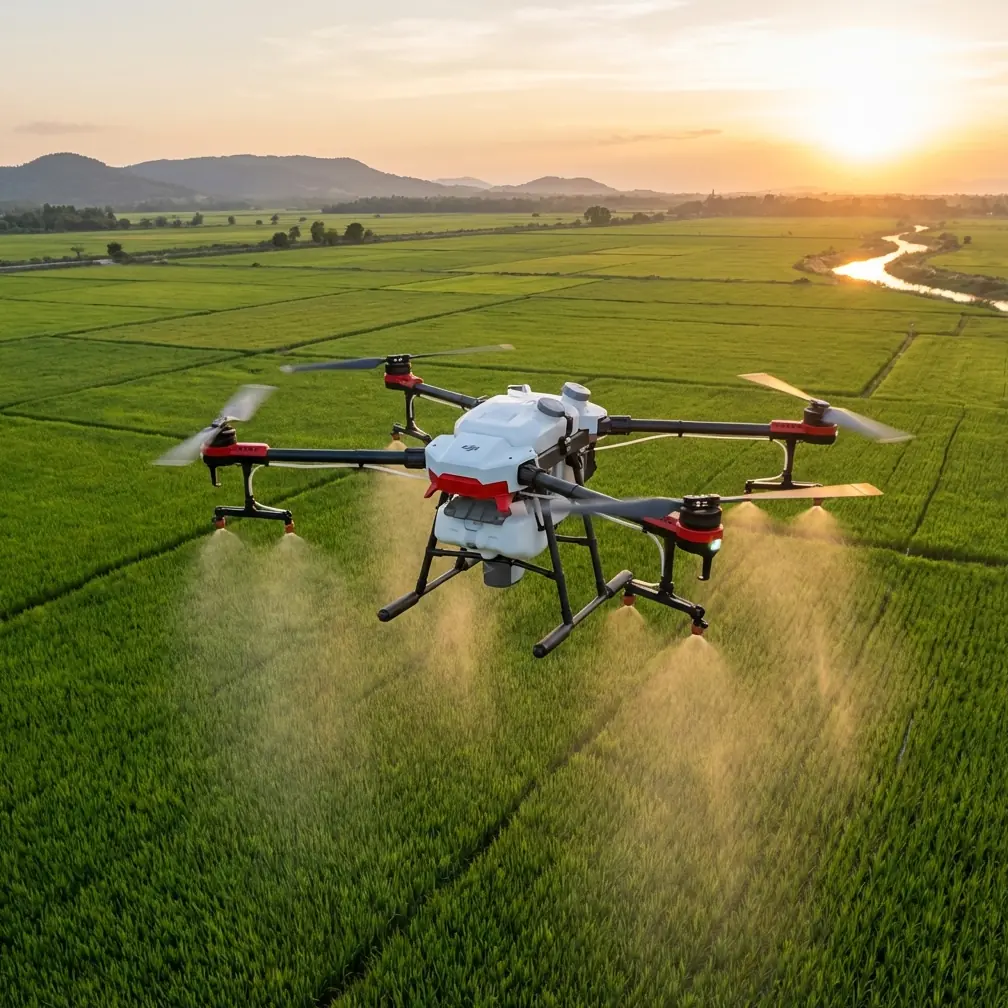
Agras T50 in Dusty Wildlife Spraying: A Field Report on Precision, Drift Control, and Signal Discipline
META: Practical field report on using the DJI Agras T50 for dusty wildlife-area spraying, with lessons on spray drift, nozzle calibration, RTK precision, route planning, and handling electromagnetic interference.
Dust changes everything.
That is the first honest lesson from spraying around wildlife zones with an Agras T50. Not because the aircraft suddenly becomes unpredictable, and not because the mission turns into a technological drama. The real issue is simpler and more serious: dust exposes every weakness in planning. If your nozzle calibration is slightly off, if your route is lazy, if your positioning confidence slips, the environment tells on you immediately.
I have spent enough time around agricultural UAV operations to know that the best field results rarely come from brute force. They come from discipline. In a dusty wildlife spraying scenario, that discipline has to cover three things at once: where the aircraft flies, where the droplets go, and how consistently the platform understands its own position.
For an Agras T50 operator, those are not abstract concerns. They directly affect spray drift, coverage, habitat protection, and turnaround time between runs.
Why dusty wildlife spraying is not a normal ag mission
Spraying near wildlife corridors, managed grassland edges, or habitat recovery areas creates a narrow margin for error. The target zone may need treatment, but adjacent areas may need protection. That means the T50’s carrying ability matters less than its repeatability.
Dust complicates repeatability in two ways.
First, airborne particles interfere with visual confidence on the ground. Markers, boundaries, and landing surfaces can all become harder to read in real conditions. Second, dust tends to appear where surfaces are dry, exposed, and often more vulnerable to drift. So the same environmental condition that reduces visibility also raises the importance of droplet placement.
That is where I find an unexpected but useful parallel in a training document on precision UAV landing and route programming. In the educational setup, students are trained to place an aircraft within a defined launch area formed by black boundary lines around a square of about 40 centimeters per side, then complete programmed autonomous flight tasks and return accurately. That is obviously a classroom or competition environment, not a wildlife spraying operation. Still, the operational lesson is highly relevant: precision starts on the ground before it shows up in the air.
When you are preparing a T50 in dust, your takeoff and landing discipline should be treated with the same seriousness. A well-defined launch zone, a clean staging routine, and a repeatable return path are not cosmetic habits. They reduce contamination risk, speed up battery and liquid handling, and keep the aircraft from ingesting unnecessary debris during repeated cycles.
What route planning really means on a T50
A lot of people talk about route planning as if it were software work. It is not. It is field logic expressed in software.
One of the strongest details from the educational reference is that straight-line travel between two platforms was recommended to improve flight efficiency. That is a small detail, but it carries operational significance for the T50. In a dusty wildlife environment, unnecessary turns and improvised path corrections do more than waste time. They can widen the variability of spray coverage and increase the chance of drift at field edges.
The T50 performs best when the route reflects the treatment objective rather than the operator’s convenience. If the habitat boundary is irregular, the route should still preserve predictable swath overlap. If one side of the area is more sensitive, that side deserves the cleanest geometry and the most conservative margin.
Centimeter-level positioning is often discussed as a specification. In practice, its value appears in boring but critical moments: maintaining swath width consistency, crossing transition points cleanly, and returning to the exact line you intended after a refill or battery swap. That is why RTK fix rate matters so much in dust. The aircraft may still fly if positional confidence degrades, but the quality of the mission can quietly decline before a novice notices it.
My advice is plain: do not judge RTK performance by whether the aircraft merely arms and launches. Judge it by whether line-to-line placement remains stable enough to support the droplet pattern you planned.
The overlooked problem: electromagnetic interference in the field
Dust is visible. Electromagnetic interference is not.
Yet in many real operations, especially around pumps, temporary generators, metal sheds, perimeter infrastructure, or improvised field charging stations, electromagnetic noise can be the hidden variable behind inconsistent positioning confidence or telemetry unease. Operators often misdiagnose this as a software mood swing or blame the site generally.
That is a mistake.
Antenna adjustment can make a measurable difference, particularly when the interference source is local rather than broad-area. I have seen crews improve signal stability simply by changing ground station placement, increasing separation from metallic clutter, and correcting antenna orientation instead of pointing it carelessly out of habit. With the T50, this matters because confidence in the control and positioning link underpins everything else: swath alignment, return behavior, and safe work around ecologically sensitive edges.
In dusty operations, I recommend treating interference checks as part of pre-mission setup, not as a troubleshooting step after the aircraft begins behaving poorly. If the RTK fix rate looks inconsistent or the link seems less stable near certain staging positions, move first. Re-aim second. Then reassess. Too many operators reverse that sequence.
If you need a quick field discussion on antenna setup and signal hygiene for the T50, I’d suggest using this direct line for operational questions: message the flight support desk.
Spray drift is not just about weather
People love to reduce drift to wind speed. That is far too shallow.
With the Agras T50, drift control begins with nozzle calibration and application logic. The aircraft can only execute what the setup allows. If flow characteristics are mismatched to the target vegetation, if droplet behavior is not matched to the environmental dryness, or if the swath strategy assumes ideal conditions that do not exist, drift management has already failed before takeoff.
Dust is a warning sign of a dry, reactive surface environment. In those conditions, I want operators thinking carefully about three linked variables:
- droplet size behavior,
- boom or nozzle performance consistency,
- edge-pass discipline.
The reason nozzle calibration deserves emphasis is simple. If output is uneven, the crew may try to compensate by altering speed or making extra cleanup passes. That usually creates more variability, not less. In wildlife-adjacent work, cleanup passes can be the very thing that pushes material where it should not go.
A well-calibrated system supports predictable swath width. Predictable swath width supports fewer corrective decisions in the air. Fewer corrective decisions reduce pilot-induced inconsistency. That chain matters.
A useful lesson from old-school flight training
One of the reference texts on model aircraft training includes a sharp observation: 80% of hobby flyers spend 70% of their time pulling the aircraft back from where it should not be. The number comes from a training context, not agriculture, but the lesson translates perfectly.
Weak drone operators are always recovering. Strong drone operators are always anticipating.
In a T50 spraying mission, “recovery mode” shows up as late line corrections, reactive altitude changes, repeated edge cleanups, and hasty repositioning after poor planning. Dust makes these habits worse because visual ambiguity and environmental stress encourage overcorrection. That can degrade coverage and increase the risk of off-target deposition.
The old training doctrine also stressed understanding what each control input will make the aircraft do before making it. For agricultural UAV work, that principle belongs in every serious operation. Do not wait to see the aircraft drift, then react. Think one step ahead: if you alter heading here, how does that affect the next two passes, the edge overlap, and your return corridor?
That is what separates competent T50 fieldwork from merely getting the job done.
Landing accuracy is more than a neat trick
The educational flight task required the aircraft not only to depart from a confined launch area but also to land on designated platforms and return successfully to the start zone. A successful return to the start area was worth 40 points in that training framework. Again, this is not an agricultural scoring event, but the operational logic is excellent.
Why does this matter for the Agras T50 in dusty wildlife spraying?
Because every mission cycle includes repetitive ground handling. The more accurate and consistent the aircraft’s return behavior, the less chaos the crew introduces into refill, inspection, and relaunch. In dust, that orderliness becomes a form of risk control. It helps keep sensors, tank openings, connectors, and working surfaces cleaner. It also reduces rushed movements by support crew near a powered aircraft.
If your T50 can repeatedly return with centimeter-level confidence to a disciplined service area, the entire workflow tightens. That means less wasted motion, fewer interruptions, and better treatment consistency over the full job rather than just the first tank.
Where IPX6K matters, and where it does not
IPX6K is one of those details that gets thrown around casually. In the field, it deserves a more grounded interpretation.
For a dusty spraying operation, environmental sealing matters because real agricultural work is dirty, wet, and repetitive. It helps the aircraft tolerate the abuse of normal commercial use better than lightly built platforms designed for cleaner conditions. But IPX6K is not a substitute for field hygiene. It does not excuse poor washdown practice, sloppy staging, or allowing dust to accumulate around critical interfaces between sorties.
A sealed aircraft still benefits from a clean operating routine. That should be obvious, but in commercial drone work the obvious often gets ignored until downtime appears.
What I would prioritize before a wildlife spraying run
If I were briefing a crew for a dusty wildlife-area mission with the Agras T50, I would put the emphasis in this order:
1. Boundary intelligence
Know exactly where treatment stops and sensitive habitat begins. Precision tools only matter if the boundary is correctly defined.
2. RTK confidence, not just availability
A fix is not enough. Watch stability and consistency, especially after moving the staging area or introducing generators and support vehicles.
3. Antenna positioning
Do not let electromagnetic clutter quietly degrade your mission quality. Adjust orientation and staging location before accepting poor link behavior as normal.
4. Nozzle calibration
Get the application pattern right on the ground. Trying to repair poor calibration through flight behavior usually creates new problems.
5. Clean route geometry
Use efficient, predictable lines. The training reference’s straight-line efficiency principle applies directly here. Simpler geometry often produces better biological and operational results.
6. Landing and turnaround discipline
A precise return cycle preserves crew rhythm and reduces contamination in dusty environments.
The bigger point about the Agras T50
The T50 is often discussed in terms of capacity and productivity, and those are fair discussions. But in sensitive dusty spraying work, its real value is different. The aircraft is most useful when it allows a crew to hold precision under imperfect field conditions.
That means controlling spray drift instead of chasing it. It means maintaining swath width instead of guessing. It means preserving RTK reliability and correcting interference with smart antenna adjustment before line quality slips. And it means understanding, as the training materials make clear in a different context, that autonomous aircraft perform best when routes, launch points, and landing logic are designed deliberately rather than improvised.
The public reaction to new drone operations tells us something too. In the UK, Amazon’s first drone parcel service reportedly drew visitors who came just to watch, and the aircraft were described as capable of delivering up to 100 parcels per day within a 12 km radius of the hub. That may seem far removed from an Agras T50 in a dusty wildlife treatment area, but the connection is real: society is getting used to drones not as novelties, but as working machines expected to perform repeated tasks accurately, safely, and within defined operating zones. Agricultural UAVs are part of that same shift. The novelty fades. The standard rises.
And once the standard rises, field excuses become less acceptable.
That is why I keep returning to the same point. In dusty wildlife spraying, the Agras T50 is only as good as the crew’s precision culture. Not the brochure version. The lived version. The one that shows up in calibration, route logic, landing discipline, and signal management when conditions are less than kind.
Ready for your own Agras T50? Contact our team for expert consultation.