
Agras T50 spraying tips for high-altitude vineyards
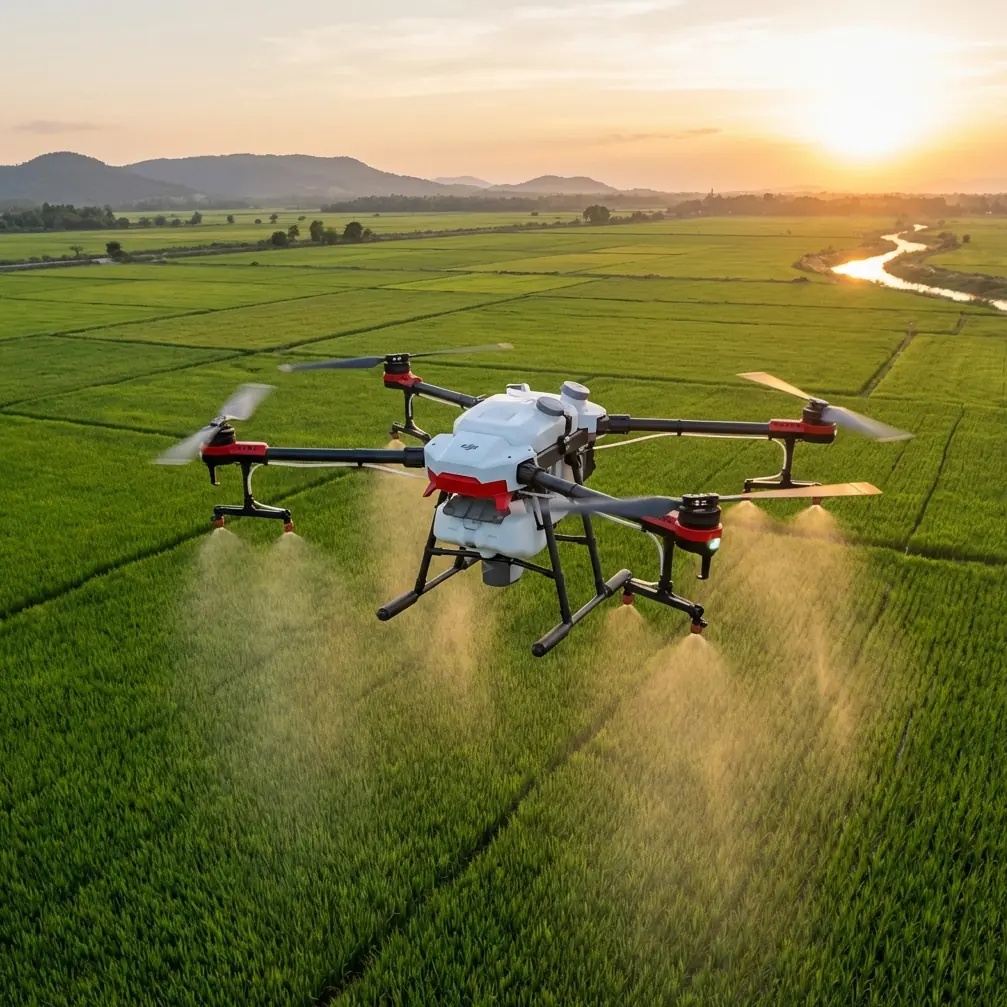
Agras T50 spraying tips for high-altitude vineyards: what actually matters in the field
META: Practical Agras T50 guidance for vineyard spraying at elevation, with expert advice on drift control, nozzle calibration, RTK precision, workflow planning, and operator training.
High-altitude vineyards punish vague drone advice.
Wind behaves differently across terraces. Temperature swings change droplet behavior. GNSS reception can look stable on paper and still produce uneven passes when the aircraft moves along steep, broken terrain. I learned this the hard way during a mountain vineyard project where a beautiful flight plan produced frustratingly inconsistent coverage on edge rows. The aircraft was capable. The workflow was not.
That is why the Agras T50 should not be discussed as just another “big agricultural drone.” In elevated vineyard work, the machine only performs as well as the system around it: operator training, route discipline, nozzle calibration, terrain awareness, and post-flight evaluation. The reference materials behind this discussion, though not written specifically as a vineyard manual, point to something useful: success with advanced UAV operations comes from combining robust aircraft capability with disciplined training and data interpretation.
Below is the practical framework I would use for spraying vineyards at altitude with the Agras T50.
Start with the real problem: mountain vineyards magnify small errors
Flat-field spraying forgives a lot. Vineyards at elevation do not.
Rows can be narrow, irregular, and broken by slope changes. Uplift and lateral gusts can move droplets off-target, especially near exposed ridge sections. If your RTK fix rate drops or your terrain following lags on changing elevation, overlap problems appear quickly. In vineyards, those mistakes are expensive because canopy geometry is less uniform than broadacre crops.
This is where centimeter-level positioning matters. On paper, that sounds like a feature checklist item. Operationally, it determines whether the aircraft repeats lines cleanly on a steep block or leaves untreated bands on the uphill side of the canopy. In high-altitude vineyards, a strong RTK workflow is not just about neat maps. It is about spray placement.
Why the T50 fits this job better than a generic spraying drone
The Agras T50 makes sense in vineyards because it is built for hard outdoor operating conditions and repeated agricultural cycles, not occasional demo flights. Its weather-resistant design and IPX6K-rated protection matter more in mountain viticulture than many operators admit. Vineyards often require early-morning work windows, quick turnarounds, and operation in damp or dusty environments depending on season. Equipment that tolerates washdown and contamination is not a luxury; it is part of uptime.
Just as important is the T50’s ability to maintain controlled, repeatable application patterns when terrain and row structure become the main source of complexity. Swath width is useful only when it remains compatible with canopy density, wind, and slope geometry. Wider is not automatically better in vineyards. The T50 gives operators enough throughput to work commercially, but the real value is that you can tune for accuracy rather than chase headline coverage numbers.
That distinction matters.
My rule for high-altitude vineyard spraying: calibrate to the canopy, not the brochure
Most spraying errors I see in vineyards begin before takeoff. Operators load the aircraft, choose a standard profile, and assume the aircraft will compensate for local variability. It will not.
Nozzle calibration should be treated as a site-specific task every time conditions shift. Different blocks can require different droplet strategies depending on trellis density, leaf stage, and exposure. At elevation, you also need to think about evaporation and drift together. Finer droplets may improve canopy penetration in some conditions, but on exposed slopes they can become exactly the wrong choice.
The T50 is capable of precise application, but precision starts with a measured output check, not trust. Confirm actual flow rate, inspect nozzle condition, and verify that left-right distribution remains uniform. On steep vineyards, even a slight imbalance becomes visible across repeated passes.
If you are seeing one side of the row carrying more residue or disease pressure after treatment, do not first blame route planning. Check the basics. Nozzle wear and calibration errors often masquerade as mapping or positioning problems.
Spray drift is the hidden tax on mountain vineyard operations
High-altitude sites bring one persistent threat: drift that looks minor in the air and significant on the crop.
A vineyard on a slope creates its own local airflow story. The valley side may draw movement downward in the morning; exposed upper rows may catch crosswinds by late morning. If you spray without adapting to those shifts, you lose deposition efficiency and increase off-target movement.
My practical approach with the T50 is simple:
- Fly earlier, before thermal mixing intensifies.
- Reduce assumptions about “light wind” because slope wind is rarely uniform.
- Prioritize stable droplet behavior over maximum acreage speed.
- Re-check row-end behavior, where direction changes often coincide with exposure changes.
This is also where operator experience becomes far more valuable than product familiarity. A drone pilot who understands aircraft controls but not agricultural application physics is not yet ready for demanding vineyards.
That point is reinforced by the training reference material. One document describes a company operating with 5 experienced drone instructors, supported by structured theory teaching, simulator sessions using PhoenixRC, and a dedicated outdoor flight training area. That may sound unrelated to the T50 at first glance. It is not. In steep vineyard work, simulator-first discipline and supervised real-flight progression reduce the exact kind of hurried field improvisation that causes drift, overlap errors, and unsafe row-end turns.
In other words, vineyard spraying quality starts long before the spray tank is filled.
Training is not optional if you want consistent T50 results
I am often asked whether an experienced general UAV pilot can step directly into agricultural vineyard work. My answer is usually no, at least not without structured transition training.
The training document provides a useful benchmark. It mentions theory instruction, mock testing, simulation practice, and practical flying in an open outdoor area. It also outlines qualification tracks for drone pilot, drone captain, and drone instructor certificates. That layered approach mirrors what serious T50 vineyard operations need.
Why?
Because spraying at altitude combines three skill sets:
- Aircraft handling
- Agricultural application judgment
- Terrain-based mission planning
A pilot may be strong in one and weak in the other two. The weak areas are where expensive mistakes hide.
For vineyards, I recommend using simulator time not just for basic maneuver practice, but for rehearsing terrain-induced workflow problems: line recovery after a pause, route interruption near terrace edges, and smooth transitions on variable row length. The field is the worst place to discover that an operator struggles with consistency under visual complexity.
If you are building a vineyard spraying team, a structured training ladder is one of the highest-return investments you can make. If you want to compare training pathways or discuss operator readiness for mountain vineyards, you can message a specialist here.
RTK fix rate: the metric vineyard operators should watch more closely
Many operators check that RTK is “working” and move on. That is too casual for steep vineyard blocks.
In mountain environments, satellite visibility can degrade near slopes, tree lines, structures, or broken terrain features. Even when the system reconnects quickly, temporary instability can show up as line deviation or inconsistent spacing. In vineyards, where row structure is visually repetitive, those errors may not be obvious until coverage is inspected later.
A strong RTK fix rate supports cleaner path repeatability and more predictable swath placement. That becomes especially important when treating alternating blocks, returning for follow-up applications, or working in areas where the margin between on-target spray and neighboring non-target vegetation is narrow.
My operating preference is to treat RTK integrity as a live variable, not a preflight checkbox. If site conditions reduce confidence in positional consistency, adjust mission expectations immediately. Slowing down and tightening your operational margin is often smarter than chasing a schedule.
Use mapping intelligently, but do not confuse imagery with crop understanding
One of the most useful reminders in the reference material comes from an ArcGIS-based crop survey workflow. It notes that creating an orthomosaic for one plot can take roughly 1 to 6 hours, depending on photo resolution, image count, CPU cores, and memory. It also states that a 5 cm orthomosaic resolution still may not allow crop identification simply by zooming in on leaves.
This is a powerful lesson for vineyard spraying.
Operators often assume that more imagery automatically means better decisions. It does not. A beautiful map is not the same as an actionable agronomic diagnosis. Even at 5 cm resolution, visual detail may still be insufficient for definitive crop interpretation or fine canopy health assessment if you rely only on standard orthomosaics.
That is where multispectral tools and field observation earn their place. If you are trying to prioritize treatment zones, verify vigor differences, or investigate stress patterns in a mountain vineyard, RGB imagery alone may not answer the question. The T50 is a spraying platform, but the workflow around it benefits from better scouting inputs. Use imagery to guide questions, not to replace verification.
For example, if one upper-slope section repeatedly underperforms after treatment, the issue might be:
- drift exposure,
- route inconsistency,
- canopy density variation,
- water stress,
- or a disease pressure pattern linked to airflow.
An orthomosaic may help you locate the pattern. It may not tell you the cause. That distinction saves time.
Build missions around row reality, not theoretical field efficiency
The temptation with a high-capacity agricultural drone is to think in hectares per hour. Vineyards punish that mindset if it overrides row logic.
In high-altitude blocks, route design should reflect:
- terrace breaks,
- headland width,
- turnaround safety,
- slope orientation,
- and the wind exposure of edge rows.
This is where swath width must be used judiciously. In broadacre operations, maximizing width may make sense. In vineyards, effective swath width is the width that preserves deposition quality and repeatability across the canopy. Anything beyond that can become false efficiency.
I generally advise operators to create conservative baseline profiles for exposed mountain blocks, then optimize only after reviewing actual results from the first few applications. The T50 gives enough productivity headroom that you do not need to force aggressive settings on difficult terrain.
A field workflow that makes the T50 easier to trust
Here is the simplified operating sequence I prefer for high-altitude vineyard spraying:
1. Scout the block in person
Walk the exposed rows, note airflow patterns, identify hazard turns, and inspect canopy density differences.
2. Verify positioning conditions
Do not assume RTK quality from a nearby site translates to the vineyard itself. Check in-block performance.
3. Calibrate the spray system
Confirm nozzle condition and output before every serious application window.
4. Start conservatively
Use a profile built for drift control and row consistency first. Optimize later.
5. Review coverage after the first section
Check deposition pattern and visual uniformity. Small corrections early prevent a whole-day rework problem.
6. Use imagery as support, not proof
If mapping is part of the workflow, remember the ArcGIS lesson: processing may take hours, and even 5 cm imagery has interpretation limits.
7. Train continuously
The best teams treat simulation, theory refreshers, and supervised review as part of operations, not as beginner-only tasks.
The bigger lesson: advanced drones reward disciplined systems
The most interesting connection in the source material is not obvious at first glance. One source describes a new commercial unmanned transport aircraft, the HH-200, rolled out on December 29 in Shaanxi for “low-altitude plus logistics” applications. Another source focuses on drone pilot training with experienced instructors and simulator use. A third reminds us that image processing can be computationally heavy and still incomplete as a decision tool.
Put together, they describe the current UAV reality well: modern platforms are becoming more capable, but capability alone does not solve operations. Whether the mission is cargo transport, training, or crop surveying, the breakthrough comes from integrating aircraft, people, and workflow.
That is exactly how the Agras T50 should be approached in high-altitude vineyards.
Yes, the aircraft matters. Its ruggedness, precision potential, and agricultural design make it a strong fit. But the difference between average and excellent outcomes usually comes from the quieter variables: disciplined calibration, realistic route planning, strong RTK habits, and pilots trained well enough to make good decisions when mountain conditions stop being predictable.
That is what made my own vineyard operations easier over time. Not a single setting. A better system.
Ready for your own Agras T50? Contact our team for expert consultation.