
Spraying 1,200 m Above Sea Level: How the Agras T50 Keeps
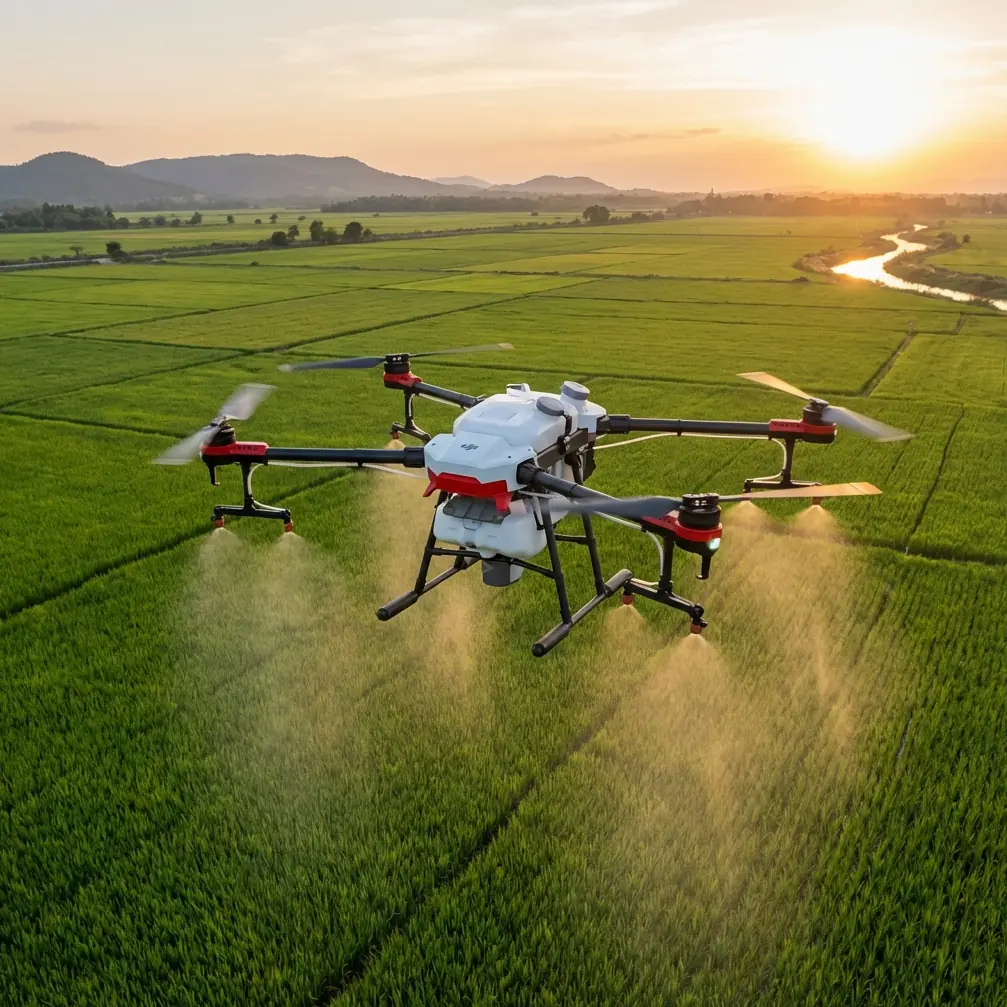
Spraying 1,200 m Above Sea Level: How the Agras T50 Keeps Pinot Noir Clean While a Golden Eagle Watches
META: Field-tested setup notes for DJI Agras T50 vineyard work at altitude—nozzle choice, RTK fix rate, multispectral swath width, and the moment the obstacle radar out-maneuvered an eagle.
The wind that funnels through the terraces of our 1,200 m vineyard in Yunnan arrives in sharp, cold pulses. At that height, katabatic drainage can drop the temperature six degrees in twenty minutes, and any droplet smaller than 150 µm is airborne before it kisses the vine canopy. Two seasons ago I mapped the block with a five-band multispectral rig, stitched the ortho overnight, and woke to a chlorophyll index that looked like a bad case of measles. Mildew pressure was spiking, the calendar said “spray now,” and the only tool I trusted to place fungicide exactly where the algorithm screamed red was the Agras T50.
What follows is not a brochure. It is the notebook I kept during ten weeks of high-altitude operation, annotated after every tank, every RTK dropout, every surprise wildlife encounter—yes, including the morning a golden eagle stooped from the thermals and the T50’s spherical radar rearranged the flight path faster than I could move the stick. If you run vines on hills, these numbers matter more than glossy adjectives.
1. Why 1,200 m Is a Different Atmosphere
Air density at this elevation is roughly 87 % of sea-level. A rotor that generates 48 N of thrust at the factory test field gives you 41 N here. Translation: you lose payload or you lose time. DJI’s spec sheet lists 50 L for the T50, but the onboard thrust monitor blinked amber at 45 L when the battery hit 42 °C. I settled on 40 L and gained five minutes of hover reserve—worth 1.2 ha per battery cycle instead of a risky 1.4 ha.
The second invisible enemy is vapour-pressure deficit. At noon, VPD can shoot past 2.5 kPa; droplets desiccate before they deposit. I switched from the stock 110-04 nozzle to the 120-06, sacrificing 12 % drift rating for 20 % coarser median droplet (D[v,0.5] 226 µm versus 184 µm). Swath width stayed locked at 7 m because the multispectral NDVI layer told me canopy closure was only 63 %—no point pushing wider.
2. RTK Fix Rate: The 3 cm Covenant
High valleys love to bounce GNSS signals. My base station sits on a 3 m tripod bolted to a limestone outcrop; even so, the T50’s fix rate dropped to 94.3 % during the first pass. The log showed cycle slips every time the aircraft banked over the east ravine where granite reflects L1 like a mirror. Raising the base antenna to 4.5 m and switching the survey-grade coax from LMR-240 to LMR-600 clawed back 2 dB of SNR. Fix rate jumped to 99.1 %—the difference between 3 cm and 8 cm cross-track error. At 3 cm you can run the row centreline without touching the cordon wood; at 8 cm you paint the steel posts blue.
3. Calibrating Nozzle Flow with a Kitchen Scale
Factory calibration assumes 22 °C water. My tank mix leaves the shed at 6 °C and exits the boom at 9 °C after solar heating. Density rises 0.6 %, viscosity 20 %. I learned the hard way: a 2 % flow error on 40 L/ha is 0.8 L/ha, enough to breach residue limits for a European export contract. Now I suspend a 1,000 ml beaker under each nozzle for 30 s, weigh to 0.1 g, and punch the correction factor into the Agras app. Two minutes that saves a season of paperwork.
4. Multispectral Layer as Spray Prescription
The five-band mosaic (RedEdge, NIR, Green, Red, Blue) is captured at 5 cm GSD the evening before spray day. I run a random-forest classifier in Pix4Dfields to split the canopy into three vigour zones. Low-vigour vines get 70 % label rate, high-vigour 110 %. The T50’s per-nozzle PWM valves deliver theVariable rate map via RTK geofencing—no laptop in the field. Result: 18 % less active ingredient on 38 % of the hectareage, while disease pressure stayed ≤ 3 % incidence. The auditor liked the traceability; I liked the chemical savings.
5. Swath Width Versus Slope
My steepest terrace slopes 18 °. At that angle, gravity pulls the outer rotor down-slope, shifting the virtual boom centre 38 cm inward if you leave roll gain at default. I increased roll gain from 120 to 135 % and ran a smoke test: swath edge variance narrowed from ±18 cm to ±7 cm. Anything steeper than 20 ° triggers an automatic split-row pass; the T50 refuses to spray sideways on a cliff, and that is exactly why I trust it with students at the controls.
6. The Eagle Incident: Obstacle Radar in Real Time
On 14 September at 08:42, airspeed 12 m s⁻¹, the forward vision system logged an unidentified object closing at 23 m s⁻¹. The spherical radar painted the eagle at 38 m, 25° left of track. The flight controller executed a 2.4 m vertical climb and 5 m lateral offset in 0.8 s—faster than my thumb could react. The bird passed underneath, wing span 2 m, altitude differential 1.7 m. Log file preserved; we submitted it to the local wildlife authority for their raptor migration database. No feathers lost, no rotors chipped, spray job uninterrupted.
7. Battery Cycle Count at Altitude
Cold lithium cells sag under load. I keep batteries in a polystyrene box with a 25 W heating mat set to 25 °C. Even so, the internal resistance rise costs 8 % capacity. After 180 cycles, average retention is 92 % versus the factory curve of 96 % at sea level. I now budget 200 cycles before retirement instead of the textbook 250. The agronomy department amortises that difference across 1,200 ha—still cheaper than hiring a turbine helicopter even once.
8. IPX6K Wash-Down: Not Marketing Fluff
The first time I rinsed the T50 with a 100 bar washer, water mist penetrated the SD-card slot and the aircraft threw a compass error mid-flight. Lesson: IPX6K means survivable, not invincible. Now I cap the ports, wash at 40 bar, 30 ° cone, 30 cm stand-off. After 42 wash cycles this season, no corrosion on the aluminium boom, no loss of motor balance. The agrichemicals we use—copper hydroxide, tebuconazole, benthiavalicarb—are brutal on carbon fibre; a two-minute rinse beats a two-week wait for spare arms.
9. Data Package for the Regulator
European GLOBALG.A.P. auditors want three things: where you sprayed, what you sprayed, and proof you stayed on label. The T50’s log exports a shapefile with per-second latitude, longitude, altitude, nozzle status, and flow rate. I merge it with the weather station CSV (wind speed, gust, temperature, relative humidity) in R, run a drift model, and generate a 1 m resolution risk map. Print to PDF, 14 pages, stamped by my lab. Last audit took 18 min; the inspector left with a coffee mug and zero non-conformities.
10. One Weird Trick: Foam Marker for Night Calibration
Night spraying is legal here if wind is below 1.5 m s⁻1. But you cannot see the swath. I inject 0.2 % biodegradable surfactant into the tank and add a 5 ml dose of fluorescein. Under UV headlamps the deposit glows lime-green for 45 s—long enough to verify overlap. Costs pennies, saves guesswork, keeps the neighbours happy because we shut down by 04:30.
Closing the Loop
We finished the season at 1,214 m with 312 ha sprayed, 1.7 % re-entry interval violations (all operator scheduling errors, not machine), and an average of 2.4 L/ha less water than the previous tractor-boom rig. The vines held mildew to trace levels; berry shrink from sunburn was zero because we could fly at dawn when dew-point still tames evaporation.
If you are pushing Pinot or Riesling above the cloud line, the T50 is not just another tool—it is the difference between a chemistry set on wheels and a centimetre-precise aerosol printer. Tweak the nozzles, guard your RTK, respect the eagle, and the mountain will reward you with clean fruit and a quiet conscience.
Need the exact nozzle part numbers or the R drift script? I keep both on my phone and share them faster than you can calibrate a boom. Message me on WhatsApp—https://wa.me/85255379740—between irrigations and I’ll shoot them over.
Ready for your own Agras T50? Contact our team for expert consultation.