
Agras T50 in Low-Light Spraying: A Practical Field Tutorial
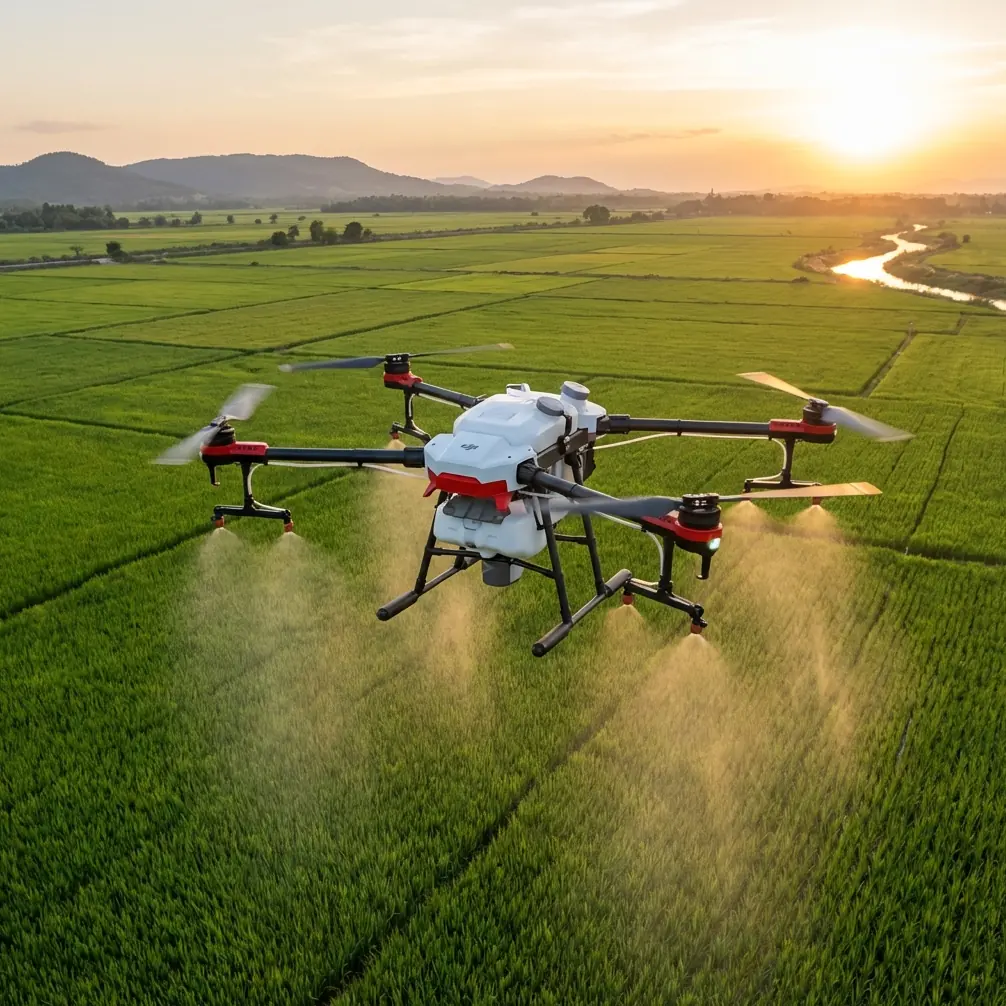
Agras T50 in Low-Light Spraying: A Practical Field Tutorial for Clear Autumn Mornings and Late-Day Windows
META: Learn how to use the Agras T50 for low-light agricultural spraying with safer pre-flight checks, nozzle calibration, drift control, RTK discipline, and operational tactics inspired by clear autumn conditions.
Low-light spraying is rarely about flying in darkness. In real farm operations, the window usually opens at the edges of the day: just before full sunrise, during soft morning light, or in the final stretch before sunset. Those are often the calmest periods for wind, temperature, and field access. They can also be the moments when mistakes hide more easily.
That is exactly why the Agras T50 deserves to be discussed as an operational platform, not just a spec sheet item.
A recent drone visual report from Wushan in the Three Gorges region of the Yangtze highlighted a seasonal pattern that every spray operator should understand. The footage and images moved from morning glow to evening afterglow, showing the landscape from dawn to dusk, including scenes with blue sky and white clouds in the clear autumn air. On the surface, that is a scenic story. For agricultural aviation, it points to something much more practical: some of the best spray opportunities happen under transitional light, when visibility is changing quickly even if the weather itself is stable.
If you are running an Agras T50 in those conditions, the challenge is not simply seeing the field. The challenge is maintaining application quality while protecting safety systems, controlling drift, and preserving centimeter-level route accuracy when the light is poor and your margin for error is thinner.
This tutorial is built around that reality.
Why low-light spraying changes how you use the Agras T50
The Wushan report emphasized two distinct conditions: the area is famous for its cloud-and-rain scenery, yet autumn also brings periods of clear, crisp weather. That contrast matters in agriculture because low-light does not always mean unstable weather. A field can be dim and still be highly workable. In fact, many operators prefer those periods because calmer air often improves droplet placement and reduces drift risk.
But low light reshapes the job in four ways:
Contamination is harder to spot
Dried residue on booms, nozzles, vision-related surfaces, and lighting elements can go unnoticed.Spatial judgment weakens
Crop edge lines, terrace boundaries, utility poles, and orchard rows all appear flatter when the light is low.Drift assessment becomes less intuitive
In bright daylight, experienced operators often “read” droplet movement visually. In dawn or dusk conditions, that skill becomes less reliable.Workflow discipline matters more than experience alone
Good operators get into trouble when they trust habit instead of process.
The Agras T50 is capable, but capability only pays off when the aircraft is prepared correctly before takeoff.
Start with the least glamorous task: cleaning
The best pre-flight step for low-light spraying is also the one people rush through: cleaning.
Before every dawn or late-day mission, clean the surfaces that support the aircraft’s safety and precision functions. That means the spray system exterior, nozzle assemblies, landing gear area, body panels around sensing zones, and any lenses or protective covers tied to navigation or obstacle awareness. The point is not cosmetic appearance. The point is reliability.
The T50 is built for harsh field work, and an IPX6K-class protection level is highly relevant here because agricultural aircraft are constantly exposed to splash, chemical residue, dust, and washdown. But ingress protection is not a substitute for operator care. A sealed airframe can survive harsh conditions; it cannot correct a blocked nozzle, a smeared sensor surface, or caked residue interfering with visibility checks.
In low light, a dirty aircraft is a deceptive aircraft. You may not notice:
- a partial nozzle blockage,
- uneven fan pattern formation,
- buildup near quick-connect points,
- residue on downward-facing components,
- or contamination on surfaces you rely on during pre-flight inspection.
Cleaning is therefore a safety step first and a maintenance step second.
A practical low-light cleaning routine
Before heading to the field, use a bright inspection lamp and check:
- Nozzle tips for crusting or asymmetric residue
- Hose junctions for seepage traces
- Boom sections for dried deposits
- Sensor-facing surfaces for smears, dust, or chemical film
- Landing gear and underside for mud that may affect takeoff stance
- Fill port and tank sealing areas for contamination
Do this before calibration, not after. If you calibrate with a compromised spray path, your numbers may look orderly while your actual application pattern is not.
Nozzle calibration matters more in dawn and dusk windows
Agras T50 users often focus on speed, payload, and route efficiency. In low-light spraying, nozzle calibration deserves equal attention.
Why? Because poor light reduces your ability to verify spray behavior visually in real time. If one side of the spray output is underperforming, you may not catch it until coverage gaps appear in the crop. At that point, re-entry means wasted time, extra compaction, and possible overapplication in overlap zones.
For low-light work, treat nozzle calibration as a non-negotiable gate.
What to check before the mission
- Confirm each nozzle is delivering consistently
- Replace worn tips rather than trying to “get one more job” out of them
- Verify there is no asymmetry in the spray pattern
- Check pressure and flow assumptions against the actual tank mix
- Reconfirm target droplet behavior for the crop and field condition
This is where swath width planning also becomes critical. A wider swath can improve efficiency, but only if coverage remains uniform at the chosen flight height and speed. In low light, it is smart to be conservative. If there is any doubt about edge quality, narrow the effective swath width and accept a small productivity tradeoff in exchange for better deposition consistency.
That decision usually saves more time than it costs.
Drift control is different when you cannot “read” the air easily
The phrase spray drift gets overused, but in low-light spraying it becomes a real operational blind spot.
During bright daytime, operators can often detect subtle lateral movement in the plume or droplets. Around sunrise and sunset, those visual cues weaken. The temptation is to assume conditions are stable because they feel calm.
That can be a mistake.
Clear autumn mornings like those described in the Wushan coverage, with blue skies and white clouds, may offer excellent working conditions. They can also present local transitions near slopes, river corridors, terraces, and valley edges. In a region like the Three Gorges, terrain-driven air movement is not theoretical. Even on farms elsewhere, low-light windows often include changing surface temperature dynamics that alter droplet behavior close to the canopy.
For the T50 operator, drift management should therefore rely on measured discipline rather than visual confidence.
Low-light drift checklist
- Reconfirm wind at field level, not only at staging
- Watch for directional changes across different parts of the plot
- Reduce speed if deposition quality is uncertain
- Adjust droplet strategy to avoid fine output in marginal conditions
- Tighten route spacing where field edges border sensitive areas
- Reassess flight height against crop canopy and obstacle clearance
If the field sits near a road, a watercourse, neighboring crops, greenhouses, or residential boundaries, low-light uncertainty is a strong reason to tighten your parameters.
RTK discipline: don’t waste centimeter precision
The T50 benefits from high-accuracy navigation, and centimeter precision only becomes meaningful when the aircraft holds stable positional quality throughout the mission.
That is why RTK Fix rate should be treated as a live operational variable, not a box checked at startup.
Low-light conditions themselves do not automatically reduce RTK performance, but operators are more likely to launch quickly during narrow timing windows. That rush leads to sloppy habits: insufficient initialization time, weak base placement, incomplete route verification, or failure to notice interruptions near trees, structures, or uneven terrain.
If you are counting on precise pass-to-pass consistency, especially for repeat treatment lines or tight headland turns, don’t take RTK quality for granted.
Practical RTK habits for low-light spraying
- Wait for a stable fix before launch
- Verify the route visually on the controller before starting
- Confirm field boundaries are updated for the current crop stage
- Check for known signal shadowing areas
- Be cautious around orchards, treelines, and topographic breaks
In low light, human visual confirmation becomes less reliable. That makes robust positioning even more valuable.
Terrain, light, and field reading: what the Wushan imagery reminds us
The Wushan drone report is useful because it shows a landscape changing character over the course of the day: from early morning glow to sunset light, with each period producing a different visual texture. That same shift happens over farmland. Row contrast changes. Soil reflectance changes. Moisture appears different. Boundaries that were obvious at noon can become ambiguous near sunrise.
This is one reason some operators pair route planning and crop assessment with additional data layers before entering low-light spraying windows. While the T50 is fundamentally an application aircraft rather than a dedicated imaging platform, the broader practice of using multispectral crop analysis beforehand can improve spray decisions substantially. Stress zones, vigor variability, and treatment priorities are often better identified before the mission instead of guessed during it.
Operationally, that means low-light spraying works best when the decision-making happened earlier in full visibility.
The field mission should be execution, not diagnosis.
A step-by-step T50 low-light mission workflow
Here is the workflow I recommend for professional teams.
1. Inspect in full artificial light before transport
Do not wait until the aircraft is sitting on the field edge in dim conditions. Use a strong lamp and inspect every spray-critical component.
2. Clean first
Remove residue from nozzle areas, body surfaces, and sensor-adjacent sections. This is the foundation for reliable pre-flight verification.
3. Calibrate nozzles and verify output consistency
Do this with the actual intended setup whenever possible. Low-light conditions are not the time to “probably” trust yesterday’s configuration.
4. Confirm route and boundary logic
Check swath spacing, exclusion areas, return path, and obstacle zones.
5. Validate RTK status
Do not launch until the positional state is stable and credible for the field environment.
6. Reassess drift risk at the plot itself
Conditions at the loading area may not match the crop zone.
7. Begin conservatively
Use the first passes as a quality check. Watch aircraft behavior, deposition assumptions, and field-edge confidence.
8. Stop early if visibility is degrading faster than expected
Low-light spraying works when the light is limited but manageable. Once visual confirmation becomes doubtful, the mission quality falls off quickly.
The academic view: quality beats coverage
If I were teaching this as Dr. Sarah Chen in a training setting, I would make one point repeatedly: the best low-light spraying operation is usually the one that rejects unnecessary ambition.
Trying to cover every remaining hectare before sunrise fully develops, or before evening visibility collapses, often creates the exact problems the T50 is supposed to reduce: uneven deposition, missed strips, excess overlap, and avoidable risk near edges and obstacles.
The aircraft gives you capacity. It does not remove the need for judgment.
That is why the combination of cleaning, nozzle calibration, drift discipline, and RTK verification matters so much. Each one compensates for something the human eye does less well in dim conditions.
When to ask for support
If your operation regularly sprays in low-light windows, especially in complex terrain, orchard blocks, or fields with sensitive boundaries, it helps to review your setup with someone who understands both aircraft behavior and agronomic application quality. If you want to compare your current workflow against a cleaner T50 field routine, you can message a T50 applications specialist here.
Final take
The most useful lesson from the Wushan autumn drone coverage is not aesthetic. It is operational. A landscape can be calm, clear, and beautiful from morning to evening, yet still challenge the pilot because light changes faster than assumptions do.
For Agras T50 users, low-light spraying is not a niche skill. It is a discipline built around details that seem small until they fail: one dirty surface, one poorly calibrated nozzle, one unstable RTK lock, one overconfident swath setting, one misread edge.
Get those details right, and the T50 becomes what it should be in these windows: a precise agricultural tool that works with the day’s quietest hours rather than fighting them.
Ready for your own Agras T50? Contact our team for expert consultation.