
What a Fast-Food Drone Demo Really Means for Agras T50
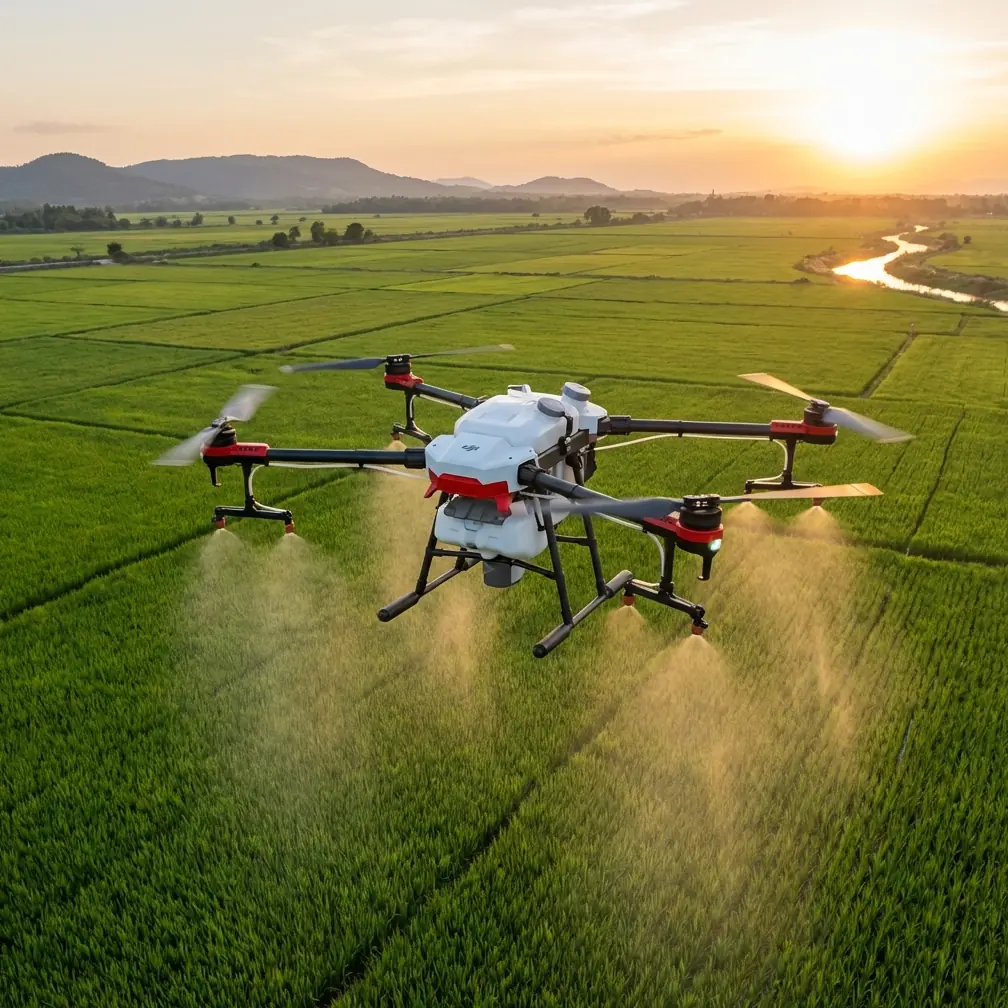
What a Fast-Food Drone Demo Really Means for Agras T50 Operations in Dusty Spraying Venues
META: A UAV consultant’s take on what KFC’s 8-minute low-altitude drone delivery demo reveals for Agras T50 pilots working in dusty environments, from route stability to antenna placement, RTK reliability, and safer spray execution.
Most Agras T50 operators do not look to a food-service exhibition for field lessons. They should.
At the 7th China Tianjin International Helicopter Expo on October 16, one of the most useful low-altitude aviation signals did not come from a traditional ag platform launch. It came from a restaurant brand. During the show, KFC joined exhibitors including Yunchuang Technology and Klan Eagle to stage a simulated drone delivery mission. The aircraft lifted off from a restaurant setting, crossed urban airspace, and landed accurately beside a mobile KFC food truck after an 8-minute flight. The expo itself also mattered: this year it reportedly introduced a dedicated low-altitude economy pavilion for the first time, putting UAV operations and aircraft innovation at the center of the event rather than at the edge.
That is not just a branding exercise. For Agras T50 owners, especially those spraying in dusty venues, it is a practical reminder that the industry is moving toward one standard above all others: repeatable low-altitude performance in messy real-world conditions.
The aircraft type in the KFC concept demo is not the Agras T50. Still, the operational logic carries over directly. If a drone can move payload safely, steadily, and on schedule through a constrained low-altitude corridor in front of industry observers, then the same ecosystem pressures apply to spraying platforms: navigation confidence, link stability, controlled descent behavior, landing precision, and mission consistency around people, vehicles, and temporary infrastructure. In agriculture, dusty work sites amplify every one of those variables.
Why this story matters to Agras T50 users
The biggest takeaway from the Tianjin demonstration is not “delivery is coming.” It is that low-altitude missions are now being judged as integrated service operations. The drone is only one piece. The route, landing zone discipline, payload handling, surrounding ground activity, and public safety expectations all travel together.
That directly mirrors Agras T50 work in orchards, dry open fields, seed treatment zones, and large farm transfer points. In dusty venues, operators often focus on tank volume, pump performance, nozzle choice, and throughput. Those are essential. But once visibility degrades, ground surfaces turn loose, and support vehicles stir up suspended particles, the mission becomes an ecosystem problem. The KFC showcase highlighted exactly that kind of integrated operating environment.
Two details from the news are especially useful.
First, the flight reportedly ended with a precise landing next to a mobile service vehicle. Operationally, that is the same discipline T50 crews need when launching or recovering near trucks, chemical staging tables, water tanks, battery stations, or temporary refill points. Dusty venues are rarely neat. A drone that can hold a dependable terminal approach and land accurately in relation to ground assets reduces both contamination risk and turnaround confusion.
Second, the flight duration was given as 8 minutes. That number matters because short missions are where many operators become casual. They assume brief distance means low complexity. In reality, compact low-altitude flights often concentrate the hardest parts of a mission into a small time window: takeoff in disturbed air, link establishment, route tracking, obstacle awareness, descent into particulate-laden turbulence, and fast redeployment. T50 missions over dusty plots can create the same compression effect, especially when working fragmented parcels or repeated refill cycles.
Dust changes everything on the Agras T50
The Agras T50 is built for serious field work, but dusty sites punish weak setup habits. Fine particles interfere with visibility, coat surfaces, complicate inspection, and can make operators misread the true source of a performance issue. What looks like poor spray pattern consistency may actually be a combination of rotor wash interacting with dust plumes, incorrect boom height, or sloppy nozzle calibration. What feels like weak signal range may be less about radio hardware and more about bad controller antenna positioning or body-blocking during turns.
This is where the Tianjin demo becomes unexpectedly relevant. A public-facing low-altitude mission has little tolerance for erratic aircraft behavior. The same mindset should govern your T50 spraying workflow.
If you spray in dusty venues, your benchmark should be boring reliability. No last-minute improvisation. No guessing whether the aircraft is holding line. No vague confidence in RTK status. No hand-waving around drift.
A field method for dusty spraying venues
Here is the way I advise T50 crews to think about it.
1. Start with the route, not the liquid
Many teams begin with chemical mix planning and only later think about aircraft path quality. Reverse that order. In dust, path discipline is your first control layer.
The KFC exhibition flight was framed around a clear origin, a defined transit segment, and a precise endpoint. That is exactly how a T50 mission should be built, even for short spray blocks. Mark the launch area, refill area, and treatment lanes as a connected system. If vehicles are moving nearby, do not assume your usual takeoff point is still optimal once dust starts lifting from access roads.
For the T50, swath width planning must reflect real surface conditions rather than nominal ideal ones. A wide swath looks efficient on paper, but in dusty venues it can hide edge inconsistency and increase spray drift if the operator is tempted to maintain output despite unstable air near the canopy or surface. Conservative lane planning usually produces better net coverage.
2. Protect RTK quality before takeoff
Dust does not directly “break” RTK, but dusty venues often come with the kind of operating clutter that degrades confidence: trucks, sheds, metal implements, temporary structures, tree lines, and pilots standing in poor controller positions. The result can be a weak or unstable fix rate at the exact moment precise guidance matters most.
Centimeter precision is only useful when it is consistently available. Before launching, verify that your working area supports stable correction reception and that the aircraft is not being initialized in a compromised zone. If the site is busy, move the setup point. A small relocation can have outsized impact on route repeatability.
On the T50, a high RTK fix rate is not just a nice technical metric. It directly affects pass-to-pass confidence, overlap control, and the ability to maintain intended spray geometry when the environment is already visually noisy.
3. Antenna positioning is not a minor detail
This is the advice too many operators treat as optional: your controller antenna position has to serve the aircraft, not your comfort.
For maximum range and cleaner link behavior, keep the controller oriented so the antenna face presents properly toward the aircraft’s working area, avoid letting your body shield the signal path, and do not stand beside large metal surfaces or parked support vehicles if you can help it. In dusty venues, crews often cluster near trucks because that is where the water and supplies are. That can be convenient, but it is not always the best RF position.
If the plot is long and narrow, reposition yourself during the mission so the aircraft stays in a stronger geometry relative to the controller rather than forcing the link through a poor angle. The lesson from the Tianjin delivery demo is simple: precise end-to-end low-altitude work depends on system discipline, and signal discipline starts with the operator.
If your team wants a practical controller-placement checklist for field layouts, I can walk through it here: message me directly for the antenna setup notes.
4. Tune nozzles for dust, not just for label compliance
Nozzle calibration in dusty venues needs more respect than it usually gets. A technically correct nozzle choice can still perform badly if site conditions push the droplet spectrum in the wrong direction. Too fine, and spray drift increases quickly when rotor wash meets suspended dust and uneven microcurrents. Too coarse, and you may lose the coverage quality needed for the target.
The right answer depends on crop, chemistry, canopy structure, and ambient conditions, but the process is non-negotiable: calibrate, verify flow consistency, and inspect pattern quality under actual site conditions rather than assuming the last clean-site setup transfers perfectly. Dust can also make visual judgment harder, so crews should use repeatable checks instead of intuition.
When operators complain that the T50 “isn’t laying down evenly” in dry fields, I often find the root issue is not the aircraft. It is a mismatch between nozzle setup, flight height, and operator expectations under dusty airflow.
5. Treat spray drift as a mission-planning issue
Spray drift is often discussed as if it begins at the nozzle. It starts earlier than that. It starts when the operator chooses a takeoff point, route direction, pass order, altitude, and work window without accounting for the site’s dust behavior.
A dusty venue is telling you something about air movement. If the ground is shedding fine particles visibly, you already have evidence that small droplets can be displaced in ways that a calm-weather plan will not capture. Use that information. Adjust timing. Shorten working windows if conditions worsen. Reevaluate pass direction relative to sensitive areas. Lower confidence in assumptions, not standards.
The KFC drone concept mattered because it framed low-altitude UAV work as a visible public operation. Agriculture deserves the same seriousness. Drift is not just a technical miss. It is an operational planning failure when warning signs were already present in the environment.
6. Use the landing zone as a quality checkpoint
One of the most telling details in the expo story was the drone’s accurate arrival beside a mobile service point. For T50 crews, that should trigger a habit: every recovery is a diagnostic moment.
When the aircraft returns, inspect for dust loading on critical surfaces, confirm nozzles remain clean and balanced, check for any buildup that could affect cooling or moving parts, and verify the mission data against what you observed in the field. A sloppy landing area makes all of that harder. So does a landing zone placed directly in the heaviest vehicle-generated dust.
Set up your recovery point to support inspection, not just convenience. If you can recover two meters farther from a dust source and preserve better visibility for checks, that is usually the smarter choice.
Why the low-altitude economy angle matters
The Tianjin expo did more than host a demo. By adding a low-altitude economy pavilion for the first time, it signaled that UAV activity is being viewed as infrastructure, not novelty. That matters for Agras T50 operators because expectations will rise accordingly.
As low-altitude aviation becomes more visible across logistics, inspection, and public-facing demonstrations, agricultural UAV work will be judged against a broader professional standard. Not just acreage per hour. Not just payload capability. Operators will increasingly be measured by how consistently they manage safety buffers, route precision, environmental control, and integration with other on-site activities.
That is good news for disciplined T50 crews. The operators who already think in terms of centimeter precision, link quality, nozzle verification, and field logistics will adapt fastest. The ones who rely on habit and rough judgment will feel more pressure.
Where multispectral fits, and where it does not
Some readers will ask whether multispectral tools belong in this discussion. They can, but not as a substitute for good spraying practice.
In dusty venues, multispectral data may help identify stress patterns, vigor differences, and treatment priorities before a mission. That can sharpen where and how you deploy the T50. But once you are on site, imaging does not solve poor antenna positioning, bad nozzle calibration, unstable RTK conditions, or careless landing-zone setup. It informs decisions upstream. Execution still wins or loses the mission.
The practical lesson
A restaurant brand using a drone to move meals across an expo is not an agriculture story on the surface. For Agras T50 operators, though, it contains a clear operational message.
Low-altitude aviation is maturing around reliability in real environments. The KFC concept flight emphasized stable transit, an 8-minute mission rhythm, and precise arrival beside a mobile ground endpoint. Those are not abstract qualities. They map directly to how a T50 should be run in dusty spraying venues: stable route geometry, disciplined controller positioning, dependable RTK performance, careful swath planning, and recovery procedures that support inspection rather than rush the next sortie.
If you want cleaner coverage and fewer surprises in dusty conditions, stop thinking of spraying as a simple out-and-back liquid task. Think like a low-altitude systems operator. That is where the gains are.
Ready for your own Agras T50? Contact our team for expert consultation.