
Agras T50 on Solar Farms: What Actually Matters in Complex
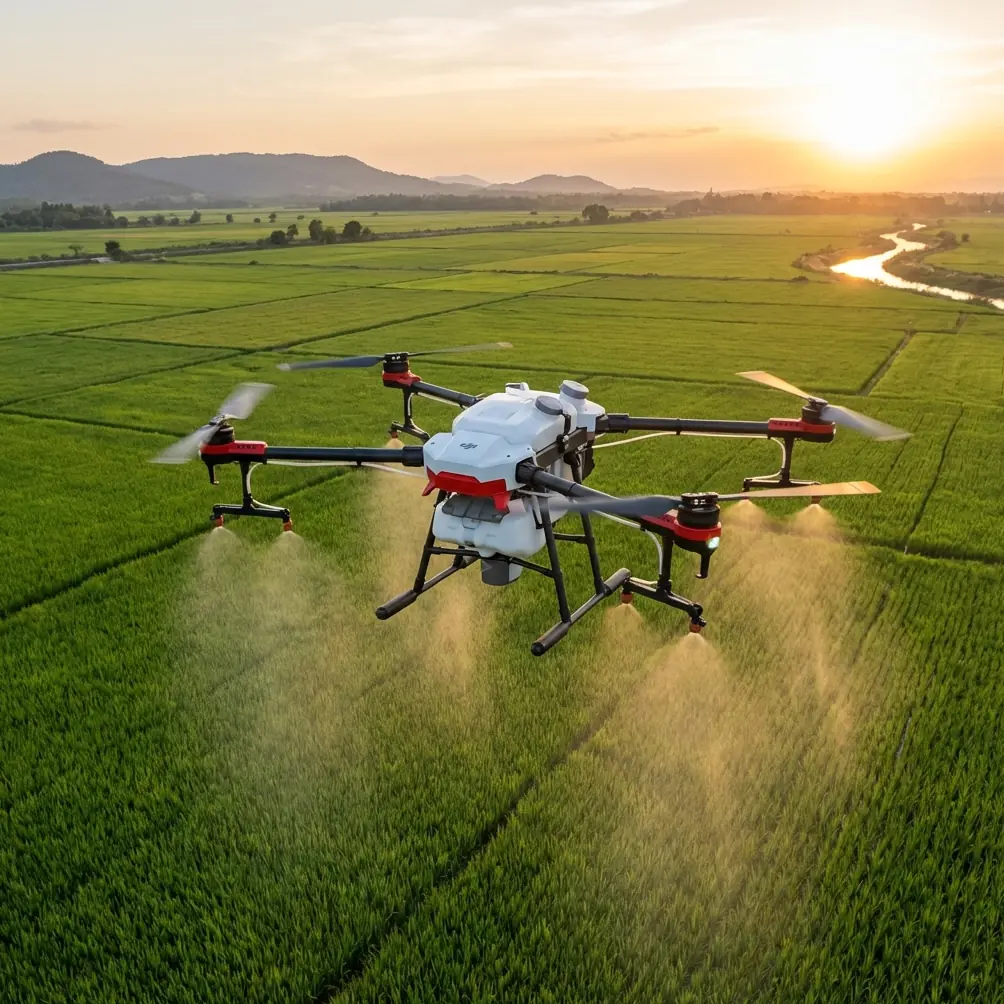
Agras T50 on Solar Farms: What Actually Matters in Complex-Terrain Spraying
META: A field-based case study on using the Agras T50 for solar farm spraying in uneven terrain, with practical insight on drift control, nozzle setup, RTK precision, and why embodied-intelligence trends matter for real-world UAV operations.
I’ve spent enough time around utility-scale solar sites to know that “vegetation management” sounds cleaner on paper than it looks in the field.
A solar farm with rolling ground, drainage cuts, access roads, cable trenches, fence lines, inverter pads, and tightly spaced panel rows creates a nasty operating environment for any spraying platform. Add slope changes, wind channeling between structures, and the constant need to avoid drift onto panel surfaces, and the job becomes less about simply covering acres and more about controlling variables. That is exactly where the Agras T50 starts to separate itself from lighter-duty assumptions people bring into this kind of work.
This article is not a generic T50 overview. It comes from a specific operational lens: spraying vegetation at solar installations in complex terrain, where repeatability matters more than spec-sheet theater.
The problem I remember most
A few seasons back, I was pulled into a site review after a contractor had struggled with inconsistent coverage along a hilly solar array. The issue wasn’t one dramatic failure. It was death by accumulation.
Some rows got adequate suppression. Others had misses near support posts and edge transitions. Drift risk increased whenever the route crossed open corridors where wind accelerated. Manual touch-up crews had to return to areas the aircraft should have covered the first time. The operation was still faster than a ground rig in that terrain, but efficiency bled away through rework.
The root cause wasn’t just pilot skill. It was the old story in a new setting: the site demanded more intelligence from the system than the workflow had been designed to provide.
That’s why a recent industry discussion caught my attention, even though it wasn’t framed around agriculture alone. On March 26, the fourth session of the Yuntian Reception Room and Embodied Intelligence Seminar brought together a cross-section of robotics, AI, and chip companies to discuss where practical deployment is getting stuck. The conversation centered on five pain-point directions: data, models, chips, compute, and commercial implementation.
That may sound far removed from a solar-farm spraying mission. It isn’t.
Those five areas map directly to what determines whether an Agras T50 performs like a professional tool or just an expensive airframe.
Why an embodied-intelligence discussion matters to a spraying drone
The seminar gathered core companies across the embodied-intelligence supply chain, including robotics and systems firms, AI companies, and AI chip developers. That matters because drones like the T50 are no longer just mechanical carriers for liquid payloads. In difficult environments, they behave more like applied field robots. Their value depends on sensing, route interpretation, terrain response, stable decision-making, and clean execution under changing conditions.
For solar-farm spraying, each of those five discussion areas has direct operational significance:
1. Data decides whether “precision” is real
If the terrain model, obstacle data, and site boundaries are weak, everything downstream degrades. On solar sites, that means inconsistent height above target vegetation, poor swath overlap, and treatment gaps along irregular edges.
With the T50, people often focus on payload or throughput first. In this application, I’d argue the higher-value question is whether you’re feeding the aircraft enough site intelligence to maintain a usable spraying profile row after row. Centimeter-level route confidence only helps if the mapped environment reflects the actual job.
2. Models matter because terrain is not flat in the places that hurt you
A perfectly straight run across a level field is one thing. A route weaving across grade changes beside panel infrastructure is another. Any model that helps the drone interpret space, maintain line discipline, and adapt to site geometry has practical value. This is where RTK fix quality and terrain-following behavior stop being technical trivia and become cost-control tools.
3. Chips and onboard processing affect reaction quality
The seminar’s focus on chips and compute wasn’t abstract. In field robotics, faster and more reliable processing means better positional awareness and more confident handling of dynamic variables. On a solar farm, those variables include changing light conditions, reflective surfaces, edge clutter, and route complexity. You don’t need marketing slogans here. You need stable execution.
4. Commercial implementation is where technology gets judged honestly
This was one of the seminar’s explicit themes, and it’s the most relevant one for contractors. A drone can look impressive at a demo and still create operational drag in the real world. Commercial viability comes down to whether the system reduces labor, minimizes retreat zones, shortens planning time, and maintains consistency across long workdays in dirty conditions.
That is exactly the standard I use when assessing the Agras T50 for solar sites.
Where the Agras T50 earns its keep
The T50 is especially useful when the site combines large acreage with enough terrain and infrastructure complexity to punish any sloppy workflow. On paper, solar farms can resemble open, repetitive spaces. In practice, each array block creates micro-constraints that affect spray pattern, route spacing, and drift behavior.
Here’s what tends to matter most.
Swath width is only useful when it stays usable
Broad swath coverage sounds great until uneven ground or crosswind turns theoretical productivity into inconsistent deposition. On solar farms, I care less about the biggest possible swath and more about the repeatable swath width you can maintain without compromising edge control.
With the T50, disciplined setup is everything. If nozzle calibration is rushed, output uniformity suffers. If flight height drifts over undulating ground, your pattern shifts. If speed is pushed too aggressively through panel corridors, you lose confidence at the exact points where retreat costs spike.
The lesson: don’t chase headline coverage. Build a spraying profile the aircraft can hold consistently in that terrain.
Nozzle calibration is not housekeeping
I’ve seen crews treat nozzle calibration as a checkbox item before launch. On a solar farm, that’s a mistake.
Vegetation around panel tables often varies sharply in density. Ground cover near drainage areas behaves differently than growth under tighter shade patterns. If nozzles are not calibrated properly, you can end up overdosing one band and under-treating another, especially when route geometry changes frequently.
Operationally, proper calibration affects three things at once:
- deposition consistency across uneven target surfaces
- drift behavior when air movement changes around structures
- confidence in coverage when you need documentation for repeat service cycles
That’s why I always tie nozzle work back to site layout, not just tank chemistry.
Spray drift control is the real credibility test
Anyone can claim efficiency. Drift control is where professionalism shows.
Solar farms introduce a unique concern: you’re not just treating vegetation. You’re working around high-value surfaces and infrastructure where off-target deposition creates cleanup risk, operator stress, and client scrutiny. Reflective panel geometry can also complicate situational judgment if the workflow is rushed.
The T50 helps when paired with conservative route planning, smart droplet strategy, and realistic weather thresholds. But the aircraft does not eliminate the need for judgment. In fact, better aircraft often tempt crews into operating too close to the edge of acceptable conditions.
My rule is simple: if the wind profile is making you argue with yourself, the site has already answered the question.
RTK fix rate matters more here than many operators admit
In rowed agricultural fields, small positional inconsistencies can sometimes be absorbed. In solar infrastructure, they become visible fast.
A strong RTK fix rate improves line repeatability, helps maintain cleaner passes along arrays, and reduces the chance of overlap errors near supports, fencing, and service roads. That translates into less retreat work and better confidence when operating near restricted zones within the site.
This is one place where the embodied-intelligence seminar’s emphasis on data, models, and compute becomes practical. Precision is not a single feature. It is the outcome of a chain: good site data, stable positioning, reliable processing, and disciplined mission setup. Break one link, and the field result tells on you.
For solar farms built across rolling or terraced ground, that chain becomes even more important. Centimeter precision is not there for bragging rights. It is what keeps a route tight when terrain and infrastructure are trying to pull it apart.
Dirty jobs reward durable systems
Solar-site spraying is messy work. Dust, residue, moisture, and repeated loading cycles expose every weakness in field equipment. That’s one reason a robust protection standard such as IPX6K matters operationally. It supports easier cleanup and better tolerance for hard-use conditions where fine debris and washdown are part of routine life, not rare events.
That sounds mundane until you manage a fleet or run long service intervals. Downtime rarely arrives through dramatic breakdowns. More often, it appears as maintenance drag, contamination headaches, and connectors or surfaces that never quite recover from abuse. Durable hardware won’t solve a bad workflow, but it does protect a good one.
What I would do on a complex solar site with a T50
If I were setting up a fresh operation tomorrow, I would build the mission around control, not speed.
Start with terrain truth
Map the site carefully enough to understand elevation transitions, row spacing, obstacle clusters, and likely wind corridors. Do not assume the visual regularity of solar panels means the site is operationally simple.
Validate RTK performance before the main mission
A weak or unstable fix rate will show up later as line inconsistency and overlap waste. It is better to delay than to spend the afternoon correcting avoidable positional errors.
Set a realistic swath
Use a swath width that holds under the actual site conditions, not the one that looks best in a planning meeting. Complex terrain punishes optimism.
Calibrate nozzles for the site, not just the product
Uniform output and predictable droplet behavior matter more than quick turnarounds. Areas under and around panel structures can create enough variation to expose lazy setup immediately.
Respect drift thresholds
The most expensive mistake on a solar farm often isn’t a missed weed patch. It’s off-target deposition that triggers rework, cleanup, or trust issues with the site operator.
Inspect and wash down as part of the job
An IPX6K-class platform still needs disciplined post-mission care. Dust and residue don’t announce when they become maintenance problems.
The bigger shift behind the T50 conversation
What struck me about that March 26 seminar was not just the attendance from robotics, AI, and chip firms. It was the framing. The discussion did not revolve around futuristic promises. It focused on where deployment stalls in the real world: data quality, model capability, chip performance, computing resources, and viable commercial rollout.
That is the right lens for evaluating an Agras T50 in solar-farm work.
Because at this point, the question is no longer whether spraying drones can be used on utility sites. They can. The harder question is whether your operation is mature enough to use one properly in an environment that exposes weak planning and sloppy execution.
The T50 is part of a broader move toward field robotics that behave with more context, more positional discipline, and better adaptability. But those gains only show up when the operator understands the site as a system, not just a polygon on a map.
That’s the difference between “covering the property” and delivering a repeatable vegetation-management program.
A final field note
If you’re evaluating the T50 specifically for solar-farm spraying, don’t get distracted by generic drone chatter. Focus on the chain that actually determines field results:
- data quality
- RTK stability
- nozzle calibration
- drift discipline
- usable swath width
- hardware durability in dirty, repetitive service
Those are not side topics. They are the work.
And if you want to compare route-planning approaches or discuss whether a particular site layout is better handled with conservative corridor passes or segmented block missions, you can send a quick note here: message me directly about your solar farm spraying setup.
The best T50 operators I know are not the ones chasing the biggest daily numbers. They are the ones who make hard terrain look uneventful.
Ready for your own Agras T50? Contact our team for expert consultation.