
Agras T50 on Solar Farms in Complex Terrain
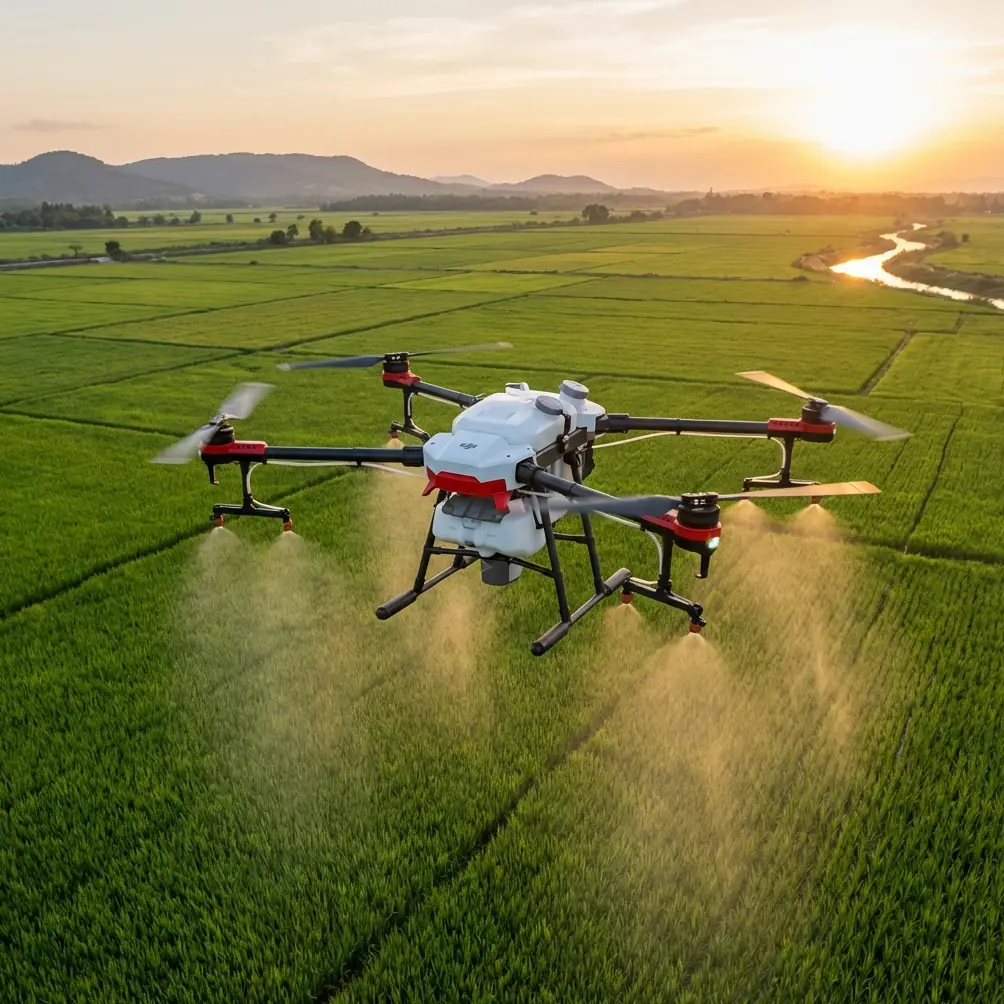
Agras T50 on Solar Farms in Complex Terrain: A Field Report Framed by What Earlier Relief Efforts Lacked
META: Expert field report on using the DJI Agras T50 for spraying solar farms in complex terrain, with practical insight on drift control, RTK precision, nozzle setup, and why modern UAV capability matters where access is hard.
I have spent much of my professional life studying how aerial systems change field operations not in theory, but in places where terrain decides what is possible. Solar farms built across ridgelines, cut slopes, rocky benches, and narrow access roads are exactly that kind of environment. They look orderly from a distance. Up close, maintenance work becomes a logistics problem.
That is why one recent reference stayed with me. A Chinese UAV industry piece looked back at Guizhou in 2008 and argued that if drones like today’s machines had existed then, disaster relief would not have been so difficult. Even with only that core statement available, the point is sharp. In mountainous regions, the real barrier is often not willingness or manpower. It is access. Moving people, liquids, equipment, and decision-making across broken ground costs time. Time becomes the bottleneck.
For readers evaluating the Agras T50 for solar farms in complex terrain, that historical contrast is useful. Not because a vegetation management mission at a solar site is the same as emergency response. It is not. The lesson is simpler and more practical: when roads are limited, slopes are awkward, and work has to be distributed over a large footprint, an aircraft changes the shape of the job.
Why the Guizhou comparison actually matters
The 2008 Guizhou reference suggests two things clearly. First, drones were not available or widely used there at that time. Second, the lack of that capability made relief work harder. Transfer that logic to solar O&M and you get a surprisingly direct operational analogy.
At many solar sites, ground teams face four recurring constraints:
- uneven terrain that slows vehicle access
- long row geometry that punishes manual repetition
- narrow maintenance windows due to weather and generation schedules
- the need to apply liquid accurately without contaminating equipment
On paper, spraying weeds or applying approved maintenance treatments around panel arrays sounds routine. In the field, the site can behave like a fragmented landscape. Sections that are only a few hundred meters apart may require a long detour by ground vehicle. Some rows sit on grades where a wheeled sprayer loses efficiency or cannot enter at all without soil damage. Once that happens, labor hours climb fast.
This is where the Agras T50 becomes interesting. Not as a generic “drone solution,” but as a machine that compresses the penalty of bad access. The same core idea implied in that Guizhou article applies here: aerial mobility reduces the friction created by terrain.
A field view of the T50 on solar sites
When people first consider the T50 for solar farms, they usually focus on throughput. That matters, but it is not the whole story. The more decisive advantage in complex terrain is controlled placement.
A solar farm is not an open paddy field. It is a dense technical environment. You are operating around table structures, inverter pads, drainage channels, cable crossings, fences, access tracks, and variable clearances beneath panel edges. Every one of those elements affects airflow, drift behavior, and route planning.
The Agras T50 fits this setting because the mission is less about broad-acre brute force and more about repeatable treatment in constrained geometry. In difficult topography, centimeter precision is not a marketing phrase. It is the difference between a pass that stays aligned with array corridors and one that begins to wander near posts, edges, or restricted zones.
That brings us to one of the most significant LSI concepts in this use case: RTK fix rate.
RTK fix rate is not a spec-sheet footnote
On a solar farm, especially one built over rolling or stepped terrain, consistent RTK performance directly affects route quality. A stable RTK fix supports centimeter precision in aircraft positioning, which helps maintain even line spacing and cleaner pass-to-pass overlap. Operationally, that means less missed vegetation between rows and less unnecessary double application.
Poor positioning consistency creates two kinds of waste. The first is chemical waste from overlap. The second is labor waste from rework. On sites where access is already complicated, rework is expensive because it often means returning to isolated sections, resetting routes, and exposing crews to another weather window.
That is why I tell operators to think of RTK fix rate as an agronomic and maintenance variable, not just a navigation variable. On solar farms, precision drives application quality. Application quality drives whether the site stays compliant, accessible, and safe for technicians.
Spray drift is the hidden issue on panel arrays
Many agricultural discussions of the T50 focus on coverage. At solar sites, spray drift often deserves equal or greater attention.
Panel arrays create a patchwork of wind effects. Airflow accelerates through row gaps, tumbles at structure edges, and behaves differently on slopes than it does over flat open ground. A treatment that looks stable in one corridor can shift unexpectedly two rows later. If drift is poorly managed, liquid can move onto module surfaces, electrical enclosures, access paths, or areas intentionally left untreated.
That makes drift control a first-order planning task.
The practical answer starts with route design and timing, but it does not end there. Nozzle calibration is essential. Operators who treat nozzle setup as a one-time checkbox usually struggle in complex terrain. Flow rate, droplet profile, flight speed, and height above target interact continuously. The goal is not merely to spray. It is to place droplets where they are needed despite the microclimate created by the solar infrastructure.
In my experience, the most reliable crews recalibrate whenever site conditions materially change. A south-facing slope in the late morning can behave differently from a shaded lower bench an hour later. Terrain exposure changes evaporation risk, drift tendency, and the effective swath width. That means swath width should be treated as an operationally verified field parameter, not an assumption copied from a flat-field mission.
Swath width on solar farms is usually narrower in practice
This point is worth emphasizing because it affects productivity calculations. In open agricultural plots, operators often think in terms of ideal swath width. At solar farms in complex terrain, the usable swath width is often constrained by row spacing, panel overhang, structural turbulence, and the need to keep deposition tightly bounded.
A narrower but more controlled swath is often the correct choice. Yes, it reduces theoretical area-per-hour figures. No, that does not mean the mission is less efficient. Real efficiency is measured by first-pass success, minimal drift, and low rework. If a broad pattern forces cleanup or missed strips, the operation was never truly productive.
The T50’s value appears when it can maintain disciplined coverage despite those constraints. That is the operational significance of combining stable positioning, route repeatability, and calibrated spray output. You are not trying to imitate a boom sprayer from the air. You are solving a different geometry problem.
Why IPX6K matters more than many buyers expect
Another detail that deserves attention in the solar-farm context is IPX6K. On paper, ingress protection can sound like a background durability feature. In practice, it matters every week.
Solar sites are dusty. Some are exceptionally dusty. Add fine particulate from service roads, residue from vegetation, occasional muddy staging areas, and repeated wash-down requirements, and the aircraft lives in a harsher maintenance environment than many first-time operators anticipate. An IPX6K-rated system is meaningful because routine cleaning is part of professional fleet care, not an occasional event.
That matters operationally in two ways. First, it supports uptime. Equipment that is easier to clean and maintain predictably is easier to keep mission-ready. Second, it supports reliability on remote sites where sending a machine back for avoidable contamination issues disrupts the entire treatment schedule.
Again, this connects back to the Guizhou lesson. When work is difficult because the environment is difficult, resilience is not a luxury. It is part of mission design.
The role of multispectral thinking, even when the T50 mission is spraying
The keyword “multispectral” often enters this conversation indirectly. The T50 itself may be discussed primarily as an application platform, but solar-farm spraying should not be planned in isolation from site intelligence.
If a team uses multispectral or other remote sensing workflows to distinguish vigorous regrowth, moisture-retaining zones, erosion-prone strips, or recurring weed corridors near drainage lines, the spraying mission becomes more selective and more strategic. That is especially useful in complex terrain, where problem areas are rarely distributed evenly.
I encourage operators to think beyond blanket application logic. The better your aerial or geospatial diagnosis, the more intelligently the T50 can be deployed. That means fewer unnecessary passes and a tighter connection between treatment effort and site condition.
What changed since 2008 is bigger than the aircraft itself
The Guizhou reference is fundamentally about capability absent at a critical moment. The aircraft matters, of course. But the deeper shift is that modern UAV operations now combine mobility, precision, and repeatability in one field tool.
In 2008, according to the reference’s framing, having such drones could have made disaster relief less difficult. That idea reflects more than simple airborne presence. It reflects the ability to reach hard areas quickly and work without depending entirely on damaged or limited ground access.
For solar farm maintenance in rough terrain, that same operational principle applies in a civilian commercial context. The T50 lets crews bypass some of the friction imposed by steep grades, poor access roads, and fragmented site layout. It does not eliminate planning. It raises the value of good planning.
That distinction matters. Advanced aircraft do not rescue weak operating discipline. They amplify strong discipline. If drift control is sloppy, if nozzle calibration is ignored, if RTK setup is inconsistent, the machine’s capability is wasted. But when the workflow is rigorous, the T50 can turn a site that once required awkward, slow, ground-heavy intervention into a controlled aerial maintenance program.
A practical deployment model for complex solar terrain
For teams evaluating adoption, I generally recommend a field workflow built around five stages:
1. Terrain and obstacle segmentation
Break the site into treatment zones based on slope, array spacing, exposure, and access limitations. Do not plan the entire solar farm as one uniform spraying surface.
2. RTK validation before productivity targets
Confirm stable RTK fix behavior first. Precision is foundational. Throughput estimates made before positioning confidence are usually misleading.
3. Nozzle calibration by zone, not only by day
Different site sections may justify different settings due to wind channeling, row geometry, and vegetation density.
4. Conservative swath width near sensitive infrastructure
Where arrays, inverters, fencing, or drainage edges create higher drift risk, reduce ambition and prioritize deposition control.
5. Post-mission review using site intelligence
Cross-check treated areas against imagery, maintenance observations, and regrowth patterns. This is where multispectral thinking can improve the next cycle.
This kind of workflow is not glamorous. It is effective. And effectiveness is what matters when vegetation pressure, access difficulty, and maintenance windows all collide.
The real reason the T50 fits this reader scenario
If your reader scenario is spraying solar farms in complex terrain, the Agras T50 is compelling for one reason above all: it changes where effort is spent.
Without aerial application, too much effort goes into reaching the work area, maneuvering around the site, and compensating for terrain. With a properly deployed T50 program, more effort can go into application accuracy, safety margins, and schedule control. That is the reallocation that creates value.
The historical reference to Guizhou in 2008 gives this a human frame. Work becomes “hard” for many reasons, but in rugged environments the common denominator is often the same: the ground resists you. Modern UAV systems do not magically simplify every task. They reduce the penalty of hostile terrain.
That is exactly why the T50 deserves serious consideration for solar O&M teams managing large sites across difficult topography.
If you are comparing route strategy, nozzle setup, or site-specific operating questions, I suggest sending your field parameters through this direct Agras T50 planning channel: https://wa.me/85255379740
Ready for your own Agras T50? Contact our team for expert consultation.