
Agras T50 for Urban Power-Line Spraying: Flight Height
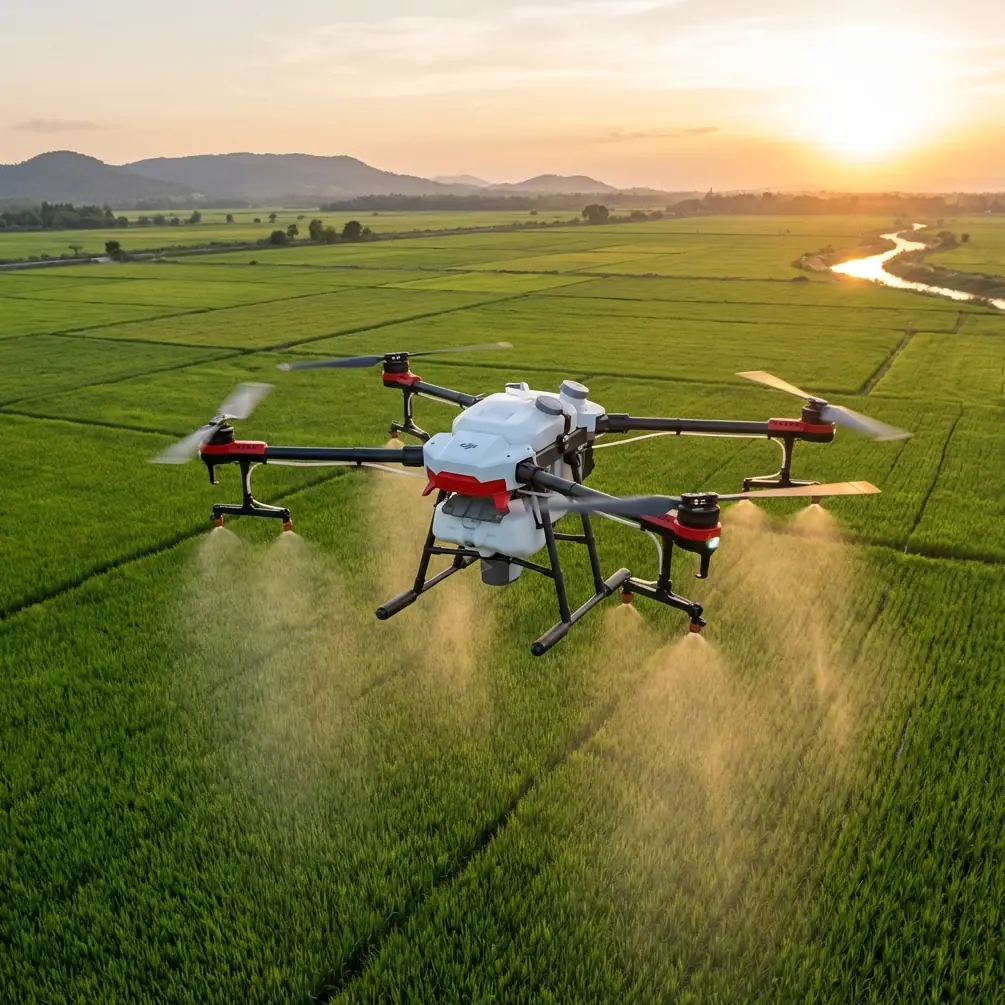
Agras T50 for Urban Power-Line Spraying: Flight Height, Drift Control, and the Training Discipline That Actually Matters
META: A practical expert tutorial on using the Agras T50 for urban power-line spraying, with focus on optimal flight altitude, spray drift control, nozzle calibration, RTK precision, and pilot training habits.
Urban power-line spraying is one of those jobs that looks straightforward until the aircraft is in the air. Then the real constraints show up all at once: narrow corridors, unpredictable air movement around buildings, conductive infrastructure nearby, vegetation density that changes pole to pole, and almost no tolerance for overspray.
That is exactly why the Agras T50 deserves a more serious discussion than a feature roundup.
For this kind of mission, the central question is not simply whether the drone can carry enough liquid or cover enough ground. The real question is whether the aircraft can deliver controlled, repeatable deposition along utility corridors where a few meters of bad altitude management can turn a clean treatment pass into drift, runoff, or missed target zones.
This article focuses on that operational issue: optimal flight altitude for urban power-line spraying with the Agras T50, and why altitude only works when it is tied to aerodynamics, control discipline, and calibration practice.
Why flight altitude is the first decision, not the last
In open farmland, altitude can often be adjusted for efficiency first and canopy penetration second. In urban utility work, that order flips. Your flight height determines three things immediately:
- How much rotor wash disturbs the spray pattern
- How long droplets remain exposed to crosswind and turbulence
- How safely and consistently the aircraft can track around poles, lines, and nearby structures
Agras T50 operators often talk about swath width and throughput. Those matter, but in urban spraying they are downstream effects. Height sets the conditions that make the rest of the spraying system behave properly.
Fly too high, and drift risk rises because droplets stay airborne longer and are exposed to more lateral movement. Fly too low, and the downwash can distort deposition, especially around vertical assets like poles, insulators, and vegetation clustered beneath lines. The best altitude is usually the lowest height that still preserves a stable spray field, obstacle margin, and reliable route tracking.
That sounds simple. It is not.
Urban utility corridors generate local airflow distortions that act more like narrow wind tunnels than open-air fields. The wrong height may produce acceptable results in one block and poor results in the next.
The aerodynamic reason altitude matters more near infrastructure
A useful way to think about the T50 in this scenario comes from basic flight physics rather than product marketing.
One of the reference materials explains lift through pressure difference: when airflow moves faster over a shaped upper surface, pressure drops, and that pressure difference contributes to lift. It also uses a pipe analogy: in a narrowing section, flow speeds up; where flow is faster, pressure is lower.
That principle is directly relevant to spraying near power-line corridors in urban environments.
Around poles, crossarms, transformer structures, walls, and tree lines, air does not move uniformly. It accelerates through tighter gaps, slows in wider pockets, and curls behind obstacles. In practice, that means the drone is not releasing droplets into a calm, consistent atmosphere. It is releasing them into a patchwork of microflows. Some sections behave like the “narrow pipe” in the reference text, where faster-moving air can carry droplets farther than expected. Other sections create recirculation and uneven deposition.
Operational significance: a flight altitude that seems safe over a clear verge can become too high near a constricted streetside corridor because the droplets spend more time in disturbed air. Lowering altitude moderately can shorten droplet exposure time and improve target capture, provided the downwash is not excessive.
That is why the “optimal” height for Agras T50 power-line spraying in urban areas is rarely a fixed number copied from broad-acre work. It is a controlled envelope, adjusted to corridor geometry, vegetation height, and wind behavior at the structure level.
A practical altitude rule for urban power-line spraying
If the goal is herbicide or vegetation treatment beneath and alongside urban power lines, the best starting point is to fly as low as the aircraft can safely and smoothly maintain above the target vegetation while keeping a conservative stand-off from poles, line hardware, and uneven terrain.
Not low for speed. Low for containment.
The target is a stable spray band, not a dramatic swath. In utility corridors, a narrower, cleaner pass is often operationally better than pushing width and then dealing with drift complaints or retreatment.
Here is the practical insight: for urban power-line spraying, the sweet spot is usually a low-altitude pass that keeps the nozzle output close enough to the target to reduce airborne travel time, but high enough that rotor wash does not blast droplets off the treatment zone. That balance must be validated on site with water-sensitive paper or a comparable deposition check, not guessed from a menu setting.
Nozzle calibration becomes critical here. If output rate, droplet size behavior, and speed are not aligned, altitude adjustments alone will not rescue the pattern.
Nozzle calibration is what turns a good height into good coverage
A lot of operators blame drift on wind and forget the machine-side variables. In urban utility work, nozzle calibration is often where the real improvement comes from.
At low altitude, even a small mismatch in flow rate or atomization behavior shows up quickly. You may see:
- heavy deposition directly under the aircraft
- weak edge coverage
- bounce-off from hard surfaces
- inconsistent treatment around pole bases or fence-line vegetation
Calibration is not just about volume. It is about matching droplet behavior to corridor conditions. The closer you operate to buildings, parked vehicles, sidewalks, and ornamental planting, the less room you have for vague spray tuning.
This is where the T50’s operational value shows up. A platform used in commercial spraying has to hold a stable route, maintain predictable output, and repeat passes with minimal deviation. If your RTK fix rate is strong and the aircraft is tracking with centimeter precision, you gain a real advantage: less overlap uncertainty and fewer “just to be safe” correction passes that increase drift exposure.
Operational significance: high RTK reliability reduces over-application risk in narrow urban corridors. In power-line spraying, repeatability matters almost as much as raw deposition quality, because double coverage near sensitive edges can create visible and regulatory problems.
Why centimeter precision matters more in the city than in the field
The phrase “centimeter precision” gets used casually, but urban spraying is one of the few environments where it has immediate practical meaning.
In a farm block, a small lateral deviation may only create slight overlap. Under urban power lines, that same deviation can push spray toward a roadside verge, garden edge, drainage path, or pedestrian-facing area. The difference between a neat corridor pass and a messy one is often measured in very small offsets.
This is why RTK fix rate should be monitored as an operational health metric, not treated as a background technical spec. If fix quality degrades, the pilot should think beyond navigation confidence and ask a spraying question: does this corridor still justify application right now?
A high-accuracy route is especially valuable when you are working a segmented utility line with repeated poles, variable clearances, and stop-start geometry. Consistent pass placement also improves post-job documentation, which utility and vegetation-management contractors increasingly need.
The training lesson most T50 operators skip
One of the reference documents on remote-control flight training makes a point that deserves wider use in professional UAV work: daily training beyond one hour tends to create fatigue and reduce the ability to repeat precise movements cleanly. It also argues that one hour per day is often the most effective training block.
That was written for model aircraft skill development, but the insight transfers neatly to Agras T50 operations.
Urban power-line spraying is precision work. It is mentally dense. The pilot is processing route alignment, obstacle awareness, spray activation logic, wind shifts, vehicle movement below, and corridor geometry in real time. After prolonged sessions, control quality drops in ways that are hard to notice from the pilot’s perspective but obvious in the results: more corrections, rougher line holding, and late responses around clutter.
Operational significance: for T50 crews doing urban spraying, shorter structured proficiency sessions often beat marathon practice days. If you want better control smoothness and less accidental overcorrection, train in focused blocks.
The same document also recommends increasing the controller stick’s return spring tension and using a more stable finger placement for finer feedback. That might sound small, but it has real relevance for T50 pilots. In tight utility corridors, accidental cross-inputs are not a minor nuisance. They can shift the aircraft laterally just enough to disturb the spray line or force a corrective maneuver at the wrong moment.
A refined hand position and stronger centering feel help reduce unintended inputs. On a large agricultural platform working in a sensitive urban corridor, that is not a hobbyist detail. It is part of risk control.
A better way to evaluate spray quality in utility corridors
Another useful training idea from the reference material is that the quality of a maneuver can be judged by how much correction is needed before the next action. That concept adapts well to spraying.
For Agras T50 urban power-line work, one pass should be judged partly by the amount of correction needed before the next pass begins. If each run ends with heavy alignment fixes, abrupt braking, or sideways repositioning, the route plan or altitude is probably wrong. Smooth transitions usually indicate that the aircraft is operating inside a manageable corridor envelope.
That matters because rough pass transitions often coincide with the worst deposition irregularities:
- overlap spikes at turn-in points
- missed strips near obstacles
- drift from late spray shutoff
- inconsistent speed over the target zone
A clean operation should feel almost uneventful. If the pilot is fighting the aircraft, the spray pattern is probably fighting physics too.
Weather resistance is not a license to spray carelessly
The T50 is often discussed in terms of robust field readiness, and an IPX6K-class weather-resistance profile is relevant for commercial crews who work in dirty, wet environments. For utility spraying, that durability matters because job sites rarely offer pristine conditions. Dust, splash, chemical exposure, and frequent washdowns are part of the reality.
But durability should not be mistaken for environmental immunity. Urban drift problems are usually caused by airflow and decision-making, not by whether the aircraft can tolerate a harsh washdown after the job.
Ruggedness helps maintain uptime. It does not replace site judgment.
Where multispectral does and does not fit this scenario
Multispectral tools are useful in broader vegetation programs, especially where utilities want more informed maintenance planning instead of uniform treatment. But for direct urban power-line spraying, multispectral is usually secondary to three simpler variables: target identification, altitude discipline, and application accuracy.
If multispectral data is available, it can help distinguish stress patterns or prioritize sections of a corridor. Still, once the T50 is on site and spraying, the outcome depends far more on execution than on remote sensing layers. Treat multispectral as a planning aid, not a substitute for calibration and controlled flying.
A field workflow that works
For crews preparing an Agras T50 for urban power-line spraying, a disciplined sequence is more valuable than improvisation:
- inspect corridor geometry and identify airflow traps such as walls, narrow gaps, embankments, and dense shrub clusters
- confirm RTK stability before relying on tight route placement
- calibrate nozzles for the actual application setup, not a remembered profile
- start with a conservative low-altitude test pass
- check deposition before scaling up the route
- watch how much correction is needed at the end of each pass
- if alignment is messy, rethink height or speed before continuing
If you want help thinking through that setup in a real-world workflow, this Agras T50 urban spraying planning chat is a practical place to start.
The core takeaway for Agras T50 urban power-line spraying
The best flight altitude is not the one that looks efficient on paper. It is the one that produces stable deposition with the fewest corrections in a corridor full of obstacles and disturbed air.
The references behind this discussion point to two deeper truths. First, airflow changes pressure and behavior in ways that directly affect both aircraft stability and droplet movement. Second, precise control degrades under fatigue and improves with disciplined technique. Put those together, and the message for Agras T50 operators is clear: urban utility spraying is won through low-drama precision.
Keep the aircraft close enough to the target to limit drift exposure. Calibrate nozzles instead of guessing. Treat RTK fix rate as a spraying variable, not just a navigation one. And train in focused blocks, because fine control is easier to preserve than to recover.
That is how the T50 becomes more than a large spray platform. It becomes a controlled tool for a difficult civilian job.
Ready for your own Agras T50? Contact our team for expert consultation.