
Agras T50 in Steep Utility Corridors: A Field Report
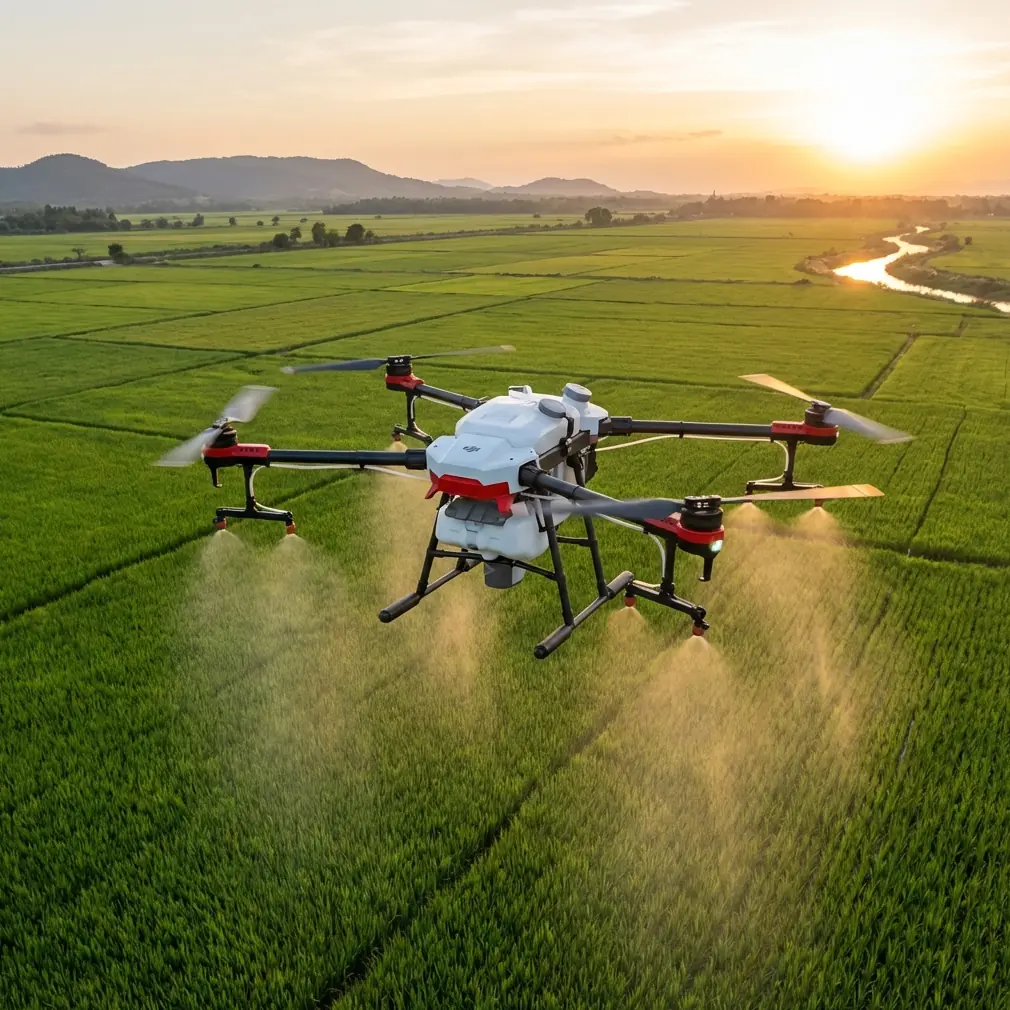
Agras T50 in Steep Utility Corridors: A Field Report on Spraying Power Lines with Better Positional Discipline
META: A practical field report on using the DJI Agras T50 for spraying power lines in complex terrain, with operational insight on precision, drift control, mapping workflow, and why geotagged field data matters.
Power-line vegetation work looks simple from a distance. It is not. Once the corridor cuts across ridges, broken slopes, access roads, drainage channels, and irregular tree lines, the aircraft stops being just a spray platform and starts becoming a navigation, documentation, and consistency problem.
That is where the Agras T50 becomes interesting.
Most discussions around the T50 stay broad: tank size, productivity, ruggedness, the usual headline points. For utility corridor work in difficult terrain, those summaries miss the real story. What matters is whether the aircraft can hold a stable line where GNSS quality fluctuates, maintain a predictable swath in cross-slope air movement, and leave behind evidence that the work happened where it was supposed to happen. On those three fronts, the T50 fits the job unusually well when the operation is structured correctly.
Why power-line spraying is harder than a standard farm pass
A row-crop field rewards repetition. A transmission corridor punishes assumptions.
The vegetation under and beside power lines rarely presents a uniform canopy. Height changes quickly. Wind behaves differently near towers, cut banks, and narrow valleys. The operator is not simply covering hectares. They are trying to treat a constrained strip without excessive drift into adjacent vegetation, waterways, roads, or infrastructure. In practical terms, that makes nozzle calibration and positional confidence more valuable than raw throughput.
This is also why centimeter-level positioning matters more here than in a broadacre block. When a utility contractor says a section was treated, they may need to show exactly where the aircraft flew, where sample photos were taken, and how those points relate to the corridor map. An RTK fix rate that stays dependable through broken terrain is not just a nice technical metric. It is the difference between repeatable corridor passes and a flight record full of uncertainty.
Where the T50 separates itself
The T50’s advantage in this kind of work is not one isolated feature. It is the way its core platform traits support disciplined spraying in awkward places.
Start with aircraft stability and route consistency. On utility corridors, every deviation changes deposition. A small lateral shift can move droplets from target brush to non-target vegetation, especially when operators are trying to stay parallel to a line that curves with the land. Compared with lighter agricultural platforms that can feel nervous over uneven terrain, the T50 is generally better suited to carrying momentum through a demanding route while still reacting accurately to operator inputs and terrain-following demands.
Then there is weather exposure. Utility work does not happen in a pristine test field. Dust, moisture, residue, and splash from roadside access points are all normal. An IPX6K protection rating matters because these aircraft are expected to return day after day to dirty, wet, abrasive environments. That rating does not make the machine invincible, but it does align with the reality of corridor operations where cleanliness is managed, not guaranteed.
The other differentiator is the aircraft’s ability to support precision-first workflow rather than brute-force coverage. That sounds abstract until you are standing on a hillside trying to treat a narrow growth band under conductors without washing the adjacent slope in fine droplets. In those conditions, swath width is not something you maximize blindly. It is something you shape around terrain, target density, and wind behavior.
The T50 is only as good as its spray discipline
This is where experienced operators either make the aircraft look exceptional or mediocre.
On power lines, spray drift is the first operational risk to manage. The temptation is to chase output, widen the swath, and keep moving. That approach often fails in broken terrain because air does not move uniformly along a corridor. You can have one section sheltered by a slope and another section, 80 meters later, exposed to a crosswind funneling through a gap. A T50 with poor nozzle calibration will still fly beautifully while producing inconsistent deposition.
That is why nozzle calibration deserves more attention than many teams give it. The goal is not just “spraying.” The goal is matching droplet behavior to the corridor environment. If your pattern is too fine, the line may look covered in the log while the herbicide lands somewhere else. If the pattern is too coarse, canopy penetration and coverage uniformity can suffer on mixed brush.
The T50 gives the operator enough platform capability that setup errors become more visible. In other words, the machine is rarely the limiting factor. Field discipline is.
Mapping and evidence: the overlooked half of utility spraying
One of the more useful ideas from the reference material has nothing to do with an agricultural drone model directly, but it has everything to do with how T50 corridor jobs should be documented.
In an ArcGIS-based crop survey workflow, the “GeoTagged Photos To Points” tool in ArcMap can automatically read GPS information from field photos and write each image into a point layer. It can also store the photo as an attachment in a File GDB database, where the image can later be opened through an HTML popup. That may sound like GIS housekeeping. In utility corridor work, it is operationally significant.
Here is why.
When a crew treats vegetation beneath power lines in complex terrain, they often need before-and-after records, sample-point verification, and a way to tie field observations to mapped sections. Using geotagged photos converted into point features creates an auditable corridor record. A supervisor can click a point, open the original image, and verify what the crew saw at that location. If the output is stored in a File GDB rather than a shapefile, the photo attachment capability remains intact. That specific detail matters because shapefiles do not support the same attachment workflow.
This is not academic. It solves a real accountability problem.
Imagine a 69th parcel or work segment along a long corridor route. The reference material describes opening a thumbnail in an information window to view the high-resolution original image. For a T50 contractor, that same style of workflow can support treatment verification, vegetation classification, and post-job reporting without relying on memory or informal phone albums. You are building a location-based evidence trail.
And there is another important insight in the ArcGIS document: even when you zoom into orthomosaic imagery, you still may not be able to identify a crop reliably by leaf detail alone. That is exactly the kind of reminder utility spray teams should respect. Remote imagery has limits. Ground-truth sample points still matter. If your corridor includes mixed vegetation types that respond differently to treatment, field photo points help prevent office-side assumptions from becoming application errors.
What this means for T50 corridor planning
A serious T50 power-line workflow should combine three layers:
- A precise route framework using RTK-supported flight planning and repeatable corridor segmentation.
- A spray setup protocol focused on nozzle calibration, drift management, and terrain-adjusted swath width.
- A geotagged evidence layer using sample photos tied to GIS points for verification and reporting.
That third layer is where many operators can outperform competitors.
Lots of crews can say they sprayed a utility line. Fewer can show mapped sample points with attached high-resolution images, linked to exact treatment sections, and backed by consistent flight logs. For contractors bidding on repeat utility work, that level of documentation can quietly become a decisive advantage.
If you are building that kind of workflow around the T50 and want a technical discussion rather than a generic brochure pitch, this direct WhatsApp line for utility drone questions is a sensible place to start.
The role of multispectral thinking, even if the spray aircraft is the star
The T50 is the application platform, but corridor decision-making gets better when teams think beyond spraying alone.
Multispectral analysis can help identify vegetation vigor differences, regrowth patterns, and treatment priority zones across long utility routes. Even if the T50 is not the sensor aircraft in your workflow, a multispectral reconnaissance layer can improve where and how you deploy it. In steep or fragmented terrain, that can reduce unnecessary passes and tighten treatment boundaries.
This matters because utility vegetation management is rarely one clean event. It is a cycle. You inspect, classify, treat, verify, and revisit. The strongest T50 operations sit inside that wider system. They are not just flight operations; they are corridor management programs.
What operators should watch in the field
The T50’s strengths show up clearly in difficult corridor work, but only if the operator pays attention to the variables that actually move the outcome.
1. RTK fix stability
A strong RTK fix rate supports repeatable lines and cleaner overlap control. In utility corridors, especially near terrain breaks, positional jumps can show up as missed strips or drift toward off-target zones. Watch the quality of your positioning continuously, not just at takeoff.
2. Swath width discipline
Do not use one swath width across the entire corridor because it looked efficient on the first segment. Narrow sections, crosswinds, and uneven vegetation density may justify a tighter pattern. Better controlled deposition usually beats headline productivity.
3. Drift exposure near structures and slope changes
Power-line routes create localized airflow. Tower areas, cuts, and open saddles can change droplet movement quickly. The T50 can carry the mission load, but the operator still needs to adjust speed, altitude, and pattern behavior to match micro-conditions.
4. Post-flight documentation
If a job matters enough to fly, it matters enough to document correctly. Geotagged sample images, stored in a GIS-friendly structure, make later reporting far easier. The ArcMap workflow from the reference is a practical reminder that field photos become much more valuable when they are spatial records rather than loose files.
A smarter benchmark for judging the T50
Too many comparisons between agricultural drones are shallow. Bigger, faster, more payload, end of story.
For power-line spraying in complex terrain, a better benchmark is this: which aircraft lets a contractor maintain application quality, positional confidence, and defensible records when the corridor stops behaving like a field?
That is where the Agras T50 stands out.
Its platform robustness, precision-oriented workflow potential, and compatibility with disciplined GIS-backed reporting make it better suited than lighter, less stable competitors for utility-adjacent vegetation treatment. Not because it breaks the laws of physics. Because it gives a skilled crew more control where control actually matters.
And that is the right way to evaluate a spray aircraft for utility corridors. Not by the easiest pass of the day, but by the ugly section on the hillside where drift risk rises, access gets worse, and the documentation requirement gets stricter.
The T50 is not magic. It is a serious tool. In the hands of a crew that understands nozzle behavior, centimeter precision, and map-linked field verification, it becomes a very effective one.
Ready for your own Agras T50? Contact our team for expert consultation.