
Agras T50 in Extreme Temperatures: What Battery Science
Agras T50 in Extreme Temperatures: What Battery Science and Precision Flight Training Actually Mean for Highway Spraying
META: A field-focused look at Agras T50 for highway spraying in extreme temperatures, linking battery energy density advances, precision route control, drift management, nozzle calibration, and rugged operations.
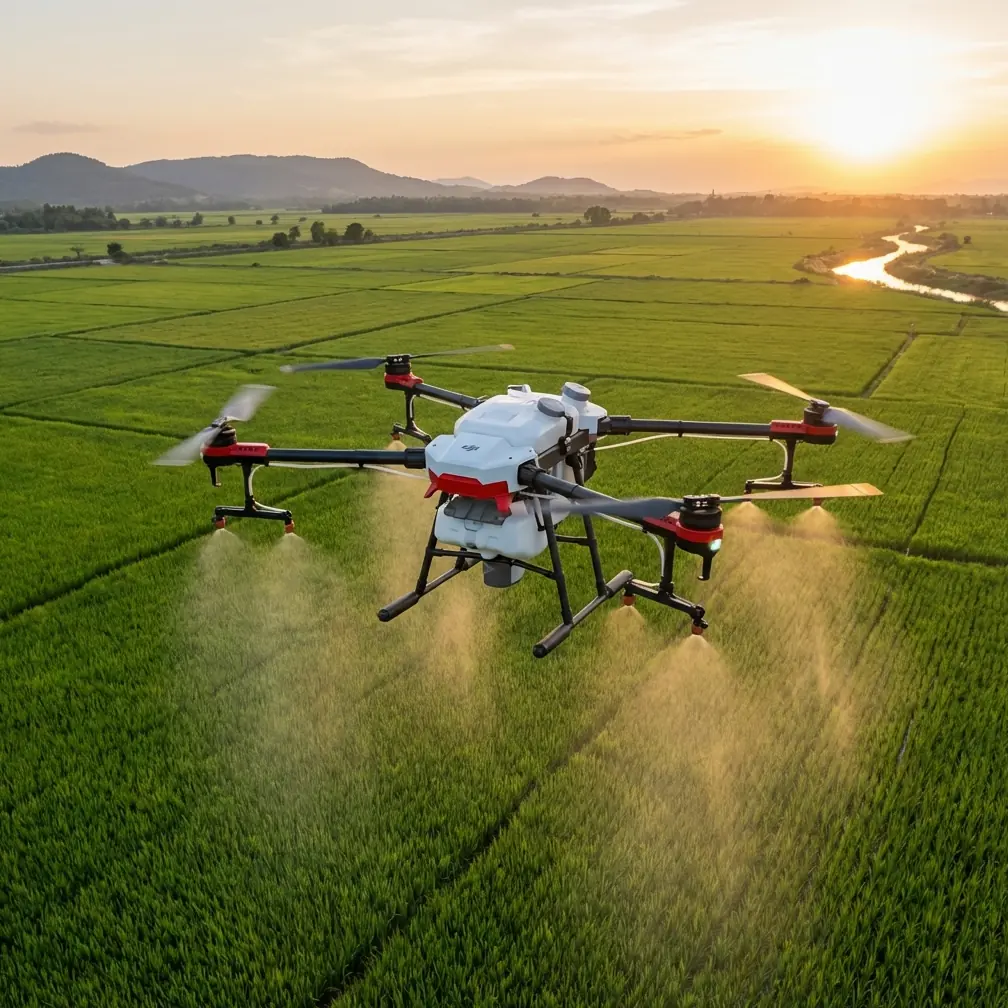
Highway spraying is a strange corner of agricultural aviation. It borrows from crop protection, infrastructure maintenance, and industrial inspection all at once. The Agras T50 sits right in that overlap. On paper, it is a spray platform. In practice, when crews are working long roadside corridors in heat, wind, and temperature swings, the machine becomes a system problem: endurance, route precision, drift control, nozzle behavior, and turnaround speed all matter at the same time.
That is why the most interesting recent development around drones is not a new airframe at all. It is battery chemistry.
A team led by Associate Professor Zhou Guangmin at Tsinghua University Shenzhen International Graduate School proposed a functional molecule design method for lithium-sulfur batteries. The description coming out of that work is unusually vivid: building functional molecules like molecular blocks rather than staying locked into older battery material design habits. The headline claim is the one operators care about immediately—energy density can potentially double.
For an Agras T50 crew spraying highways in extreme temperatures, that is not a lab curiosity. It points directly at the industry’s most stubborn operating pain: endurance anxiety.
Why endurance matters more on highways than many teams expect
Field spraying usually allows a certain rhythm. Loads are planned, refill points are set, and the work area is relatively compact. Highways are different. A corridor job stretches linearly, often with fragmented access points, changing wind exposure, and more transit between treatment segments. Every forced battery swap or return-to-base cycle introduces three penalties:
- Lost productive spray time
- More opportunities for route deviation or skipped sections
- Greater drift risk if work pushes later into worsening thermal or wind conditions
A higher-energy-density battery does not just mean “longer flight.” It changes mission design. If lithium-sulfur development really delivers the kind of uplift suggested by the Tsinghua research, a future highway spray mission could cover longer segments per sortie, reduce interruptions, and maintain tighter consistency across an entire corridor.
That consistency matters because roadside vegetation management is often less forgiving than broad-acre work. Guardrails, drainage channels, signposts, embankments, and nearby traffic infrastructure create micro-environments where airflow becomes messy. When conditions are already extreme—high surface temperatures, sudden gusts, or cold-weather viscosity shifts in spray liquid—crews need the aircraft to spend more of its battery budget on controlled application, not on deadhead travel.
Extreme temperatures expose the hidden weaknesses in a spray mission
The phrase “spraying in extreme temps” gets used casually, but temperature stress enters the operation through several different doors.
Battery performance is the obvious one. Capacity, discharge behavior, and cycle confidence all shift with temperature. But the less discussed issue is that temperature also affects the spray itself. Droplet formation changes. Viscosity can shift. Evaporation risk rises. Drift behavior can worsen before the operator even realizes the plume has changed shape.
That is why nozzle calibration becomes central on an Agras T50 highway job. In mild conditions, a small calibration error may be tolerable over a short run. In extreme heat or cold, the same error can compound over distance. A machine with strong payload capability still depends on exact fluid delivery. If the target is roadside vegetation rather than a broad crop canopy, overapplication and underapplication both become expensive mistakes.
This is where good operators stop thinking only about throughput and start thinking in layers:
- nozzle calibration relative to liquid properties and ambient temperature
- swath width relative to roadside geometry
- flight speed relative to deposition quality
- drift behavior relative to traffic-side turbulence
- RTK fix rate relative to repeatable pass placement
The Agras T50 is most useful when those layers are tuned together.
Precision is not a marketing feature; it is a drift-control tool
One of the most useful reference points in the source material comes from an educational DJI TT drone exercise, not from a heavy-lift platform. The program example describes a drone taking off, climbing to 150 centimeters, following a planned route, pausing 1 second at the end, and landing. Another exercise explains how challenge cards placed at a start point, end point, and between route segments allow the drone to use coordinates for precise flight and automatically return to the start.
At first glance, that looks far removed from a highway spraying mission. It is not.
Those educational drills capture the core operational logic behind safe corridor work: precise route initiation, controlled altitude, waypoint discipline, and deterministic return behavior. The scale changes on the Agras T50, but the principle does not. Highway spraying in difficult temperatures is won by repeatability. If the aircraft can maintain centimeter precision with a strong RTK fix rate, each pass becomes less dependent on pilot improvisation and more dependent on a reliable geometry of application.
That has two direct benefits.
First, it reduces overlap and misses. On a long roadside segment, tiny deviations add up. A few decimeters off line is enough to alter deposition near barriers, culverts, or slope edges.
Second, it supports drift management. When pass spacing and altitude are stable, the operator can make cleaner decisions about droplet size and swath width. If route accuracy is inconsistent, crews often compensate by widening margins or changing application behavior in ways that reduce efficiency.
In other words, centimeter precision is not just about navigation. It is about making spray behavior predictable.
What the “10 times” inspection lesson teaches highway spray teams
Another source detail deserves attention. The training material notes that drone inspection efficiency can reach 10 times that of manual work in scenarios such as roads, rivers, reservoirs, and lakes. Although that statement refers to patrol and inspection, not chemical application, the operational lesson still holds: corridor work rewards automation disproportionately.
Highway spraying benefits from the same logic. Repeated, preplanned route execution produces far more than labor savings. It compresses the uncertainty window. In extreme temperatures, shortening the time crews are exposed to unstable application conditions is itself a quality advantage.
That is especially useful when combining treatment with pre-spray or post-spray visual checks. A team that already thinks like corridor inspectors will usually perform better with the Agras T50 than a team that treats the job like a simple field spray mission. The reason is straightforward: highways are route problems first and spray problems second.
Spray drift on highways is a systems issue, not just a weather issue
Many discussions of spray drift stop at wind speed. That is too simplistic for roadside work.
Highway environments generate localized turbulence from terrain cuts, vehicle movement, sound barriers, tree lines, and hard reflective surfaces. The downwash from the drone can be an advantage when managed correctly because it helps deposition onto plant surfaces. The training source on plant protection points out that rotor-driven airflow supports open mist application, helping droplets adhere evenly to both sides of leaves and to stems. That observation is operationally significant for the Agras T50 because roadside vegetation is often irregular, layered, and hard to penetrate uniformly from ground equipment.
But downwash is not a free pass. In hot conditions, small droplets can still evaporate or move off-target quickly. In colder conditions, liquid characteristics can alter atomization quality. So the real drift question becomes: how do you preserve the deposition benefits of rotor airflow while controlling off-target movement?
That usually means tightening the relationship between:
- nozzle calibration
- droplet spectrum selection
- flight altitude
- speed over ground
- swath width
- ambient thermal behavior
The Agras T50 can be highly effective here, but only if the operator treats the aircraft as part of an application system rather than a flying tank.
Why ruggedization matters when the work is ugly
Highway maintenance conditions are rarely clean. Dust, splashback, residue, roadside moisture, and constant loading cycles punish equipment. That is why an industrial-grade expectation such as IPX6K matters in the conversation, even before one discusses productivity. In real corridor operations, crews cannot afford a platform that becomes fragile when the environment turns dirty or the weather shifts unexpectedly.
A ruggedized spray drone is not simply more durable. It is more trustworthy in the narrow windows when treatment conditions are acceptable. Extreme temperatures already squeeze the day. If the platform also demands delicate handling or frequent interruption, useful work time collapses fast.
The accessory question: small upgrades, big operational effect
The prompt asks for mention of a third-party accessory that enhanced capabilities, and this is worth addressing carefully. On highway spraying projects, one of the most practical additions is a third-party portable weather and drift monitoring kit mounted into the field workflow rather than the aircraft itself. It does not change the Agras T50 mechanically, but it can materially improve decision-making on when to shorten swath width, revise route timing, or pause for thermal instability.
That kind of accessory sounds minor compared with batteries or RTK, yet its effect is outsized in extreme temperatures. It gives crews a local, continuously updated read on conditions instead of relying on distant forecasts that may not reflect roadside heat buildup or terrain-driven wind behavior.
If your team is evaluating suitable add-ons and workflow integration for corridor spraying, this field coordination channel is a practical place to discuss compatible setups.
Battery science could change how the T50 is deployed, not just how long it flies
The Tsinghua lithium-sulfur work deserves one more look because its implications go beyond minutes in the air.
If higher energy density becomes practical at scale, spray drone design and operations may shift in at least four ways:
1. Longer productive segments per sortie
This is the obvious gain. Fewer interruptions mean more stable application over long roadside runs.
2. Better reserve margins in temperature-stressed conditions
Extreme heat and cold both complicate mission confidence. More energy headroom allows operators to stay conservative without sacrificing too much area coverage.
3. Greater flexibility for sensor-enhanced workflows
If a future Agras-class platform carries more energy, operators can allocate some of that margin to route verification, imaging, or multispectral support in mixed vegetation management workflows.
4. Reduced operational friction
Every battery event is a handling event, a scheduling event, and a safety event. Reducing the count improves the whole job, not just flight time.
This is why the battery story matters so much for the Agras T50 audience. Spray performance is usually discussed through pumps, nozzles, and payload. Yet endurance determines how often all of those subsystems get to work under ideal conditions before the aircraft has to disengage.
The real takeaway for Agras T50 highway spraying
The strongest Agras T50 operations in extreme temperatures will not come from one breakthrough alone. Not a bigger tank. Not a more aggressive spray rate. Not even a better battery by itself.
They will come from combining three disciplines:
- energy confidence, potentially transformed by advances such as lithium-sulfur chemistry
- route precision, supported by strong RTK fix rate and repeatable corridor logic
- application control, especially around spray drift, swath width, and nozzle calibration
The reference material points in exactly that direction. Tsinghua’s “molecular block” approach suggests a future where drone endurance is constrained less by chemistry. The DJI TT training examples show how disciplined programmed flight, coordinate-based navigation, and automatic return behaviors underpin reliable corridor operations. The plant protection lesson reminds us that rotor airflow can improve droplet adhesion on both leaf surfaces and stems, which is highly relevant when treating irregular roadside vegetation. Even the inspection example claiming up to 10 times human efficiency highlights the value of automation for route-based work.
Put together, those are not random facts. They describe a maturing operating model for machines like the Agras T50.
Highway spraying in extreme temperatures is not simply about whether the drone can fly. It is about whether the aircraft can maintain accurate, repeatable, low-drift application through a harsh and variable corridor while keeping enough energy in reserve to stay disciplined. That is where the next gains will be found.
Ready for your own Agras T50? Contact our team for expert consultation.