
Agras T50 in Windy Conditions: A Field Report on Drift
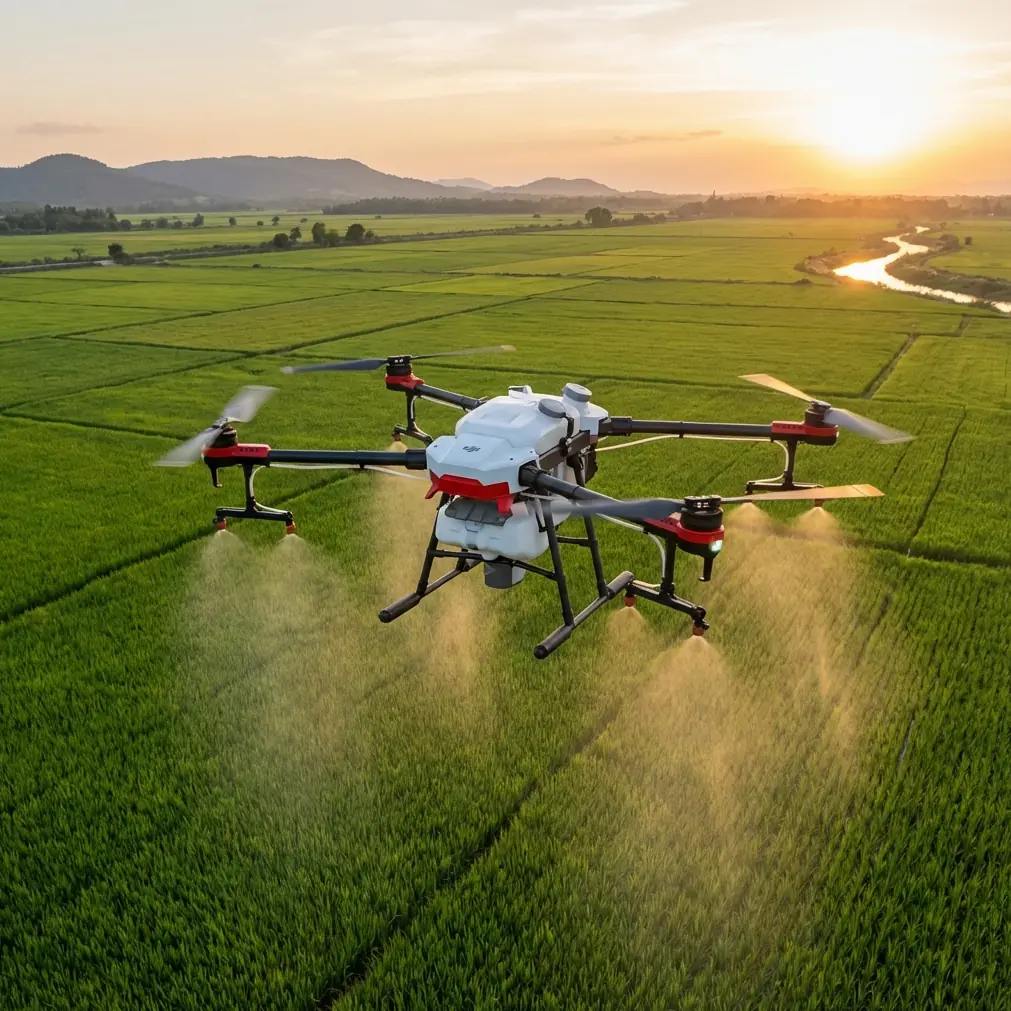
Agras T50 in Windy Conditions: A Field Report on Drift Control, Precision, and What Chengdu’s Low-Altitude Push Means on the Ground
META: Expert field report on using the DJI Agras T50 for spraying in windy fields, with practical guidance on drift control, nozzle calibration, RTK precision, and the operational impact of expanding drone airspace in Chengdu.
Wind changes everything in crop spraying. Not in theory. In practice.
I’ve watched otherwise capable operators turn a clean application plan into a patchy, wasteful pass just because the breeze picked up halfway through the block. With a platform like the Agras T50, the question isn’t whether the aircraft is powerful enough. It is. The real question is whether the operator, the route design, and the application setup are tuned tightly enough to keep coverage uniform when the field stops being cooperative.
That’s the frame for this report.
I’m writing this with the Agras T50 specifically in mind, but not as a generic brochure-style overview. The more interesting story is what happens when a high-throughput ag drone meets two hard realities: wind in the field, and regulation in the air. Those two constraints are starting to change at the same time, especially in places that are treating low-altitude operations as infrastructure rather than novelty.
Chengdu is a good example. The city recently published a two-year low-altitude development roadmap with some unusually concrete targets: by the end of 2026, it aims for more than 100 low-altitude application scenarios, more than 150 low-altitude routes, and 3.75 million drone flight operations. It also wants the local low-altitude industry to reach 45 billion yuan in scale, with growth above 20%, while continuing a “scan-to-fly” pilot model and pushing for optimized drone flight-test airspace.
Those numbers matter to T50 operators more than they might seem.
If you spray for a living, access and predictability are operational assets. A drone like the Agras T50 performs best when the mission chain around it is smooth: airspace approval, launch site readiness, route continuity, battery turnaround, refill workflow, and safe low-level access over real farms. When a region works to increase suitable drone airspace and normalize fast authorization models such as “scan-to-fly,” that cuts dead time. Less waiting. Less improvisation. Fewer rushed windows where crews feel pressure to fly in conditions they should have rejected an hour earlier.
And in windy work, that margin is everything.
Wind does not just move droplets. It exposes every weak link.
People tend to reduce wind spraying to one issue: drift. That is too narrow.
Drift is the visible symptom. The deeper problem is that wind magnifies any inconsistency already present in your setup. A slightly uneven nozzle set, a less-than-ideal swath width, small RTK instability at field edges, a route that crosses a slope awkwardly, a refill pattern that causes changing tank loads at the wrong point in the block — all of that becomes more costly once air movement starts pushing droplets off the intended path.
With the Agras T50, that means your preparation has to do more of the work.
Nozzle calibration is the first place I look. Not because it is glamorous, but because a windy day punishes sloppy output matching. If one nozzle bank is laying down a subtly different flow rate, the wind won’t hide it. It will stretch that error laterally across the crop and turn a minor calibration issue into a coverage problem visible row after row. The operator may blame the weather when the real cause was asymmetry in the spray system before takeoff.
Swath width comes next. On calm mornings, some pilots get comfortable running aggressive spacing because the field appears to tolerate it. In wind, that comfort disappears fast. If your spacing is too optimistic, the crop receives alternating strips of over-application and under-application. The T50’s productivity encourages big thinking, but windy application is where discipline beats ambition. Narrowing the effective swath can look like a productivity sacrifice on paper. In reality, it is often the move that preserves biological performance and avoids expensive rework.
Then there is flight precision.
The T50’s value in field spraying is not just payload and speed. It is repeatability. That is why RTK fix rate matters more than many crews admit. In a windy field, centimeter-level positioning is not a luxury metric. It is one of the few things keeping your path geometry stable while everything else tries to drift. If the aircraft can hold clean lines with centimeter precision, overlap management gets more predictable, edge treatment improves, and your confidence in reduced swath settings increases. If the RTK environment is unstable, wind will expose that weakness immediately in irregular overlap and missed margins.
Why basic aerodynamics still matters for T50 operators
This is where a lot of ag operators mentally separate “practical flying” from “theory.” I think that is a mistake.
One of the reference materials I reviewed was an educational explanation of lift that walks through Bernoulli’s principle using a simple image: flow moves slower in a wider section and faster in a narrower one, like river water speeding up where the channel narrows. It then connects that to wing behavior, where air moving over the upper curved surface creates lower pressure than below, producing lift through pressure difference.
That sounds far removed from a spraying mission. It isn’t.
When you are flying a T50 low over a crop in wind, you are managing moving air around surfaces, pressure differences, and flow behavior near the aircraft and the canopy. Understanding that air accelerates and changes pressure as it is redirected is not academic trivia. It helps explain why droplets behave differently at different heights, why flying a little too high in a gust can sharply worsen spray drift, and why downwash interaction with crop structure can either improve deposition or scatter it, depending on setup.
The operational significance is straightforward: air is not passive. It is the medium you are working inside.
That is also why pilots who fly purely by feel can get into trouble on windy days. The machine may feel stable enough, but droplet transport can already be compromised. A T50 can maintain the route and still deliver a poorer application if altitude, speed, atomization, and line spacing are not adapted to the day’s airflow.
The forgotten discipline: line entry and maneuver quality
Another useful reference came from a technical aerobatics training text. Obviously, no one is taking an Agras T50 out to practice reverse Cuban eights over farmland. That would be absurd and unsafe for this category of work. But the training principle in that material is still worth borrowing: a maneuver is only clean if the entry is clean, and the start point matters because symmetry and timing depend on it.
One passage emphasizes entering a 45-degree climb quickly but smoothly, then neutralizing at the right moment. Another stresses choosing the correct start location so the action remains symmetrical in front of the pilot.
Strip away the aerobatic context and the lesson translates beautifully to agricultural drone work.
Windy spraying rewards smooth, deliberate transitions. Harsh entries onto a spray line, sloppy realignment after turns, and uneven acceleration at the start of a run all disturb consistency before the aircraft has even settled into the pass. The T50 is not just a flying tank. It is an application platform. Every line should begin with the same settled attitude, the same expected speed window, and the same planned spray state. That is how you reduce variation from one swath to the next.
The symmetry point matters too. In fields with crosswind, planning your opening location and turn logic can make the entire mission more stable. If one side of the field forces awkward repositioning or repeated correction against wind, it may be smarter to restructure the block sequence rather than accept degraded line quality. Good operators do not just react in the air. They choose where the mission begins so the rest of the work unfolds predictably.
A practical T50 windy-day workflow
Here is the workflow I recommend when the wind is present but still within legal, safe, label-compliant operating limits.
1. Start with the field, not the aircraft
Walk the edges. Look for tree lines, ditches, open corners, poly tunnels, neighboring sensitive crops, water channels, and elevation breaks. Wind is rarely uniform across the block. A T50 may perform one way over open ground and very differently near a shelterbelt or embankment.
2. Confirm RTK quality before loading into a high-tempo cycle
Do not assume your fix rate is “good enough” because the map initializes. Verify stable positioning before committing to production runs. In windy conditions, poor positional stability is expensive because you will often compensate by shrinking swath width or slowing speed anyway.
3. Recheck nozzle calibration even if the system ran fine yesterday
This is where many crews lose money. Small output deviations that are tolerable in calm conditions become visible in wind. Calibrate, inspect wear, and confirm even discharge behavior.
4. Tighten your swath width proactively
Do not wait until you see evidence of inconsistency. A conservative swath plan is often the right windy-day decision on the T50, especially in blocks with irregular edge effects.
5. Fly lower only within safe crop and terrain constraints
The goal is to shorten droplet travel distance and reduce exposure to lateral movement. This must still be done safely and intelligently, with awareness of canopy height variability and obstacles.
6. Treat turns as part of application quality
Messy turn exits ruin line starts. Stabilize before each productive pass. That sounds basic, but it is often the dividing line between average and excellent work.
7. Record what changed
Windy-day success should be documented: line spacing, altitude band, nozzle setup, output pattern, and observed deposition. The best T50 crews build their own local playbook instead of relying on memory.
The accessory that made a real difference
One of the more useful upgrades I’ve seen in the field was not flashy at all: a third-party weather meter and microclimate mast kit mounted at the staging area. Not on the drone. On the ground, where decisions are made.
That accessory changed operator behavior because it replaced gut feeling with repeatable site readings. Instead of relying on a nearby general weather app, the crew could watch actual field-edge wind shifts, note gust patterns during refill intervals, and decide whether to tighten parameters or pause. On windy days, that kind of accessory can do more for application quality than another battery or another tank cycle.
For larger operations, pairing that with a logging workflow and field notes creates an evidence base. Over time, you start to know which blocks can tolerate a certain crosswind and which ones become unacceptable far earlier.
What Chengdu’s low-altitude strategy signals for ag drone operators
Let’s come back to Chengdu.
A target of 3.75 million drone flights is not just a headline. It implies normalization. And normalization changes operator behavior. If a city is building toward more than 150 low-altitude routes, over 100 use scenarios, and expanded suitable airspace, agricultural drone work becomes easier to schedule into compliant, repeatable operations rather than squeezed into uncertain gaps.
The “scan-to-fly” pilot concept is especially interesting for agriculture. If authorization and operational status checks become faster and more legible in the field, crews gain confidence to wait for the right weather window instead of launching early out of administrative anxiety. That is a subtle but real quality improvement. Better airspace processes can produce better agronomy because they reduce pressure to force missions into bad conditions.
And the infrastructure target matters too. Chengdu’s plan mentions more than 50 low-altitude takeoff and landing facilities across categories by the end of 2026. For field operators, infrastructure is not abstract policy. It means more predictable staging, charging, support, and route planning ecosystems. The Agras T50 benefits when the surrounding system matures.
My closing take as a consultant
If you are using an Agras T50 for windy-field spraying, don’t frame the problem as “Can the drone handle wind?” That is the wrong question.
Ask instead:
Can your operation preserve deposition quality, line consistency, and legal compliance when wind exposes every shortcut in your process?
That is where good crews separate themselves.
The T50 gives you capacity. RTK gives you structure. Proper nozzle calibration gives you uniformity. Conservative swath decisions give you margin. And a maturing low-altitude environment — the kind Chengdu is actively trying to build with larger suitable airspace, “scan-to-fly” pilots, and a plan for 375万架次 level operations — gives you the breathing room to operate professionally instead of opportunistically.
If you’re comparing field setups, accessories, or route-planning workflows for T50 spraying, you can share your scenario here: message our team on WhatsApp.
That is the real future of agricultural drone work. Not just better aircraft. Better decisions around the aircraft.
Ready for your own Agras T50? Contact our team for expert consultation.