
Agras T50 Field Report: Spraying Construction Sites in Low
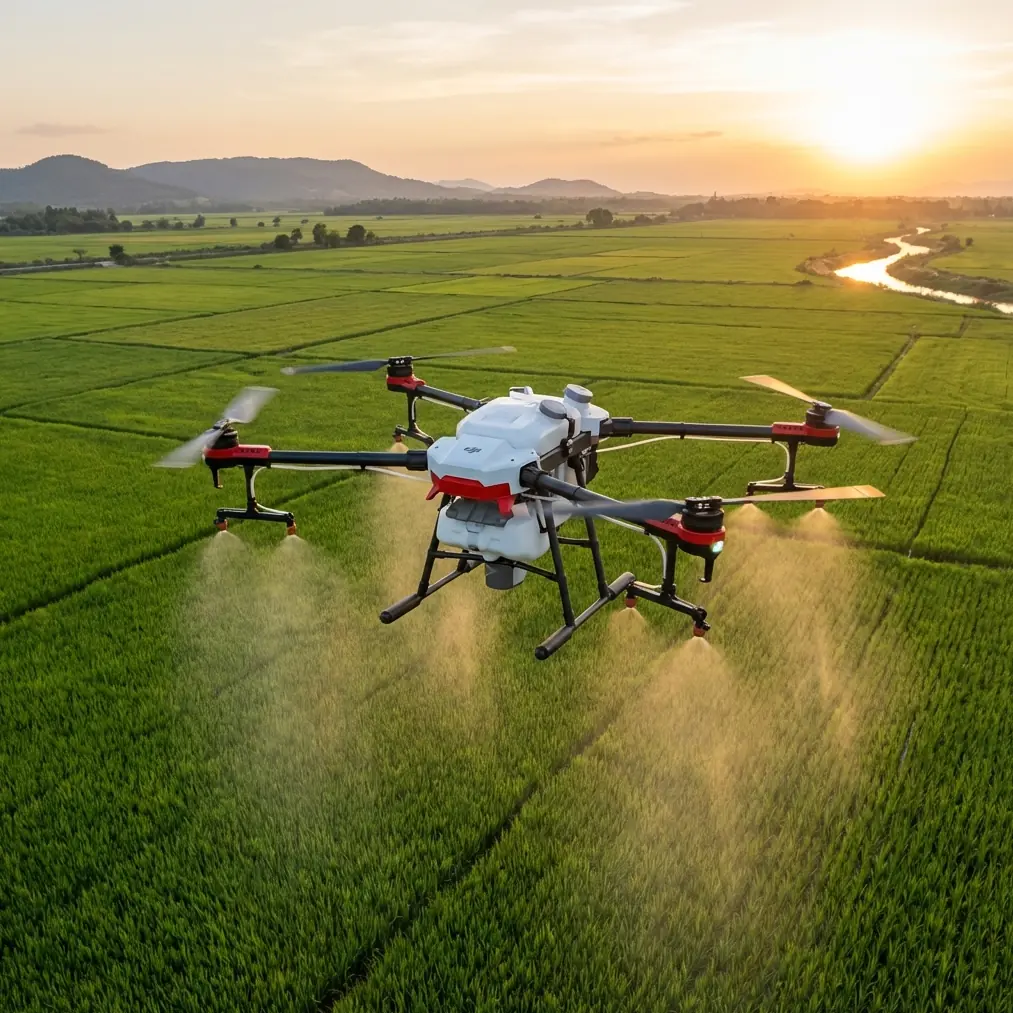
Agras T50 Field Report: Spraying Construction Sites in Low Light Without Losing Precision
META: Expert field report on using the DJI Agras T50 for low-light construction site spraying, with practical insight on precision, drift control, RTK reliability, and site workflow.
Low-light spraying on a construction site is not the same job as daytime crop application. The air behaves differently. Dust lingers. Visual references disappear right when alignment matters most. And unlike a uniform field, a site has rebar stacks, partial structures, temporary fencing, parked equipment, and abrupt surface changes that can turn a routine pass into a messy one.
That is where the Agras T50 becomes interesting.
I am approaching this as a field systems question rather than a product pitch. The real issue is whether a spray platform can maintain repeatable coverage when visibility drops, surface conditions are uneven, and the operator has to protect adjacent work zones from drift. For contractors using a T50 around dusk, dawn, or under temporary site lighting, the answer depends less on raw lift and more on how the aircraft, guidance stack, spray setup, and operator discipline come together.
A useful way to understand the T50 in this context is to contrast it with the public idea of drones that still dominates many headlines. Years ago, one of the most visible drone narratives came from Amazon’s promise of package delivery within 30 minutes, using GPS-guided aircraft to serve customers within a 16-kilometer radius of a warehouse. That announcement pulled enormous attention because it was easy to imagine. A drone leaves a depot, flies straight to a doorstep, and the job is done. Experts at the time were much more cautious, arguing that real-world deployment still faced serious obstacles and might take another four or five years before becoming practical at scale.
That gap between public imagination and field reality matters here. Construction spraying is not a publicity concept. It is a demanding operational task where navigation quality, droplet behavior, and environmental control are more important than headline-friendly speed. The T50 earns its place not because it fits the dream of autonomous aerial work, but because it addresses the mundane, difficult details that actually decide whether an application succeeds.
On a low-light site, centimeter precision is not a luxury term. It is operationally significant. If the aircraft is treating a dust-control lane, a soil stabilization section, or a surface-prep zone near unfinished structures, small positioning errors can create visible striping, overlap, or untreated gaps. This is where RTK fix rate becomes one of the most important performance indicators. A strong, stable RTK solution allows the T50 to hold line discipline when the pilot can no longer rely on ground texture or high-contrast visual cues. In practical terms, better fix consistency means cleaner lane spacing, more reliable swath placement, and fewer corrective passes after sunrise reveals mistakes the floodlights hid.
That directly affects nozzle calibration as well. Many operators talk about flow rate but not enough about alignment between application logic and aircraft positioning. In low light, poor calibration can hide in plain sight. The aircraft may appear to be flying properly, yet the actual deposition pattern tells a different story. On a construction site, where the target surface may alternate between compacted soil, aggregate, and partially damp areas, a miscalibrated nozzle setup creates inconsistent coverage faster than most crews realize. The T50’s value rises when calibration is treated as part of the navigation system, not a separate maintenance task. Precise pathing without matched output still produces uneven work.
Spray drift becomes even more sensitive after sundown. That surprises people who assume calmer conditions automatically make night or near-night operations easier. Sometimes they do. Sometimes they do not. Construction sites often generate localized turbulence from unfinished walls, shipping containers, scaffold wraps, and moving vehicles. Light fades, but the air can remain structurally messy. A wide swath width may look efficient on paper, yet if the aircraft is operating near perimeter fencing, drainage edges, fresh concrete forms, or materials staging areas, the effective swath should be chosen for containment, not just throughput.
This is one reason the T50 is best managed with a conservative site-specific profile rather than an all-purpose spray template. In low light, I would rather see a disciplined operator reduce aggressiveness, verify edge deposition, and maintain repeatable lane geometry than chase maximum hourly coverage. The operational significance is simple: rework on a construction site is expensive not because of chemical loss alone, but because it disrupts crews, schedules, and safety buffers the next morning.
Another overlooked factor is weather resistance and cleanup discipline. Construction spraying is hard on equipment. Mud aerosol, cement dust, and abrasive particulate can be more punishing than many agricultural environments. That makes an IPX6K-class protection mindset valuable in the field, not as a brochure talking point but as part of maintenance planning. Low-light jobs often start or end in damp conditions, and post-job washdown quality has a direct relationship to reliability on the next deployment. If the platform and accessory ecosystem can tolerate aggressive cleaning routines, operators are more likely to keep sensors, booms, and exposed assemblies in dependable condition.
That accessory ecosystem is where some crews have quietly improved T50 performance. One of the better third-party upgrades I have seen in this niche is a high-output portable LED site-light mast mounted on a support vehicle near the staging area and refill point. It does not turn night into day across the whole work zone, and it should not try to. Its real benefit is more specific. It gives the team a controlled light island for nozzle checks, tank verification, hose inspection, and pre-flight visual confirmation without flooding the active spray corridor with glare. That small change improves calibration discipline and turnaround quality. In several cases, it also reduced rushed mistakes during refill cycles, which is where low-light operations often begin to unravel.
A second category of add-on worth noting is third-party RTK infrastructure support, particularly portable tripods and field-friendly base-station mounting kits that make setup faster on uneven surfaces. Construction sites are temporary environments by definition. Trip hazards, moving equipment, and changing work footprints can all interfere with positioning equipment. A more robust portable RTK setup can improve the likelihood of a solid fix early in the shift, and that matters because the first few runs often set the pattern for the rest of the application block.
Some readers will notice the inclusion of “multispectral” in discussions around site spraying and wonder whether it belongs here. In a pure sense, multispectral workflows are more often associated with crop vigor mapping than construction treatment. Still, there is a practical connection. On larger industrial or civil sites, teams increasingly blend aerial data sources to distinguish moisture variation, disturbed soil patterns, and coverage anomalies. The T50 is not defined by multispectral sensing, but the broader operational stack around it can benefit from upstream mapping data that informs where spraying should be more targeted, where runoff risk is higher, or where treatment boundaries need tighter control. For a serious site manager, the aircraft is one node in a decision chain, not the whole chain.
Let us go back to the Amazon comparison, because it is more useful than it first appears. The public drone-delivery idea centered on two simple numbers: 30-minute delivery and a 16-kilometer service radius. Those figures made the concept vivid, but they also reveal how the drone conversation often prioritizes distance and speed over execution quality. In low-light construction spraying, the reverse is true. The job rarely hinges on how far the aircraft can travel from a base in a single abstract radius. It hinges on whether every pass lands where it should, at the correct output, with acceptable drift behavior, despite poor visual conditions and a changing physical environment. The industry has matured precisely because commercial users stopped asking what sounds futuristic and started asking what remains repeatable at 6:10 a.m. near a half-built structure with dust in the air.
That is why the T50 is best evaluated as a workflow platform. Operators who succeed with it on construction sites tend to share a few habits. They verify RTK lock before treating precision-sensitive sections. They recalibrate nozzles on a tighter schedule than daytime-only users. They define realistic swath widths based on perimeter sensitivity, not just tank efficiency. They plan refill and inspection zones with controlled lighting. And they treat drift assessment as a live operational variable, not a box checked during the morning briefing.
Training matters just as much as hardware. Low-light work compresses decision time. An operator must be able to interpret aircraft behavior, telemetry stability, site airflow, and surface response without hesitation. The T50 can support that discipline, but it cannot replace it. Academic discussions around autonomy sometimes miss this point. The closer a drone gets to a professional worksite, the less useful generic “smart drone” language becomes. What matters is whether trained personnel can use the system to reduce variability across repeated missions under imperfect conditions.
If you are planning a T50 deployment for construction spraying, the best preparation is not to ask whether the drone can technically spray after daylight drops. The better question is narrower: can your team preserve nozzle consistency, RTK reliability, and drift control when visual confidence falls away? If the answer is yes, the T50 becomes a practical site instrument rather than a novelty.
For teams comparing notes on low-light setup choices, accessory combinations, or field workflow details, I often recommend sharing actual site constraints rather than generic wish lists. If you need to discuss a specific scenario with someone familiar with this type of operation, you can start the conversation here: message a T50 field specialist.
The larger lesson is that professional drone work has moved beyond spectacle. Publicity once focused on drones crossing a 16-kilometer delivery radius in a tidy 30-minute promise. Real operators now know better. The hard part is not the concept. The hard part is producing controlled, repeatable results in environments where conditions change by the minute. On low-light construction sites, that is exactly the standard the Agras T50 has to meet.
Ready for your own Agras T50? Contact our team for expert consultation.