
Agras T50 for Highway Scouting in Complex Terrain
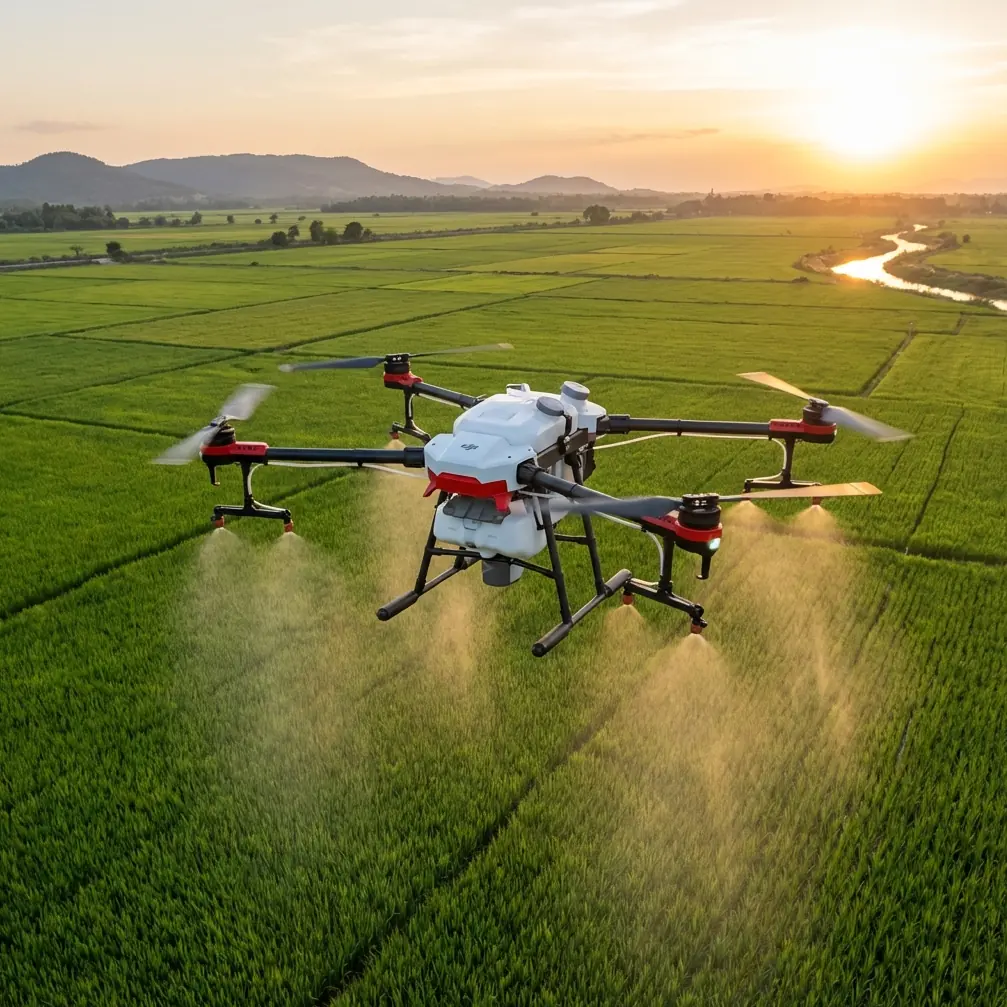
Agras T50 for Highway Scouting in Complex Terrain: A Practical Field Method
META: A field-focused guide to using the Agras T50 in complex terrain for highway corridor scouting, with operational lessons on multirotor stability, RTK precision, spray workflow discipline, and accessory integration.
When people hear “Agras T50,” they usually think first about spraying. That is fair, but incomplete. In difficult roadside environments—cut slopes, embankments, drainage channels, fragmented access roads, scattered tree lines—the same platform characteristics that make the T50 useful in agriculture also make it surprisingly effective for scouting highway corridors.
The key is not to treat it like a generic drone.
Agras-class aircraft belong to the multirotor family, and that matters operationally. The underlying flight logic of a multirotor is simple but powerful: multiple rotors generate lift, and the aircraft changes direction by adjusting rotor speeds to tilt the flight plane. That gives it vertical takeoff and landing, controlled hovering, and precise lateral movement in tight spaces. In the real world of highway scouting, those traits are more valuable than raw speed. You are often working from narrow pull-offs, maintenance lay-bys, or uneven ground where a runway-style launch is unrealistic. A platform that can rise vertically, hold position, and edge forward meter by meter is often the safer choice.
That is the first reason the Agras T50 deserves a closer look for complex terrain assessment.
Why the T50 fits highway scouting better than many teams expect
Highway corridors are messy. On paper, a route looks linear. On site, it is layered. Elevation shifts. Vegetation obscures culverts. Retaining walls create wind turbulence. Overhead lines and roadside furniture complicate approach geometry. A scouting aircraft has to do more than fly from point A to point B. It needs to stop, observe, reposition, and maintain stable flight near irregular terrain.
This is where multirotor architecture earns its place. The source material on civilian UAV categories highlights several advantages of multirotor aircraft: small site requirements, stable hovering, and strong flight stability due to a relatively simple dynamic structure. Those are not abstract textbook points. They directly affect corridor work.
Stable hovering helps when a team needs to inspect a slope failure scar, a blocked drainage outlet, or a narrow access crossing without rushing past the target. Small site requirements reduce setup friction. You can deploy from spaces that would be unusable for fixed-wing systems. And in broken terrain, deployment speed often determines whether a sortie happens at all.
Fixed-wing aircraft still have their place, especially where long endurance and extended range are the priority. But the same reference material also notes that fixed-wing platforms are more sensitive to weather and are not ideal when airflow changes sharply. Anyone who has operated near cut-and-fill sections, bridge approaches, or canyon-like roadside topography knows exactly what that means. Complex terrain creates unstable local wind behavior. Hover-capable platforms usually cope better when the mission requires careful close observation rather than broad-area transit.
A scouting workflow that borrows discipline from spray operations
Using an Agras T50 for scouting does not mean ignoring the operational discipline developed around its agricultural role. In fact, some of the best habits come directly from regulated spray work.
Chinese operating rules for light and small UAVs require pre-operation area survey before beginning work. That sounds basic, but it is one of the most overlooked advantages in structured drone programs. Before a highway scouting flight, the crew should treat the corridor as an operational zone, not just a map line. Walk or vehicle-scout the launch area. Identify power lines, reflective signage, steep drop-offs, traffic-generated turbulence, and non-participants entering the work area. If the aircraft is carrying any spray system components, liquid residue concerns, or interchangeable mission hardware, document the configuration before flight.
That same regulatory framework also emphasizes operator knowledge of aircraft performance limits and safe operating procedures. For a T50 crew, this should translate into a mission brief built around five questions:
- Where are the terrain-induced wind traps?
- What sections require centimeter-level positional consistency?
- Which targets need hover inspection versus linear pass capture?
- Is the payload configuration optimized for scouting rather than application?
- What is the recovery plan if access roads are interrupted?
These are not bureaucratic extras. They are the difference between collecting useful data and returning with a patchwork of footage that cannot support engineering decisions.
RTK precision is not a luxury on roadside missions
When readers see terms like RTK Fix rate and centimeter precision, they often associate them with mapping or auto-guidance in crop rows. Highway scouting needs that same level of discipline.
A corridor mission in complex terrain usually involves repeatability. You may need to revisit the same drainage crossing after rainfall, compare slope movement across weeks, or verify whether vegetation encroachment has changed visibility around a curve. If the aircraft can consistently hold and return to precise positions, the data becomes comparable. Without that, “before and after” turns into guesswork.
For the Agras T50, high RTK reliability matters less as a marketing spec and more as a workflow stabilizer. A strong RTK Fix rate improves confidence when flying near linear infrastructure and when trying to align repeat passes over narrow features like shoulders, medians, culvert inlets, or retaining edges. In corridor environments, a meter of drift is not trivial. It can place the camera angle on the wrong side of an embankment break or hide the feature you meant to document.
This is also where a third-party accessory can make a meaningful difference.
The accessory that changes the mission profile
In one field program I have seen work well, the T50 was paired with a third-party multispectral module mounted through a custom integration bracket designed for inspection capture rather than spray output. That adaptation did not turn the aircraft into a dedicated survey platform, and it should not be described that way. What it did do was extend the value of each scouting sortie.
Why does that matter on highways?
Because not every problem is geometric. Some are biological and moisture-driven. A multispectral layer can help crews identify vegetation stress patterns along drainage paths, distinguish healthy cover from potential washout-prone bare sections, and flag roadside growth that may be concealing erosion or water concentration. In a complex corridor, visual RGB imagery shows shape. Multispectral can hint at process.
That does not replace engineering inspection. It sharpens where engineers look next.
If your team is evaluating similar integrations for corridor work, a good starting point is to message a specialist here to discuss mounting, balance, and data workflow compatibility before taking anything into the field.
What to do about spray drift, nozzle calibration, and a sprayer-first airframe
It may seem odd to bring up spray drift and nozzle calibration in a scouting article, but with the T50 it is completely relevant. This aircraft was built around application performance. If it is being repurposed or dual-used, the spray system cannot be treated as invisible background hardware.
First, any residual fluid system must be handled with care. The operating guidance in the source material is explicit about safe handling of toxic chemicals, proper disposal of used chemical containers, and training on the effects of pesticides and chemicals on plants, animals, and people. Even when the day’s mission is scouting, those requirements shape responsible practice if the aircraft has recently been used for application. That means flushing protocols, contamination control, and clear documentation of mission configuration.
Second, nozzle calibration matters even when no spraying is planned, because it reflects a larger truth: mission performance depends on configuration accuracy. A poorly configured T50 is not only less effective in application work; it can also carry avoidable weight, create aerodynamic imbalance, or complicate maintenance scheduling for scouting use. Teams that regularly switch between spraying and inspection should maintain a strict conversion checklist. Remove or secure unnecessary components. Confirm center of gravity. Record the installed hardware. Verify all mission-specific settings rather than assuming the previous profile is harmless.
Spray drift also offers a useful analogy for corridor operations. In spraying, drift control is about understanding how environmental forces move material away from the intended path. In scouting, the same environmental awareness applies to aircraft behavior and sensor usefulness. Crosswinds along exposed embankments can degrade image consistency. Rotor wash near loose soil can obscure detail. Sun angle on reflective barriers can destroy otherwise good capture. Drift is not just a chemical issue. It is a discipline of anticipating where external forces push your mission off target.
Operating height changes the compliance picture
One of the most concrete regulatory details in the source set is this: operators conducting independent spray work, or operations above 15 meters, should hold a civil UAV pilot qualification certificate. That 15-meter threshold is operationally significant beyond spraying.
Why? Because many highway scouting tasks in complex terrain naturally push crews above that height. You may need vertical separation to clear roadside obstacles, establish line of sight over a slope break, or capture a broad view of water flow paths. Once operations rise into that band, pilot qualification and procedural maturity stop being optional extras. They become central to risk control.
The same reference set also requires records for each agricultural flight, including the pilot’s name, contact details, certificate number where applicable, and the date of technical and knowledge checks. Even if your jurisdiction uses different paperwork, the recordkeeping principle is worth copying. For infrastructure scouting, robust logs build accountability and allow teams to correlate pilot decisions with data quality over time. When missions are repeatable and documented, the scouting program becomes easier to audit, improve, and defend.
A practical field method for complex terrain
Here is the method I recommend for using an Agras T50 on highway scouting assignments where terrain is irregular and access is constrained.
1. Survey the operating zone before powering up
The cited operating rules put area reconnaissance first for a reason. Check launch space, rotor clearance, traffic proximity, overhead hazards, and emergency landing options. In roadside work, this step should also include identifying blind curves and likely pedestrian or maintenance vehicle intrusion points.
2. Build the mission around hover points, not just route lines
Do not think only in terms of corridor transit. Break the route into observation nodes: culverts, retaining structures, slope scars, vegetation choke points, drainage confluences. The T50’s multirotor stability is most valuable when you ask it to stop and examine.
3. Prioritize RTK consistency where comparison matters
Use centimeter precision where repeat inspection is part of the job. A dependable RTK Fix rate supports cleaner change detection on narrow linear assets and repetitive viewpoints.
4. Verify payload and fluid-system status
If the aircraft has a spray lineage in mixed use, inspect for residue, confirm nozzle status, and document whether any application hardware remains installed. Nozzle calibration may not be part of the scouting capture itself, but system condition absolutely is.
5. Watch wind behavior at terrain breaks
Do not trust a single surface-level reading. Cut slopes, bridge approaches, and deep roadside channels can create localized turbulence that affects hover quality and image consistency.
6. Use multispectral only where it answers a real question
A third-party multispectral add-on is valuable when you need to understand vegetation vigor, moisture influence, or concealed surface instability patterns. It is unnecessary if the mission is purely geometric or visual.
7. Log every sortie as if it may need to be repeated
Capture pilot identity, mission purpose, configuration, operating height, environmental notes, and any anomalies. The recordkeeping model in the source regulations is a smart baseline even outside spray work.
The bigger lesson
The Agras T50 is not automatically the first aircraft that comes to mind for highway scouting. Yet when the terrain is complex, the launch area is tight, and the job depends on stable low-speed positioning, its core multirotor characteristics become highly relevant. Vertical takeoff and landing, hover stability, and controlled movement in confined areas are not side notes. They are mission enablers.
What makes the difference is discipline.
The reference materials behind this discussion are not glamorous. One explains the fundamentals of civilian UAV categories and how multirotors achieve movement through rotor-speed variation. Another lays out workmanlike rules for pre-operation surveying, chemical safety, qualification at heights above 15 meters, and record preservation. Put together, they tell a useful story: aircraft capability only delivers value when paired with procedural rigor.
That is exactly how the T50 should be approached in complex-terrain corridor work. Not as a novelty. Not as a generic drone with a large frame. As a specialized multirotor platform whose utility depends on matching the right airframe behavior, the right mission configuration, and the right operational method to the job at hand.
Ready for your own Agras T50? Contact our team for expert consultation.