
Agras T50 Scouting Tips for Forests at High Altitude
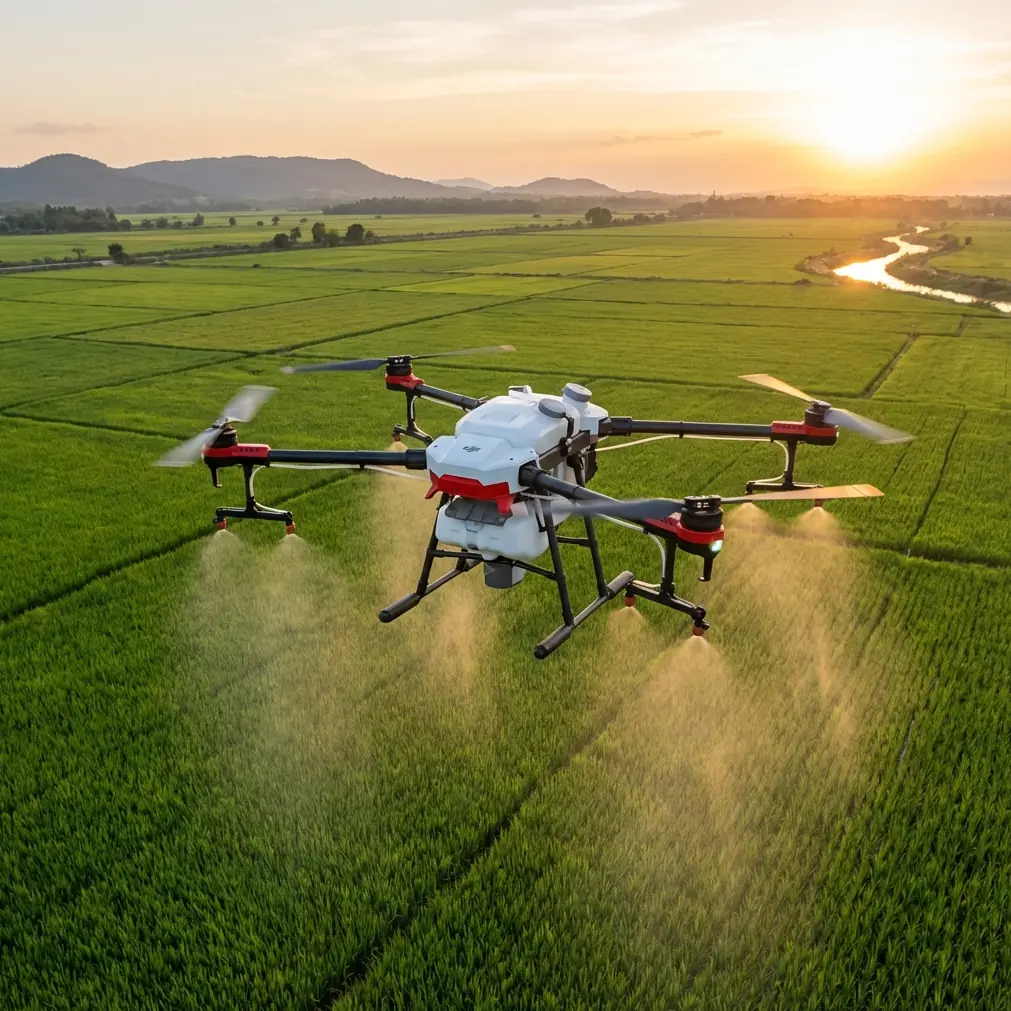
Agras T50 Scouting Tips for Forests at High Altitude: What Actually Matters When Conditions Shift
META: A field-focused tutorial on using the Agras T50 for high-altitude forest scouting, with practical guidance on weather shifts, spray drift, nozzle calibration, RTK discipline, and why environment-specific drone design matters.
High-altitude forest work exposes every weak point in an unmanned aircraft operation. Air density drops. Moisture can build fast. Wind lines split around ridges. A route that looked routine on the map can become messy halfway through the mission. If you are evaluating the Agras T50 for scouting forests rather than simply covering flat cropland, the right question is not whether the aircraft can fly. It is whether the whole operating method holds together when terrain and weather stop cooperating.
That is where a serious field setup separates itself from a brochure-level understanding.
I want to frame this tutorial around a practical lesson that comes from outside the usual agriculture conversation. At the Dubai Airshow, a drone food-delivery service was announced for the Middle East through a partnership involving United Aircraft, Abu Dhabi delivery platform Talabat, and K2 AeroSpace. The operational detail worth paying attention to is not the meal delivery itself. It is that the Raying Q20 aircraft and its packaging were specifically designed for the UAE’s high-temperature, high-humidity environment, and the delivery chain ended at fixed drop-off stations where users retrieved items by scanning a code or entering a password.
That matters for anyone thinking about the Agras T50 in forests because it highlights a principle many operators ignore: drone success is rarely about the airframe alone. It comes from matching aircraft behavior, payload handling, route design, and retrieval workflow to the environment. In the desert city case, heat and humidity shaped the platform and handoff model. In a high-altitude forest mission, cold pockets, changing wind, canopy interference, moisture, and launch-site logistics should shape how you configure and fly the T50.
Below is the tutorial I would give a forestry team trialing the T50 for scouting and light assessment work in mountain woodland.
1. Start with the environment, not the aircraft
The first planning mistake is to treat forest scouting like an agricultural mission with trees added. That usually leads to bad altitude choices, poor visibility under canopy edges, and unnecessary exposure to spray drift if you are also conducting treatment verification flights.
A forest mission at elevation should be built around four variables:
- terrain-induced wind changes
- moisture behavior across slope aspects
- canopy height variation
- GNSS quality near tree lines and ridge walls
The Middle East delivery example is useful because it shows what mature operations already understand: environmental adaptation is not optional. If another operator is redesigning packaging and aircraft systems for high heat and humidity, you should be just as deliberate when preparing a T50 for thin air, colder morning air masses, and abrupt upslope gusts.
For the T50, that means planning conservative power margins, shorter task segments, and more disciplined route checkpoints than you might use in open fields.
2. Define what “scouting” means before you take off
Many teams say “scouting” when they actually mean three different jobs mixed together:
- visual stand assessment
- treatment follow-up
- route proving for later spray work
Each one drives a different flight pattern.
If you are examining canopy stress or access corridors, your priority is stable observation and repeatable positioning. If you are evaluating prior application quality, spray drift evidence and nozzle calibration history become central. If the mission is really pre-spray reconnaissance, then swath width assumptions, slope offsets, and turning space are what matter.
The T50 can support these workflows, but only if you assign the mission type clearly. Otherwise pilots tend to compromise everything: they fly too high for visual detail, too low for safety margin, and too fast to make useful notes.
3. Treat RTK discipline as a safety and data-quality issue
In forests, “centimeter precision” only means something if your RTK fix rate remains stable where you are actually flying. That sounds obvious, but operators often celebrate an RTK lock at the takeoff point and assume it will carry into narrow valleys or along dense canopy edges.
Do not do that.
Before the main mission, run a short verification leg across the roughest GNSS section of the planned route. Watch whether the fix holds consistently near the upper canopy, near ridge shoulders, and during turns. In open agricultural land, intermittent degradation may be an efficiency problem. In forests at altitude, it can become a route-tracking problem very quickly.
Operational significance is simple: if the fix rate is unstable, your repeatability suffers, your swath width assumptions become less trustworthy, and your confidence in geotagged observations drops. For scouting, that means weak data. For subsequent treatment work, it can mean overlap errors or misses around irregular forest margins.
4. Build around weather that will change, not weather that is currently calm
Here is a realistic scenario from mountain work. You launch in a clean morning window. Air is cool, visibility is good, and the ridgeline feels manageable. Halfway through the flight, sunlight starts heating one exposed slope faster than the shaded side. Wind begins to shear across a saddle. What had been a straightforward cross-slope pass now requires active correction.
This is where the T50’s usefulness is less about raw performance claims and more about how calmly you structured the mission beforehand.
When weather changes mid-flight, the best response is usually not heroics. It is segmentation. Break scouting into small blocks with clean return logic. Keep route geometry simple enough that a pilot can suspend, reposition, and restart without confusing the dataset. If you are validating treatment boundaries, maintain your references: target trees, edge lines, and waypoint labels should be obvious at a glance.
The operational lesson again echoes that Middle East delivery deployment. Their model uses fixed drop-off stations rather than loose end-point improvisation. In forest work, the equivalent is fixed decision points. Predetermine where a mission pauses, where it can be safely resumed, and what wind threshold triggers a return. Structure is what keeps a changing environment from turning into pilot workload overload.
5. Use nozzle calibration even when scouting is the headline task
A lot of forestry teams scouting with an Agras platform are not purely scouting. They are scouting today because they may spray tomorrow.
That makes nozzle calibration relevant even before the first treatment flight. If you are carrying out route proving for future application, your notes on canopy density, clearings, and edge turbulence should be tied to the actual spray setup you expect to use later. Otherwise your drift assumptions are abstract.
Nozzle calibration matters because droplet behavior near forest edges is unforgiving. A route that looks workable in still air can produce unacceptable spray drift once wind wraps around trunks and openings. If your future mission depends on a certain droplet spectrum, flow rate, and swath width, document that now while you scout. Link observations to real operational settings, not generic field notes.
This is especially important at altitude, where environmental conditions can narrow your margin for error. Cooler pockets and shifting humidity can alter how application plans perform from one section of forest to another.
6. Don’t trust a nominal swath width in uneven woodland
Swath width in forests is not just a machine number. It is a terrain number.
On open ground, the temptation is to use a standard spacing value and move on. In forests, the canopy edge, slope angle, and local wind field can all distort the usable result. If you are using the T50 to prepare for later application work, validate swath width over representative terrain, not just at the launch site.
Look for three trouble zones:
- abrupt canopy height transitions
- exposed saddles and ridge breaks
- narrow corridors between tree stands
These are the places where overlap can become inefficient or coverage can thin unexpectedly.
The phrase “spray drift” often gets treated as a compliance term. In actual forest operations, it is a planning term. It should influence where you fly, how high you fly, and whether a section should be postponed until conditions settle.
7. Moisture and protection ratings matter more in forests than many pilots admit
The context notes mention IPX6K, and that is the right kind of specification to care about when scouting forests. Not because a rating makes an aircraft invincible, but because mountain vegetation, fog pockets, leaf moisture, and splash exposure from rough staging areas all put extra stress on field hardware.
The earlier drone-delivery example again offers a practical parallel. Their equipment was adapted for high temperature and high humidity because those conditions would otherwise undermine reliability and payload stability. Forest teams should think the same way. Moisture is not an afterthought. It affects visibility, battery behavior, surface contamination, and post-flight maintenance rhythm.
For T50 operators, the takeaway is operational: inspect after every wet leg, protect connectors and payload interfaces during turnaround, and do not let a weather-resistant design encourage lazy handling. Robustness helps. Discipline still decides uptime.
8. Borrow a lesson from training drones: make sensor feedback visible to the team
One of the more interesting reference items comes from an educational drone manual, where a matrix display shows “TT” after reset, and the bottom row uses red to indicate forward TOF distance and purple to indicate remaining battery. It also teaches students to design programs in both real-time and upload modes so the aircraft can take off and execute movement commands.
That may sound far removed from an Agras T50 in a forest, but the operational lesson is excellent: useful flight teams externalize sensor information instead of keeping it trapped in one person’s head.
In a scouting mission, the pilot, observer, and ground coordinator should all know the mission state in simple terms:
- remaining battery
- obstacle or forward-clearance concerns
- next route decision point
- weather trend over the last several minutes
The training-manual example matters because it reduces flight awareness to visible, understandable cues. In real forest operations, that same philosophy lowers error rates. If the observer can quickly interpret distance constraints and power status, the team responds earlier when conditions shift.
So even if the T50 does not use that specific educational display concept, the workflow principle is worth adopting: simplify telemetry into shared cues that everyone on site can act on.
9. Build a repeatable launch and recovery method
Forests at altitude often punish sloppy ground operations more than airborne ones. Narrow clearings, damp soil, and interrupted communications can turn turnaround into the weakest link.
Create a launch-and-recovery routine that mirrors the discipline of fixed retrieval points in urban drone logistics. The food-delivery project in Abu Dhabi relies on designated drop-off stations where the recipient scans a code or enters a password. Why is that relevant here? Because repeatable handoff points reduce ambiguity.
For T50 scouting work, your equivalent is a defined field station:
- one launch orientation
- one battery handoff zone
- one observer position
- one data logging procedure
- one weather recheck step before relaunch
That may sound basic. It is not. In uneven forest terrain, operational consistency is how teams stay efficient when fatigue builds.
If your team is building out that workflow and wants to compare staging practices for mountain operations, this field coordination line can help: https://wa.me/85255379740
10. Keep your control logic simple when conditions are marginal
One of the other source references, a BLHeli programming manual, describes audible beep sequences for entering programming mode through a PWM signal: power up once, throttle up once, full throttle with continuous beeps, then zero throttle with continuing tones before programming mode is entered. It is a small technical detail, but it reflects a broader truth in aircraft systems: clear state changes matter.
For forestry teams, the analogy is useful. When the weather turns, pilots should not be improvising complex control logic or layered ad hoc procedures. Mission states should be unmistakable:
- continue
- pause
- return
- abort and relaunch later
That clarity becomes even more valuable if wind changes mid-flight. Ambiguous decision-making is a bigger operational threat than most hardware limitations.
11. A practical high-altitude T50 scouting checklist
Before launch:
- verify RTK fix rate in the worst GNSS area, not just at home point
- inspect moisture exposure and staging surface conditions
- confirm scouting objective: visual assessment, treatment follow-up, or pre-spray route proving
- review wind behavior by slope aspect and ridge line
- match expected nozzle calibration and swath width assumptions to the actual purpose of the flight
During flight:
- watch for weather asymmetry across sunny and shaded slopes
- monitor route precision near canopy edges
- keep turns conservative in disturbed air
- document any section where spray drift risk would be elevated later
If weather changes:
- break the mission at preplanned decision points
- preserve data labeling before resuming
- do not force completion of the last block if the wind picture has changed materially
After landing:
- inspect for moisture contamination
- log where RTK performance softened
- mark sections where canopy transitions alter usable swath width
- update future treatment plans while the observations are fresh
The Agras T50 can be a very capable platform for forest scouting at altitude, but only when operators stop treating the mission like a generic agriculture flight. The strongest clue from the reference material is not a single hardware feature. It is the recurring value of environment-specific design, visible operating states, and structured handoff points. Whether it is a drone delivery project built for UAE heat and humidity, a training drone making TOF distance and battery status obvious on a matrix display, or a control manual using explicit beep sequences to mark system state, the same lesson keeps appearing.
Good drone operations are legible.
When the weather shifts, that legibility is what keeps the mission useful.
Ready for your own Agras T50? Contact our team for expert consultation.