
Agras T50 on the Coast: A Case Study in Low
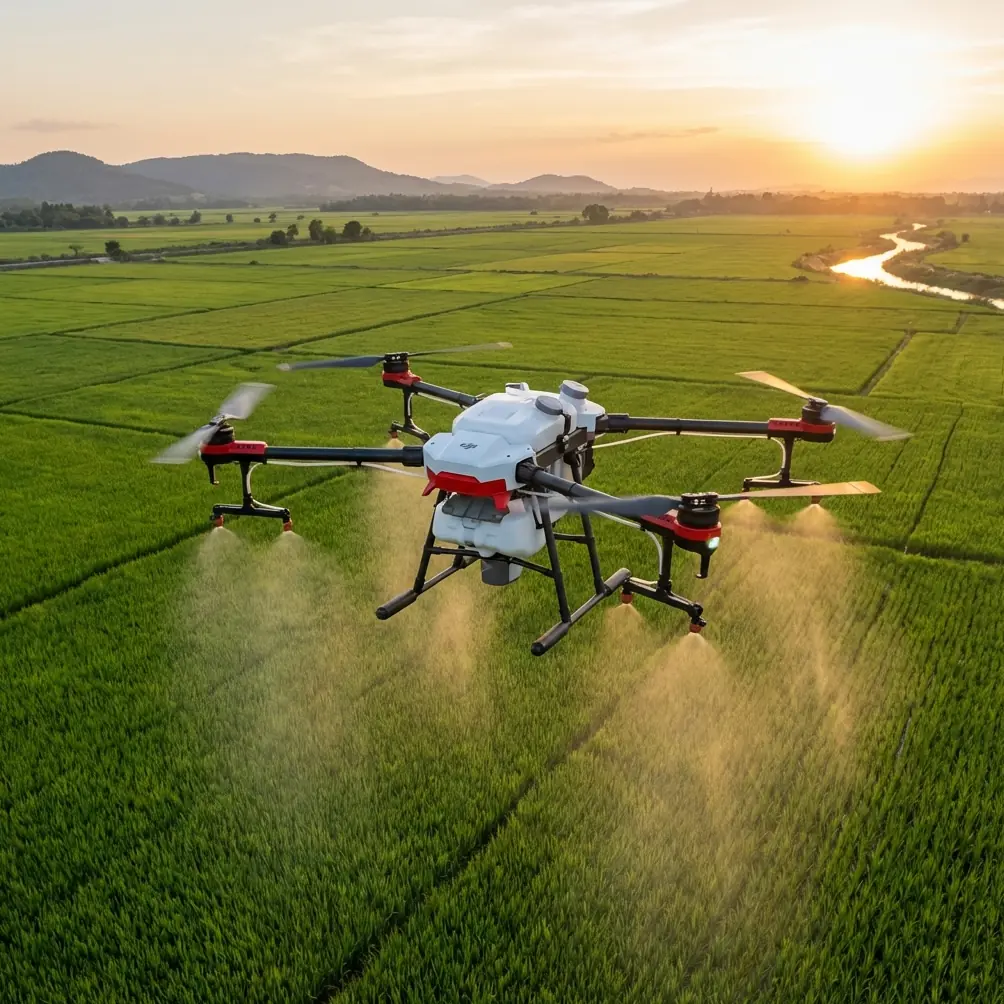
Agras T50 on the Coast: A Case Study in Low-Altitude Crop Interpretation, Drift Control, and Cross-Region Field Response
META: A field-grounded Agras T50 case study for coastal operations, covering optimal flight altitude, low-altitude sampling logic, spray drift risk, nozzle preparation, and why cross-region deployment matters in real agricultural work.
When people search for an Agras T50 article, they usually expect a spec sheet disguised as advice. That is not very helpful when the real question is operational: how should a serious team actually use a platform like the T50 when conditions are messy, crops are variable, and the work zone sits near a coastline where wind, humidity, and fragmented plots complicate everything?
That is the more interesting problem.
For this case study, I want to start with a practical scenario: scouting and treatment planning for agricultural parcels in a coastal urban fringe. The product focus is the Agras T50, but the lesson is bigger than one airframe. It is about how an agricultural drone operation becomes dependable when image interpretation, spray preparation, altitude discipline, and regional logistics are all treated as one system rather than separate tasks.
Why coastal urban-edge work is harder than it looks
A coastline near an urban area creates two kinds of pressure at once. The first is environmental. Wind can shift quickly, and that raises immediate questions about spray drift, droplet behavior, and the timing of low-altitude work. The second is operational. Fields are often broken up by roads, drainage lines, structures, utility lines, and abrupt terrain edges. In those places, “just fly lower” is bad advice unless the pilot has a clear method for transitioning between safe transit altitude and low-altitude capture altitude.
That matters directly for an Agras T50 operator because the aircraft is not only a spraying tool. In real field practice, it sits inside a broader workflow: identify the crop correctly, understand plant density and distribution, confirm treatment timing, prepare the tank properly, then execute with minimal drift and repeatable coverage.
The reference materials point to a reality that many teams learn the hard way: even very sharp orthomosaic results are not always enough. One document states that 3 cm resolution orthophotos still could not clearly show leaves well enough to identify the specific crop type. At that resolution, you can still see useful patterns such as planting density, plant shape tendencies, and distribution rules, but not always enough for confident crop-level interpretation.
That single detail is more significant than it first appears. It tells us that if you are planning Agras T50 operations in a coastal mosaic of fields, image resolution alone does not solve the agronomy problem. You may have centimeter-scale mapping and still lack biological certainty.
The altitude insight that changes the workflow
The most practical lesson in the source material is the low-altitude sampling method. The field workflow described there uses a safe transit altitude of about 40 meters, then a controlled vertical descent to 15 to 20 meters directly above the target plot, followed by one or two nadir photos. After capture, the drone climbs back to around 40 meters before moving horizontally to the next plot.
That is the altitude insight worth carrying into Agras T50 planning.
For coastal urban-fringe scouting, the best operating logic is not continuous low-level horizontal movement between plots. It is a “drop-in, capture, climb-out” pattern. The original source compares it to a dragonfly touching water, which is a good field analogy. The operational reason is simple: low horizontal transit increases the chance of snagging a wire or colliding with elevated obstacles such as embankments, buildings, or farm structures that may rise unexpectedly into the flight path.
For an Agras T50 team, this means your pre-spray scouting routine should likely look like this:
- transit high enough to maintain obstacle margin,
- descend vertically above the target area,
- gather close-range visual confirmation,
- climb before lateral repositioning.
In a coastline setting, I would treat 15 to 20 meters as the key confirmation band for visual crop interpretation when orthomosaics are inconclusive, while keeping a 40-meter transit envelope as the safer inter-plot movement height in obstacle-rich areas. That method improves both safety and data quality. It also creates better agronomic confidence before any nozzle calibration or application-rate decision is finalized.
Why this matters specifically for the Agras T50
The Agras T50 is often evaluated on payload, throughput, and swath efficiency. Those are valid metrics, but in mixed coastal plots, output is constrained less by headline capacity and more by how accurately the operator can decide what should be sprayed, where, and under what conditions.
A T50 can move product efficiently, but efficiency without correct interpretation leads to poor results faster.
This is where the mapping reference and the plant-protection service reference connect cleanly. The mapping source shows that remote imagery can miss decisive crop-identification cues. The agricultural service source shows that aerial protection work increasingly spans regions because pest timing and crop calendars do not align neatly by locality. Put those together and you get a modern operating model: mobile drone teams arriving in unfamiliar areas, needing quick but reliable field verification before treatment.
The source gives a strong example of this cross-region trend. During an armyworm control effort in Weinan, Shaanxi, plant-protection teams came from Sichuan, while teams from Henan and Jiangxi also joined the response. That is not just a story about manpower. It reflects a structural truth in agricultural aviation: drone service capacity is mobile, and pest response windows are narrow. Cross-regional deployment extends the effective service season and lets experienced crews move where the agronomic need is peaking.
For a reader interested in the Agras T50, the operational significance is clear. A serious T50 platform is most valuable when the team around it can mobilize across regions, adapt to new crop conditions quickly, and build a scouting-to-application workflow that does not depend on perfect prior knowledge of every field.
Spray drift on the coast: the issue nobody can afford to ignore
Because this scenario sits along a coastline, spray drift deserves direct attention. The reference documents do not give a drift formula, but they do give us the clues needed to frame the problem properly.
One source explains that aerial plant protection commonly uses ultra-low-volume spraying, which means less water and a comparatively higher concentration of active ingredient in the spray mixture. That has two consequences. First, droplet management becomes more critical. Second, mixture preparation errors become more expensive because there is less dilution margin.
Near the coast, wind variability adds another layer. A T50 operator should think of drift not only as a legal or neighbor-relations issue, but as a biological efficacy issue. If the application leaves the target, the crop receives less than intended, while adjacent surfaces receive material that was never meant for them.
That is why nozzle calibration and weather judgment belong in the same conversation. A well-calibrated nozzle system cannot rescue a bad wind call, but a poor nozzle setup can make marginal wind conditions much worse. The best teams build a pre-flight discipline around both: confirm application hardware, then confirm the atmospheric window.
Mixture preparation is part of performance, not a side chore
The plant-protection reference includes one detail that many new operators underestimate: well water should not be used for pesticide mixing because minerals such as calcium and magnesium can interfere with effectiveness. The recommended approach is secondary dilution, beginning with clean water in the container, then slowly adding the measured chemical and mixing evenly before further dilution to the required concentration.
That has direct relevance for Agras T50 operations.
If you are running a high-throughput platform in a temporary coastal staging area, the temptation is to focus on sortie count, refill speed, and route planning. But chemical compatibility and dilution order influence field outcome just as much as flight efficiency. A platform can hold course perfectly and still deliver a compromised treatment if the tank was prepared carelessly.
This becomes even more important in cross-region deployments, where local water quality may differ from what your team is used to. A mobile T50 crew should treat water source verification as part of standard setup. In practical terms, that is every bit as operationally significant as RTK fix rate or route repeatability. Centimeter precision in positioning is valuable, but it does not repair a poor mixture.
Safety culture still separates professionals from hobby-minded operators
One part of the source text is blunt, and it should be. Pesticides can harm people through acute poisoning, chronic harm, and the so-called three toxic outcomes: carcinogenic, teratogenic, and mutagenic effects. The document specifically warns operators not to skip protective measures out of overconfidence and highlights the need for respiratory protection, especially with fumigant-type products.
That matters in any T50 discussion because agricultural drone professionalism is not defined by aircraft size. It is defined by the systems around the aircraft. PPE discipline, mixing discipline, field confirmation discipline, and obstacle-aware altitude discipline are what turn a capable machine into a reliable service platform.
If your team is building a coastal response workflow and wants to compare operating assumptions, it is often easier to talk through a real mission profile than a brochure summary—use this direct field line for that discussion: https://wa.me/85255379740
A practical Agras T50 case workflow for coastal scouting and treatment planning
Here is the case logic I would recommend based on the reference material and the coastal-urban scenario:
1. Start with broad imagery, but do not trust it blindly
Orthomosaics remain useful for block boundaries, density patterns, access logic, and spotting irregular growth zones. But remember the key source finding: even 3 cm imagery may not reveal leaves clearly enough to identify the crop species. That is your signal to plan confirmation sampling, not to guess.
2. Use a two-level altitude method
Move between plots at roughly 40 meters where obstacle clearance is stronger. Then descend vertically to 15–20 meters over the target plot for high-confidence visual sampling. This is especially sensible near coastlines with wires, embankments, and scattered structures.
3. Confirm crop identity before setting treatment assumptions
If leaf detail is uncertain, hold off on finalizing spray logic. What looks like a minor classification error can alter timing, dose, and even whether treatment is appropriate.
4. Prepare spray liquid correctly
Because aerial plant protection often relies on ultra-low-volume methods, the liquid in the tank matters enormously. Avoid mineral-heavy well water where possible, and use proper secondary dilution so the active material is mixed evenly before final dilution.
5. Treat drift control as a planning issue, not only a piloting issue
On the coast, weather can shift during the work window. Flight timing, nozzle state, droplet behavior, and route direction should be aligned before launch, not improvised after the first pass.
6. Build for mobility
The cross-regional pest response example from Shaanxi shows how agricultural drone teams increasingly work beyond their home territory. A T50 operation should be designed for transportability, local coordination, and fast field familiarization. In many cases, the bottleneck is not aircraft capability. It is operational coordination with growers, local organizations, and timing.
The bigger lesson
The best way to think about the Agras T50 in a coastal scouting context is not as a single-purpose spraying machine. Think of it as the center of a field-response system. That system needs high-confidence close-range observation, disciplined altitude transitions, careful chemical preparation, and enough mobility to respond where agronomic pressure actually appears.
The reference materials support that view from two different directions. One shows that remote imagery alone can fail at crop identification even at 3 cm resolution, making 15–20 meter low-altitude confirmation a practical necessity. The other shows that aerial plant-protection work is increasingly cross-regional, with teams traveling from places like Sichuan, Henan, and Jiangxi to support urgent pest-control work in Shaanxi. Together, those details describe the real world the Agras T50 belongs to: not a clean lab environment, but a dynamic service ecosystem where decisions have to be fast, accurate, and agronomically grounded.
If you are scouting coastlines in an urban-edge agricultural zone, the optimal flight altitude insight is straightforward: stay high enough in transit to preserve safety margins, then go low only when directly over the plot and only long enough to capture the detail broad imagery cannot provide. That one habit improves interpretation quality and reduces avoidable risk.
Everything after that—nozzle calibration, spray drift management, route quality, and treatment confidence—gets easier because the foundation is sound.
Ready for your own Agras T50? Contact our team for expert consultation.