
Agras T50 in Windy Forest Margins: A Field Report
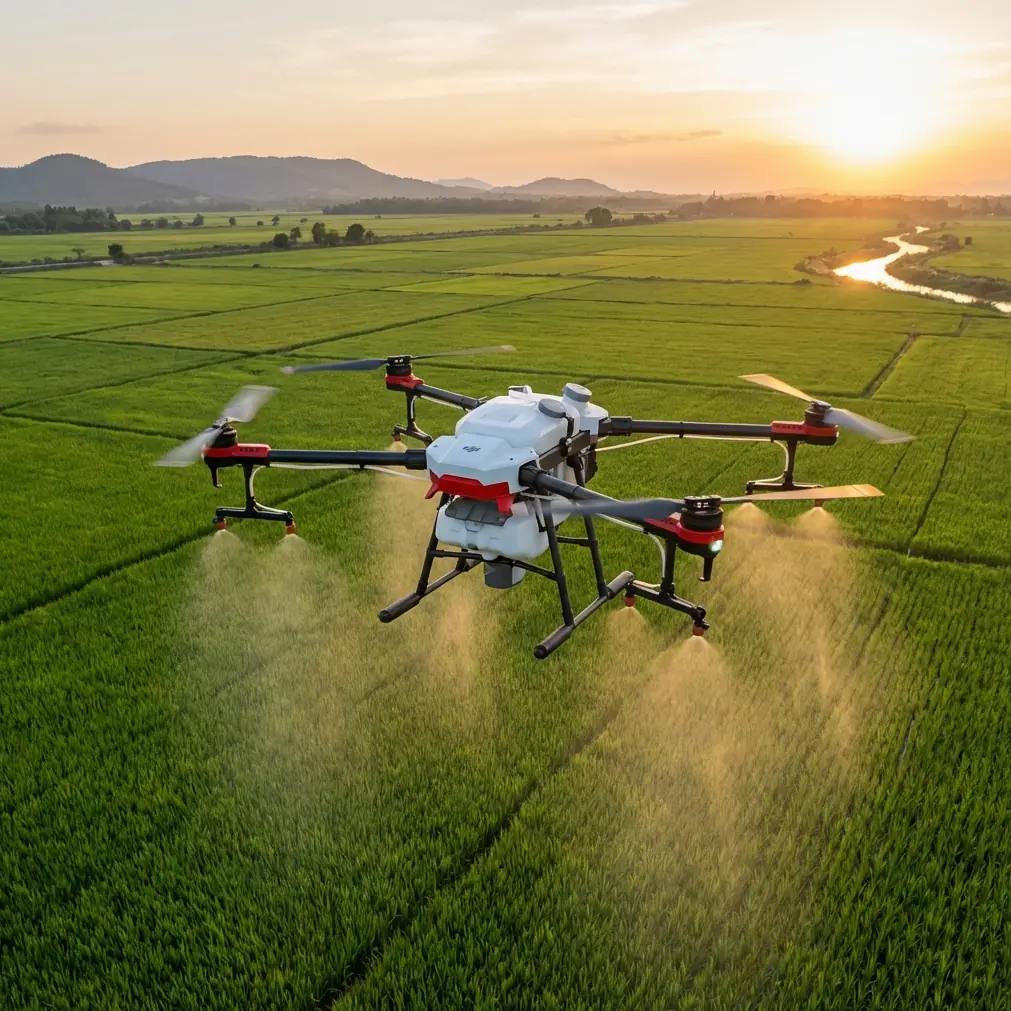
Agras T50 in Windy Forest Margins: A Field Report on Control, Tracking, and Training Logic
META: Practical Agras T50 guidance for forest-edge operations in wind, with expert insights on tracking stability, antenna positioning, precision workflow, and operator training logic.
Forest work exposes the difference between a drone that merely flies and a drone system that can hold a useful line under pressure. The Agras T50 often gets discussed through broad agriculture talking points, but that misses what matters at the forest boundary: wind turbulence, broken canopy, intermittent signal geometry, and the operator’s need to make fast, repeatable decisions when the environment refuses to behave like an open field.
This report looks at the T50 through a narrower lens: monitoring and treatment work near forests in windy conditions. Not generic crop spraying. Not marketing shorthand. Real operating logic.
The most useful way to think about the T50 in this setting is not as a stand-alone aircraft, but as the latest expression of two older ideas in multirotor development. First, the industry matured by solving stability and control in practical aircraft, from early systems like the Md4-200 released in 2006 to heavier-duty multirotor platforms such as the Draganflyer X6 introduced in 2008. Second, the academic side of the industry spent years proving that precise autonomous behavior depends on reliable sensing, repeatable control loops, and test environments where algorithms can be validated before field deployment. That research wave, active in the 2005-2010 period and serious enough to attract attention from Nature in 2007, laid the groundwork for the kind of position-holding and guided flight that operators now take for granted.
Why bring up that history in an article about the Agras T50? Because forest-edge operations punish every weakness in autonomy. Gusts roll off the canopy. GNSS geometry shifts when the aircraft passes beside dense tree cover. Spray drift risk changes minute by minute. The T50’s value is not just payload or output. It is whether the system can keep a stable relationship to the intended path, maintain centimeter-level positioning when RTK conditions are healthy, and give the pilot enough confidence to make measured adjustments instead of over-correcting.
What windy forest work does to a spray drone
Open-field assumptions break down fast near trees.
At the edge of a plantation, shelterbelt, or mixed forest block, wind is rarely uniform. Air accelerates over gaps, curls around trunks and ridgelines, and creates low-level turbulence where an agricultural aircraft may be operating close to vegetation. For a platform like the T50, that means three things need constant attention:
- Spray drift management
- Tracking precision
- Link robustness
The first is obvious. If the wind is shifting, your droplet placement changes, especially at the edge of the swath width where the pattern is already most vulnerable. The second is subtler. Even a small lateral correction error near a tree line can create overlap in one pass and under-coverage in the next. The third is often overlooked until the operator experiences it directly: signal performance degrades when the aircraft, controller, vegetation mass, and terrain combine into a bad geometry.
That is where operating discipline matters more than brochure specs.
The training clue hidden in education drones
One of the most revealing reference points here comes from an education drone program rather than a farm aircraft manual. In the DJI TT training material, a small drone is programmed to rise to 150 centimeters and hover, then use a downward-looking card-detection routine to track a marker while maintaining a fixed relative height of 80 centimeters above it. In another exercise, recognized card numbers trigger different behaviors, such as moving up or down by 30 centimeters, while a specific number commands landing.
On the surface, this has nothing to do with the Agras T50. In practice, it has everything to do with how good T50 operators should think.
Those exercises teach a core operational principle: the aircraft should maintain a reliable relationship to a reference, react predictably to inputs, and only transition states when the trigger is clearly recognized. In a windy forest margin, the “challenge card” is replaced by your mission line, your terrain model, your canopy edge, or your treatment boundary. The T50’s job is not simply to fly forward. It must preserve the intended spatial relationship despite environmental disturbance.
That is operationally significant for two reasons.
First, holding a stable relative position is the foundation of accurate application and monitoring. If a training drone can be taught to remain consistently 80 cm above a moving target, the real lesson is about control architecture: fixed offsets matter. On the T50, that translates into keeping consistent height above crop or terrain, preserving overlap, and reducing the unevenness that windy edge conditions tend to introduce.
Second, discrete trigger logic reduces pilot overload. In the TT example, one card ID means “follow,” another means “land.” In professional T50 work, operators should adopt the same mindset with field rules: one wind threshold means continue, another means reduce swath width, another means suspend edge passes. Formal trigger logic protects coverage quality better than improvisation.
Antenna placement: the simplest way to lose range
You asked for antenna positioning advice for maximum range, and this is one area where even experienced teams get casual.
In forest-adjacent work, the radio path is rarely ideal. Trees absorb and scatter signal. Slopes create line-of-sight interruptions. The aircraft may be low relative to the operator, especially during edge inspection or treatment transitions. That makes controller and antenna orientation far more important than it seems during easy flights over flat, open farmland.
A few practical rules consistently improve link quality with the T50:
1. Do not point the antenna tip directly at the aircraft
Most operators understand this in theory and forget it in the field. The strongest effective pattern is usually broadside to the antenna, not off the tip. If you aim the ends at the aircraft, you may reduce usable signal strength at the worst moment, especially when the drone is near trees or behind slight terrain relief.
2. Keep the controller high and your body out of the path
Your torso is a signal obstacle. So is a vehicle cab. When working near forest blocks, stand where the aircraft has the clearest possible line to the controller. If needed, take two steps sideways rather than trying to “power through” a degraded angle.
3. Reposition before the aircraft goes behind the canopy edge
Do not wait for link quality to drop. If the mission line will carry the T50 near dense tree cover, shift your own station early. The goal is to preserve favorable geometry before attenuation compounds.
4. Use terrain to your advantage, not accidentally against yourself
A slight rise can improve visibility and RTK consistency. A low hollow can do the opposite. On forest margins, operator location affects both control link performance and how well you can maintain visual awareness of drift behavior.
If your team wants to compare setup notes for difficult edge-of-forest sites, this direct field coordination link is useful for quick planning conversations.
RTK fix rate matters more near trees than in open plots
Agras T50 users often talk about precision in abstract terms. Near forests, it becomes concrete. A healthy RTK fix rate is what separates repeatable edge coverage from creeping inconsistency.
This is where the term centimeter precision deserves to be handled carefully. Yes, RTK-based systems can deliver very tight positional performance. But in a forest-edge environment, you should treat that precision as conditional, not automatic. Tree mass, moisture, terrain shading, and low-angle satellite geometry can all chip away at solution quality.
Operationally, that means:
- Watch fix stability before beginning the most sensitive passes.
- Avoid assuming that a clean open-area lock will remain equally clean beside tall vegetation.
- Be prepared to narrow effective swath width when conditions become less predictable.
- Use mission design that reduces the penalty of a small lateral deviation on edge rows.
A weaker RTK state in the center of a broad field may be tolerable. The same degradation along a forest boundary can mean drift onto non-target vegetation, missed treatment strips, or inconsistent monitoring data.
Nozzle calibration is not a paperwork exercise
Wind reveals poor calibration brutally.
Near forests, the operator is already managing turbulence and changing canopy effects. If nozzle output is uneven or poorly matched to the aircraft’s actual speed and path stability, the result is compounding error. The drift problem is no longer just meteorological. It becomes mechanical and procedural too.
The T50 should be treated as a system where nozzle calibration, flight speed, altitude discipline, and edge-pass judgment all interact. A well-calibrated setup gives the pilot a cleaner baseline. That matters because windy forest work often requires conservative decisions: lowering speed, adjusting route spacing, or delaying a pass until airflow settles. If the nozzles are inconsistent, those decisions lose value because the delivery pattern itself is unstable.
This is also where swath width should be treated as a variable rather than a fixed boast. In ideal conditions, a wider swath may be efficient. Along a forest margin in unstable air, a narrower practical swath can improve placement confidence and reduce the consequences of crosswind distortion.
Monitoring flights: where multispectral ambition meets reality
Many teams planning forest-adjacent work also think beyond treatment and into monitoring, including vegetation vigor assessment and stress detection. The phrase multispectral enters quickly. The right response is not skepticism, but sequencing.
Before expanding into advanced sensing workflows, make sure the basics are under control:
- stable route execution
- reliable RTK behavior
- repeatable operator positioning
- clear wind-go/no-go rules
- accurate relative altitude over mixed terrain
This may sound conservative, yet it mirrors the way multirotor capability matured historically. Early academic labs did not jump straight to complex autonomous missions. They first built environments to validate control, sensing, and repeatability. The references to commercial quadrotors combined with motion-capture systems in the 2005-2010 research era make that point clearly. Precision applications only become trustworthy when the underlying flight behavior is trustworthy.
For the T50 in windy forest work, that lesson still applies. Fancy data products do not rescue unstable acquisition.
The value of IP-rated durability, used properly
The mention of IPX6K is relevant in this context, but not for vanity. Forest-edge operations often involve moisture, residue, splash exposure, and more demanding cleanup conditions than dry inland crop blocks. Durability against water ingress and harsh operating environments supports uptime, but it should not be misunderstood as permission to ignore maintenance discipline.
A robust protection rating helps the T50 survive real agricultural work. It does not eliminate the need to inspect antennas, connectors, spray components, and sensors after difficult missions. In windy, debris-prone environments, small contamination issues can become flight-performance issues quickly.
A practical field method for forest margins
If I were briefing a new T50 team for windy work near forests, I would keep it simple:
Stage 1: Establish signal geometry Choose your standing point before takeoff. Check line of sight, likely canopy masking, and antenna orientation.
Stage 2: Verify precision state Confirm RTK stability where the most sensitive edge work will occur, not just at the launch point.
Stage 3: Reduce variables Use a conservative swath width and disciplined altitude strategy on the first passes. Let observed behavior, not assumptions, justify any expansion.
Stage 4: Watch drift at the boundary The interior of the block can look acceptable while the edge pass is already failing. Monitor the transition zone carefully.
Stage 5: Apply trigger logic Borrow the mindset from training-drone exercises. Define response thresholds in advance: if wind exceeds X, if fix quality drops, if canopy turbulence increases, then adjust or stop. Do not negotiate with your own rules mid-flight.
That final point may be the most useful of all. The educational drone examples with numbered challenge cards look basic, but they encode good aviation behavior: recognize, decide, execute. When the aircraft sees condition A, it does action A. When it sees condition B, it ends the loop and lands. For T50 crews in complex civilian operations, especially around forests, that style of disciplined logic often makes the difference between a merely completed mission and a defensible one.
The Agras T50 is capable. But capability in windy forest environments comes from how well the team manages references, offsets, triggers, and signal geometry under stress. The aircraft is only half the system. The rest is fieldcraft.
Ready for your own Agras T50? Contact our team for expert consultation.