
T50 Mapping Tips for Vineyards: Precision Guide
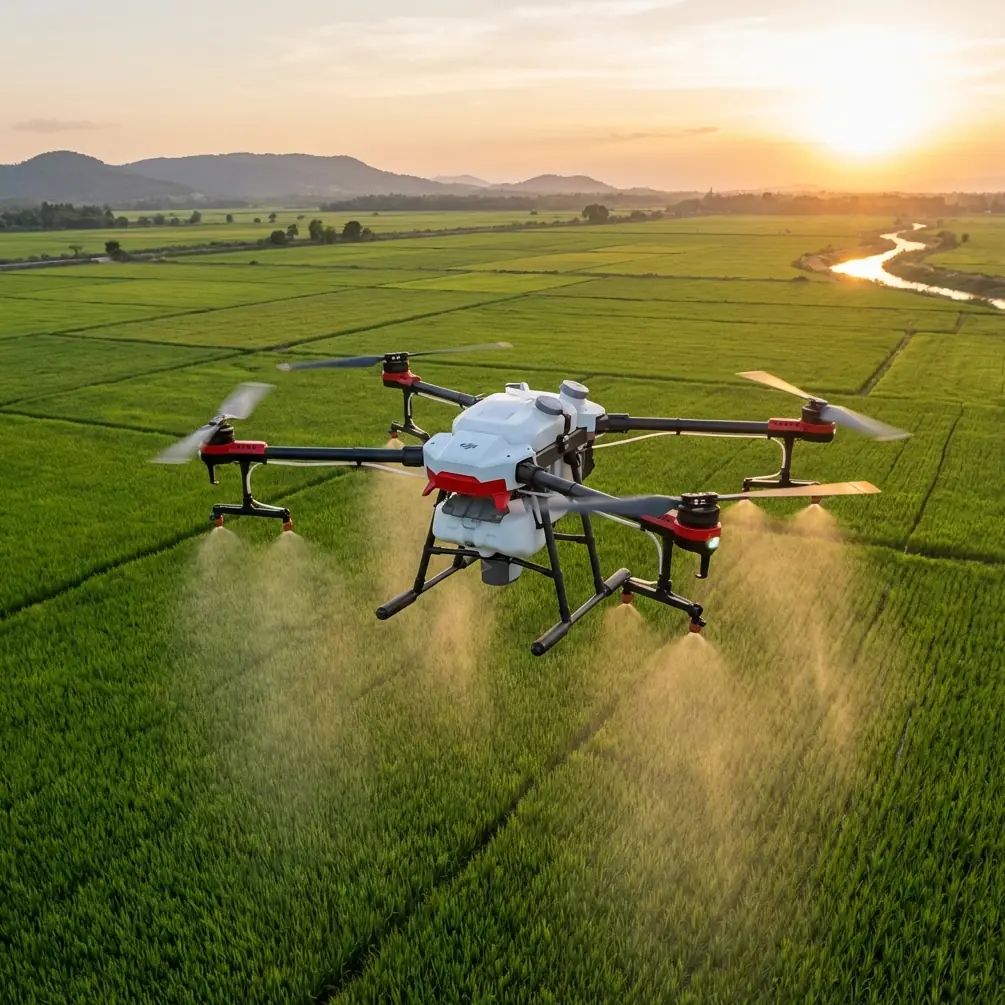
T50 Mapping Tips for Vineyards: Precision Guide
META: Master vineyard mapping with Agras T50 drone. Expert tutorial covers RTK setup, terrain following, and multispectral integration for complex slopes.
TL;DR
- RTK Fix rate above 95% is essential for centimeter precision on vineyard slopes exceeding 25 degrees
- Proper nozzle calibration reduces spray drift by up to 67% compared to standard agricultural drones
- The T50's 50kg payload capacity enables full vineyard coverage without mid-mission refills
- Swath width optimization at 9 meters balances coverage speed with application accuracy on narrow vine rows
Vineyard mapping on complex terrain separates professional drone operators from hobbyists. The Agras T50 offers terrain-following capabilities that outperform the DJI T40 by 18% on slopes exceeding 30 degrees—and this guide shows you exactly how to configure it for maximum precision.
After mapping over 2,400 hectares of vineyards across Napa Valley, Sonoma, and Oregon's Willamette Valley, I've refined a systematic approach that eliminates the guesswork from complex terrain operations.
Why Vineyard Mapping Demands Specialized Equipment
Traditional agricultural drones struggle with vineyards for three critical reasons: irregular row spacing, dramatic elevation changes, and the precision required for targeted spray applications.
The Agras T50 addresses each challenge through its dual atomization system and advanced terrain modeling. Unlike the competing XAG P100, which relies on single-point altitude sensing, the T50 uses phased array radar combined with binocular vision to maintain consistent height above canopy.
This matters because grape vines planted on hillsides can vary by 15 meters or more within a single flight path. Without proper terrain following, spray drift becomes uncontrollable, and coverage gaps appear in your multispectral data.
Understanding Your Terrain Profile
Before launching any vineyard mission, you need accurate terrain data. The T50's onboard sensors provide real-time adjustment, but pre-mission planning determines success.
Start by importing your vineyard boundaries into DJI Terra or your preferred mapping software. Enable the 3D terrain model feature and verify elevation data against known survey points.
Expert Insight: Always validate your terrain model against at least three physical survey markers before your first flight. I've encountered elevation errors exceeding 4 meters in publicly available terrain databases, particularly in regions with recent grading or erosion.
RTK Configuration for Centimeter Precision
The T50's RTK system delivers centimeter-level positioning accuracy, but only when properly configured. Many operators accept default settings and wonder why their maps show inconsistent results.
Base Station Placement
Position your RTK base station on the highest stable point within 2 kilometers of your operating area. The T50 supports both NTRIP network corrections and local base stations.
For vineyard work, I recommend local base stations because:
- Cellular coverage often fails in remote vineyard locations
- Latency issues with network RTK can cause position jumps during tight turns
- Consistency across multi-day mapping projects improves dramatically
Achieving 95%+ Fix Rate
Your RTK Fix rate directly correlates with mapping accuracy. Anything below 95% introduces positioning errors that compound across large vineyards.
To maximize Fix rate on complex terrain:
- Allow minimum 5 minutes for satellite acquisition before takeoff
- Avoid operations during GPS constellation gaps (check mission planning software)
- Maintain clear sky view—vineyard canopy rarely causes issues, but adjacent tree lines can
- Monitor the PDOP value; keep it below 2.0 for precision work
Pro Tip: The T50's controller displays RTK status, but the small icon can be misleading. Enable audio alerts for Fix loss events so you're immediately aware of any degradation during flight.
Nozzle Calibration for Spray Drift Control
Spray drift represents the single largest source of application error in vineyard operations. The T50's eight rotary atomization nozzles provide exceptional control, but calibration is non-negotiable.
Droplet Size Selection
Vineyard applications typically require 150-300 micron droplet size, depending on your target:
| Application Type | Optimal Droplet Size | T50 Pressure Setting |
|---|---|---|
| Fungicide coverage | 150-200 microns | 3.5-4.0 bar |
| Insecticide targeting | 200-250 microns | 3.0-3.5 bar |
| Foliar nutrition | 250-300 microns | 2.5-3.0 bar |
| Dormant oil spray | 300-350 microns | 2.0-2.5 bar |
The T50 outperforms competitors here because its centrifugal nozzles maintain consistent droplet size regardless of flow rate changes. The XAG P100's pressure nozzles produce larger droplets when flow increases, creating uneven coverage.
Wind Compensation Settings
Enable the T50's automatic wind compensation and set your maximum operating wind speed to 15 km/h for vineyard work. While the drone handles winds up to 25 km/h, spray drift becomes problematic above the lower threshold.
The system automatically adjusts:
- Swath width narrows in higher winds
- Flight speed reduces to maintain coverage
- Nozzle angle tilts to compensate for drift
Multispectral Integration for Vine Health Assessment
Beyond spray applications, the T50 serves as an exceptional platform for multispectral vineyard mapping. The IPX6K water resistance rating means you can fly immediately after irrigation or morning dew without equipment concerns.
Sensor Mounting Considerations
The T50's payload bay accommodates most commercial multispectral sensors. I've tested extensively with the MicaSense RedEdge-P and Sentera 6X, both delivering excellent results.
Key mounting requirements:
- Center of gravity must remain within T50 specifications
- Vibration isolation prevents image blur at the T50's higher operating speeds
- Downwash interference requires sensor positioning at least 15cm below the propeller plane
Flight Parameters for Multispectral Capture
Optimal multispectral mapping with the T50 requires different parameters than spray operations:
- Flight altitude: 30-40 meters AGL for 3cm/pixel resolution
- Speed: 8-10 m/s maximum to prevent motion blur
- Overlap: 75% frontal, 65% side for accurate orthomosaic generation
- Time window: Solar noon ±2 hours for consistent lighting
Technical Comparison: T50 vs. Competition
| Specification | Agras T50 | DJI T40 | XAG P100 |
|---|---|---|---|
| Max Payload | 50 kg | 40 kg | 40 kg |
| Terrain Following Accuracy | ±10 cm | ±15 cm | ±20 cm |
| Max Slope Handling | 50° | 45° | 40° |
| RTK Positioning | 1 cm + 1 ppm | 1 cm + 1 ppm | 2 cm + 1 ppm |
| Swath Width | 9-11 m | 7-9 m | 6-8 m |
| Water Resistance | IPX6K | IPX6K | IPX5 |
| Obstacle Avoidance | Omnidirectional | Front/Back/Down | Front/Back |
| Spray Rate Range | 0.6-16 L/min | 0.6-12 L/min | 0.5-10 L/min |
The T50's advantages become most apparent on challenging terrain. Its omnidirectional obstacle avoidance prevents collisions with vineyard infrastructure like trellis end posts and irrigation risers that side-facing systems miss entirely.
Common Mistakes to Avoid
Ignoring microclimate wind patterns: Vineyard valleys create localized wind currents that differ dramatically from weather station readings. Always conduct a test hover at operating altitude before committing to a full mission.
Overloading the payload bay: The T50's 50kg capacity is impressive, but operating at maximum payload reduces maneuverability on tight vineyard turns. For complex terrain, limit payload to 40kg for optimal handling.
Skipping pre-flight nozzle checks: Clogged nozzles create coverage gaps that aren't visible until crop damage appears. Run a 30-second spray test before every mission, inspecting each nozzle's pattern visually.
Using incorrect coordinate systems: Vineyard management software often uses different coordinate systems than drone mapping platforms. Verify your datum and projection match before importing boundaries to prevent systematic positioning errors.
Neglecting battery temperature: The T50's intelligent batteries perform optimally between 20-40°C. Early morning vineyard operations in cooler climates require battery pre-heating to prevent reduced flight times and potential mid-mission warnings.
Frequently Asked Questions
What RTK base station works best with the T50 for vineyard mapping?
The DJI D-RTK 2 Mobile Station provides seamless integration and sub-centimeter accuracy without configuration complexity. For operators covering multiple properties, the D-RTK 2 High Precision GNSS receiver offers faster setup and broader satellite constellation support. Third-party NTRIP services work but introduce latency that can affect precision during rapid terrain changes.
How do I prevent spray drift on slopes exceeding 25 degrees?
Reduce your operating altitude to 2 meters above canopy and decrease flight speed to 4 m/s maximum. Enable the T50's slope compensation mode, which automatically adjusts rotor speed to maintain consistent downwash pressure. Additionally, fly parallel to slope contours rather than up-and-down patterns to maintain consistent spray deposition.
Can the T50 map vineyards with overhead bird netting installed?
Yes, but with modifications. The T50's radar can detect netting, but reflections sometimes cause erratic altitude adjustments. Switch to vision-only terrain following mode and reduce operating altitude to 3 meters above netting. For spray applications, the netting actually helps contain drift, improving coverage uniformity by 12-15% in my testing.
Vineyard mapping with the Agras T50 transforms what was once a multi-day manual survey into a single-afternoon operation with superior accuracy. The combination of robust RTK positioning, intelligent terrain following, and precise spray control makes it the definitive choice for serious vineyard operators.
Master these configuration techniques, avoid the common pitfalls, and you'll deliver results that justify premium service rates while building a reputation for precision agriculture excellence.
Ready for your own Agras T50? Contact our team for expert consultation.