
Agras T50 Field Report: Mapping Solar Farms in Complex
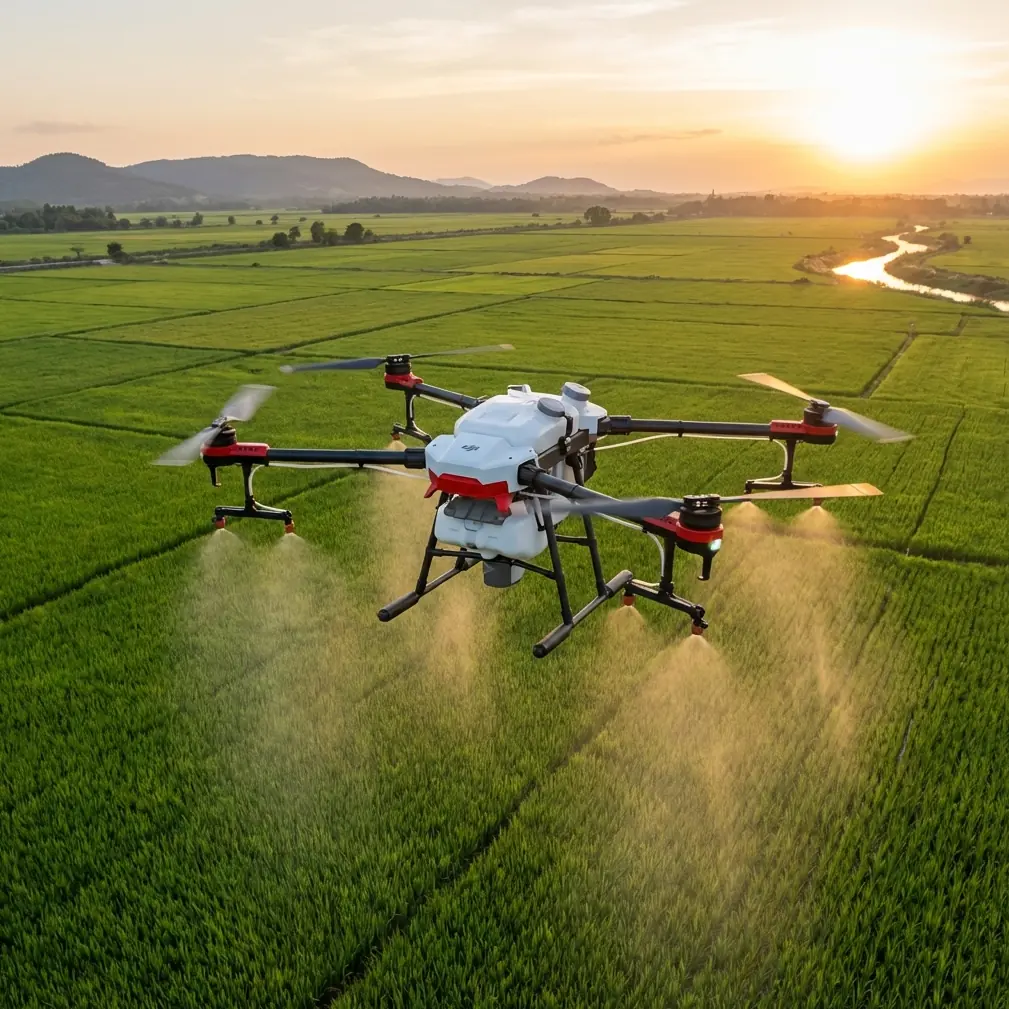
Agras T50 Field Report: Mapping Solar Farms in Complex Terrain Without Losing Positional Trust
META: Expert field report on using Agras T50 around solar farms in complex terrain, with practical insights on RTK stability, electromagnetic interference, overlap strategy, and safety thinking inspired by proven UAV mapping principles.
Solar farm mapping looks straightforward until you arrive on site.
Rows of reflective panels throw light in odd directions. Tracker systems create repeating patterns that can confuse visual interpretation. Access roads cut through uneven ground. Drainage channels disappear behind vegetation. And then there is the invisible problem: electromagnetic interference near inverters, combiner boxes, and transmission hardware that can quietly degrade positional confidence if the aircraft setup is careless.
This is where the Agras T50 becomes more interesting than its category label suggests.
Most people meet the T50 through agricultural operations, where swath width, nozzle calibration, and spray drift management dominate the conversation. But in the field, especially on large solar sites with mixed terrain and maintenance corridors, the same platform discipline that makes an aircraft productive in crop work can also make it reliable for structured aerial data capture. The difference is not just the airframe. It is the operator’s willingness to treat mapping as a precision workflow rather than a quick overflight.
I’ve been asked more than once whether an Agras T50 makes sense around solar installations where centimeter-level repeatability matters. My answer is always conditional: yes, if you respect the limits of the mission environment and build the operation around signal integrity, overlap logic, and safety redundancy.
That last point deserves more attention than it usually gets.
A useful reference from UAV education materials describes how drones can use overlapping high-resolution images and software stitching to generate distortion-free 3D maps through multi-point positioning. That matters on a solar farm because repetitive structures amplify small mapping errors. If your overlap discipline is weak, the resulting model may look acceptable from altitude while hiding local misalignment along panel rows, service lanes, or perimeter drainage. On a site where grading issues, encroaching vegetation, or erosion near cable trenches need to be identified, “close enough” is often not good enough.
The same reference also highlights a separate safety concept: a parachute system that deploys automatically after loss of power, allowing the drone to descend slowly and reducing harm to people, equipment, and surrounding property. The Agras T50 discussion should borrow that mindset even when the aircraft configuration differs. Around solar farms, there is no prize for bravado. You are often flying near expensive infrastructure, over uneven surfaces, and sometimes around contractors who are focused on electrical or civil work rather than aviation. A platform used for mapping in such an environment should be operated with the same philosophy as any safety-engineered UAV system: assume failure is possible and design the mission to reduce consequence.
That philosophy becomes very practical when electromagnetic interference enters the picture.
The hidden challenge on solar farms: not terrain, but signal confidence
Complex terrain is obvious. You can see the slope changes, berms, washouts, retention basins, and fence lines. Electromagnetic interference is subtler. It often appears as an inconsistent RTK fix rate, delayed convergence, or positional wandering near certain structures. On some sites, the aircraft behaves perfectly during setup and then starts to show instability in data confidence once it transitions over inverter-heavy zones or near power routing corridors.
This is one reason I tell teams not to judge a mapping setup solely by whether the aircraft takes off cleanly.
A stable takeoff proves very little about geospatial reliability.
For the T50, antenna adjustment and pre-flight staging location matter more than many crews realize. If you initialize near a concentrated source of interference, you are already compromising the foundation of the mission. I prefer to establish the RTK solution in a cleaner area, confirm fix consistency, and then move into the work pattern only after the system has settled. Even small physical changes in antenna orientation can affect how robustly the aircraft maintains its solution in a cluttered radio environment. That sounds minor until you compare datasets and realize the “messy” mission has row-to-row drift that complicates inspection overlays later.
Centimeter precision is only meaningful when it persists through the mission, not when it appears briefly on the status display.
Why overlap and route planning matter more than speed
There is another reference point worth keeping in view. Educational materials on drone mapping emphasize capturing multiple edge-overlapping photos and using software to merge them into a coherent 3D representation with accurate coordinates. That principle is basic, but on solar farms it has operational teeth.
Panel arrays create repeating geometry. Repetition is bad for lazy mission design.
If your overlap margins are thin, the reconstruction engine has fewer unique visual cues to work with. Add glare, midday contrast, and terrain transitions, and the result can be warped local sections even if the overall mosaic seems fine. The fix is not glamorous: plan for stronger overlap, preserve a clean flight grid, and resist the temptation to rush the mission just because the site looks orderly from ground level.
The T50’s ability to maintain disciplined route execution helps here. Automated path behavior is one of the reasons UAV mapping outperforms many legacy methods in localized, near-ground surveying. The source material explicitly notes that unmanned systems can automatically plan flight routes and perform mapping more safely, quickly, and efficiently than ground surveying or crewed aircraft in many cases. For solar operators, that translates into less time walking unstable embankments, less dependence on elevated manual inspection points, and a much faster path to terrain and asset context.
Speed, though, is not the real win. Repeatability is.
On a utility-scale site, you will likely revisit the same corridors after storm events, drainage corrections, vegetation treatment, or expansion work. A reliable T50 workflow lets you compare one mission against the next with confidence. That is where RTK fix rate, overlap, and flight geometry stop being technical trivia and start becoming business tools.
A note on multispectral expectations
Multispectral capability gets mentioned frequently in solar-adjacent UAV conversations. Sometimes that is justified. Sometimes it is just trend-following.
For solar farm mapping with the T50, the smarter question is not whether multispectral sounds advanced, but whether it answers the problem you actually have. If your current challenge is terrain deformation, washout progression, access road degradation, or vegetation encroachment near the fence line, standard mapping discipline may do more for you than adding sensor complexity. If the issue is plant stress in vegetated buffer areas or differentiating drainage-related growth patterns, then multispectral starts to earn its keep.
The mistake is assuming better sensors can rescue weak flight execution. They cannot.
If the aircraft struggles with fix continuity because antenna setup was poor near interference sources, or if overlap was compromised to finish faster, your data quality problem begins long before post-processing. Start with positional trust. Then decide whether multispectral adds value.
Borrowing lessons from multirotor history
There is a deeper reason I take these details seriously. Early multirotor development was full of ambition and disappointment. One historical example describes a large four-rotor aircraft built in 1921 in Dayton that was expected to reach 100 meters but only managed 5 meters. Another early effort improved enough by 1923 to achieve 14 minutes of flight, which at the time was a world record for that class. The gap between those two outcomes says something timeless about UAV work: vertical lift alone is not the achievement. Controlled, useful, repeatable performance is.
That lesson applies directly to the Agras T50 on a solar mapping mission.
Anyone can point at a spec sheet or talk about payload heritage. The field only rewards aircraft setups that produce dependable data under site-specific pressure. The job is not to prove the drone can fly over panels. The job is to come back with coherent, geospatially trustworthy information that supports maintenance, planning, and site management.
A mission that “flies” but yields uncertain coordinates is the modern version of reaching 5 meters when the target was 100.
Handling EMI in practice: what I look for before the first line starts
When I arrive at a solar site with uneven terrain, I work through a simple but strict sequence.
First, I inspect where I am standing, not just where the aircraft will fly. Launching beside energized equipment, metal clutter, or communications hardware invites unnecessary noise into the system.
Second, I watch RTK behavior over time, not for a moment. A quick fix that degrades as soon as the aircraft transitions across the site is a warning, not a green light.
Third, I adjust antenna orientation deliberately. This is the part many crews skip because it feels too small to matter. In EMI-prone environments, small physical changes can mean the difference between a mission that holds its line and one that slowly drifts into doubt.
Fourth, I build the route around the terrain rather than forcing a flat-earth mindset onto a non-flat site. Retention areas, service roads cut into slopes, and panel blocks at varying elevations can all affect capture consistency.
Fifth, I verify that my mission objective matches my capture settings. If I need actionable 3D terrain context, I do not plan like I am just collecting pretty top-down imagery.
If a team wants a second set of eyes on that workflow, I usually recommend sharing a site sketch and a few status screenshots before mobilization. A simple pre-mission review can save a wasted day in the field. For that kind of direct setup discussion, this Agras T50 field planning line is often the fastest route.
What solar operators should care about most
From the operator side, three outcomes matter more than the drone itself.
One: can you trust the geometry?
If the answer is no, every downstream decision gets weaker.
Two: can you repeat the mission consistently after weather events or maintenance changes?
If not, trend analysis becomes guesswork.
Three: can you operate safely around high-value infrastructure and active personnel?
If not, the data never justifies the exposure.
This is where the educational references are surprisingly relevant. The mapping reference reminds us that overlapping image capture, coordinate control, and automated route planning are what make UAV mapping truly useful. The safety reference around emergency parachute deployment reinforces the broader principle that aircraft operations should minimize harm when things go wrong. Those are not classroom abstractions. They are exactly the two pressures that shape real solar farm work: data integrity and consequence management.
The Agras T50 fits the conversation when it is treated as a disciplined aerial platform, not just a large drone with agricultural branding.
Final field judgment on the T50 for complex solar sites
If you are using an Agras T50 to map solar farms in broken terrain, the success of the operation will depend less on raw aircraft capability and more on how carefully you manage the details that undermine mapping confidence: interference, overlap, altitude consistency, and route logic.
Watch the RTK fix rate like it is part of the payload.
Treat antenna adjustment as a real control input, not an afterthought.
Do not let reflective geometry trick you into reducing overlap.
And borrow safety thinking from the broader UAV world, where redundancy and reduced-impact failure response are taken seriously for good reason.
The most valuable result is not a dramatic flight. It is a clean, repeatable dataset with enough positional integrity to support grading review, drainage assessment, vegetation planning, and infrastructure documentation across the life of the site.
That is what makes the T50 useful here.
Not because it can fly over a solar farm, but because—with the right operator discipline—it can bring back information you can actually trust.
Ready for your own Agras T50? Contact our team for expert consultation.