
Agras T50 for Dusty Construction Site Inspection
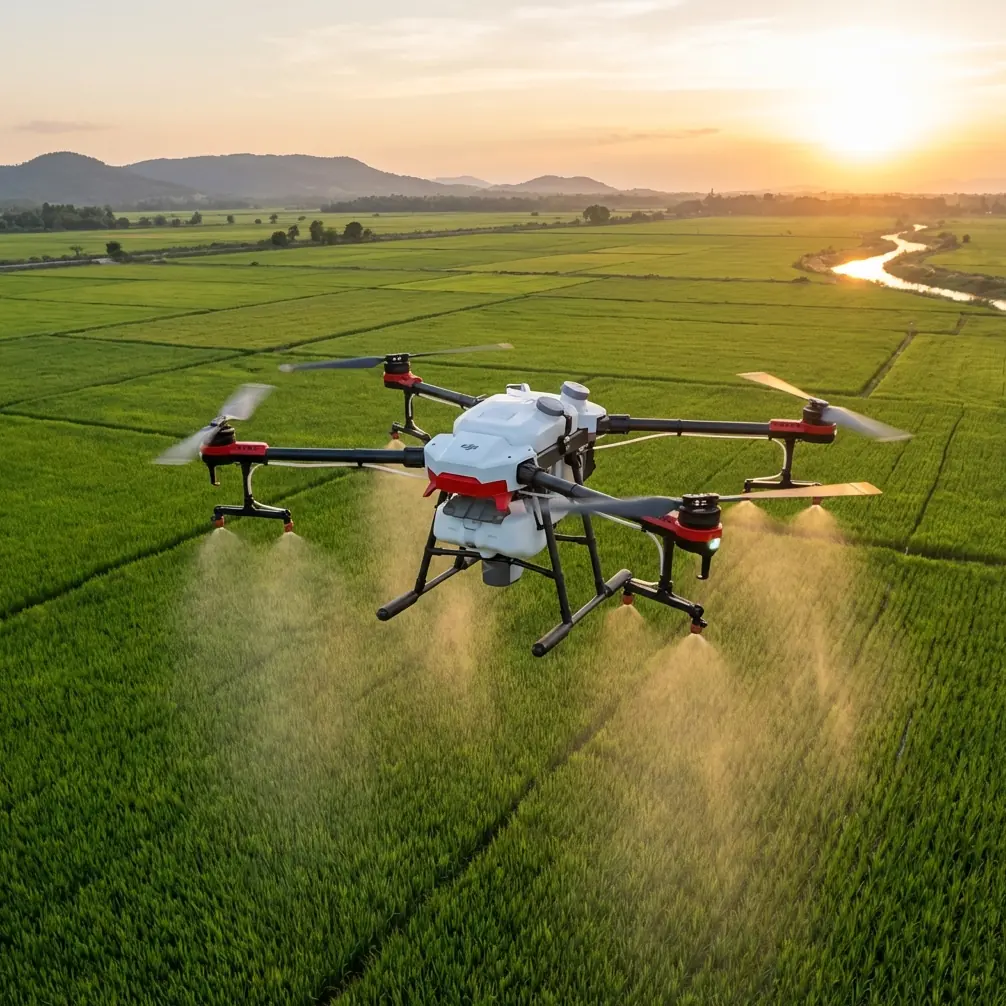
Agras T50 for Dusty Construction Site Inspection: What Actually Matters in the Field
META: A technical review of using the Agras T50 around dusty construction sites, with practical insight on flight altitude, sensor stability, route discipline, LiDAR-grade accuracy expectations, and airspace restriction awareness.
The Agras T50 is usually discussed through an agricultural lens. That makes sense on paper, but it misses something useful: this aircraft’s value on dusty construction sites is not just about payload or output. It is about control discipline, repeatability, and how well the platform behaves when the environment is messy, visibility is imperfect, and the ground itself is changing by the day.
If you are evaluating the Agras T50 for site inspection work, the wrong question is whether it can fly over a jobsite. Of course it can. The better question is whether it can produce consistent, actionable observations in a place where dust, uneven surfaces, moving equipment, and temporary obstacles constantly degrade normal drone workflows.
That is where a technical review gets more interesting.
Why dusty construction sites expose weak drone operations
Construction inspection sounds straightforward until the site stops behaving like a map. Stockpiles move. Haul roads shift. Vertical features appear quickly. Dust coats optics and reduces contrast. Homogeneous surfaces make feature extraction harder, which is a real issue if you expect photogrammetry alone to carry the workload.
One of the reference materials on LiDAR use in difficult survey areas makes this point indirectly but clearly: in hard-to-access terrain, traditional methods may be impractical, and standard UAV aerial imaging can struggle to produce high-precision output because repeated, similar-looking imagery makes it difficult to extract distinct feature points. That matters on a dusty construction site more than many operators admit. A graded pad, repetitive aggregate piles, and low-texture surfaces can create the same problem. The drone is not failing. The data model is starving for clean visual anchors.
This is why Agras T50 inspection planning should not be treated like a generic photo mission. You need a workflow that respects visual ambiguity and environmental contamination from the start.
The flight altitude insight that matters most
For dusty site inspection, the best operating altitude is usually lower than teams first assume, but not so low that rotor wash turns the mission into its own contamination source.
A practical target is to work in a moderate low-altitude band that preserves feature detail while keeping enough stand-off from the surface to avoid kicking up loose fines. The core logic comes from a training reference that describes a controlled forward acceleration sequence after takeoff: the aircraft rises an additional 50 centimeters to reach about 130 centimeters above ground before controlled forward flight begins, with pitch increased incrementally through a variable loop until the aircraft reaches a defined maximum state, then returns to hover and lands.
That training example is not about the Agras T50 specifically. But operationally, it illustrates a principle that applies very well to dusty construction inspection: abrupt low-level acceleration is the enemy of stable, readable data. Incremental acceleration is better. Hover-stabilize-transition is better. Gain speed progressively instead of punching forward immediately after takeoff.
Why does that matter on a construction site?
Because dust behaves like an invisible system penalty. If you accelerate aggressively near the surface, you create your own visual interference, reduce image clarity, and increase the chance that your first data segment is the worst part of the mission. A smoother transition profile gives the aircraft time to stabilize, lets sensors settle, and limits self-induced dust disturbance.
So the optimal altitude insight is this: start slightly higher than your instinct suggests, stabilize, then enter the inspection line with gradual forward input. If you need extremely fine visual detail on cracks, edge conditions, trench shoulders, or rebar staging, descend only after the air mass below the aircraft has settled. In dusty conditions, the lowest possible pass is rarely the smartest first pass.
Why repeatability beats raw speed
The same training material contains another detail worth borrowing into professional inspection logic: the forward control value increases step by step, with the variable v rising each cycle until it reaches 100, and the program waits 0.05 seconds between each increment. Again, this is educational content, but the significance is broader than coding pedagogy.
The value is not the number 100 itself. The value is the method.
On a dusty construction site, repeatable inspection depends on measurable acceleration behavior. If every mission begins with a different launch profile, your data consistency suffers. Differences in blur, camera angle stabilization, dust entrainment, and initial track alignment all show up later when you compare weekly progress.
This is where many teams overestimate pilot talent and underestimate procedural design. The Agras T50 benefits from a flight routine that is almost boring:
- take off cleanly
- reach a stable hover
- pause briefly
- confirm RTK fix rate and control response
- enter the route with gradual pitch changes
- avoid sudden descents near unconsolidated material
- recover to hover before repositioning
That one-second hover before descent mentioned in the training reference is another small but meaningful habit. On real sites, a short hover before landing or shifting task segments gives the aircraft a chance to settle, lets the operator verify visual conditions, and reduces sloppy endpoint behavior. Those little pauses are often the difference between clean operational logs and messy, inconsistent missions.
What centimeter-level expectations should look like
Construction clients love the phrase “centimeter precision,” but they often use it loosely. The LiDAR reference data is useful here because it frames what actual mobile mapping specifications look like in the wider geospatial world.
One lightweight long-range mobile system cited in the material reports 5 cm accuracy at 100 m, with a range of 920 m or 1350 m and a maximum effective measurement rate of 550,000 or 750,000 points per second, at a weight of 4.8 kg for deployment on UAVs and other platforms. Another lighter system lists 5 cm at 50 m and 10 cm at 100 m, a 250 m range, and 100,000 points per second, weighing 2.2 kg. A short-range system is listed at 1.5 kg, with relative precision of 5 cm and absolute precision of 10 cm over a 100 m range.
Those numbers are not Agras T50 specs. They are still extremely relevant.
They tell you what dedicated surveying payloads require to achieve true mobile-mapping-grade performance. So when someone expects an Agras T50 inspection mission to replace every detail of a LiDAR survey in a dusty, low-texture environment, that expectation needs calibration. The T50 can be highly useful for site awareness, surface condition review, stockpile monitoring, route checks, drainage path observation, and progress documentation. But if the task is formal asset-grade 3D capture in a difficult visual environment, you should benchmark against what real mobile mapping systems deliver rather than assuming any drone camera pass will do the same job.
Operational significance: this helps you define the T50’s role correctly. It is strongest as a robust aerial work platform for repeated field intelligence and site condition verification, not as a magical substitute for every survey instrument under every condition.
Dust changes the sensor conversation
The usual Agras T50 discussion circles around spray drift, nozzle calibration, swath width, and liquid delivery behavior. On a construction site, those same concepts have analogues.
- Spray drift discipline becomes air-mass discipline. You care about how downwash and ambient wind move fine material across your visual path.
- Nozzle calibration thinking becomes route calibration thinking. If your pass spacing and altitude are inconsistent, your inspection coverage will be too.
- Swath width awareness becomes field-of-view planning. Wider is not always better if edge detail is the goal.
- RTK fix rate becomes a serious operational gate, not a checkbox. If the aircraft is being used to document earthwork progression or compare recurring inspection routes, positional consistency matters more than headline speed.
Even if your output is mostly visual rather than survey-grade, repeated flights over changing terrain benefit from stable georeferencing. Without that, progress comparisons drift from meaningful to approximate.
When visual-only inspection starts to break down
A dusty construction site can be accessible but still behave like a difficult survey zone. That is exactly what the LiDAR source describes in another context: some areas are hard to measure not simply because they are far away, but because standard capture methods struggle to recover enough clear information for high-precision output.
Translate that to construction and you get a familiar list:
- repetitive ground texture
- dust haze
- washed-out surfaces at midday
- uneven embankments with weak feature definition
- partially obstructed utilities and trench edges
- rapidly changing machine tracks that confuse temporal comparisons
This does not mean the Agras T50 is the wrong aircraft. It means mission design has to do more work. Fly when dust is lowest. Avoid the hottest flat light if surface contrast matters. Break the site into smaller route blocks instead of one giant pass. Use moderate altitude first, then descend selectively for detail capture. Preserve consistent headings where possible so comparison datasets are visually coherent.
That is how you extract professional value from the platform.
Regulatory awareness is part of technical competence
There is another reference item that might seem unrelated at first: a warning that drone flights are banned during practice sessions and races on the TT course, and also banned during racing-related activity at Billown Circuit.
That sounds like a motorsport footnote. It is actually a strong reminder for construction operators.
Temporary restrictions are common around high-risk or high-profile activity zones. The operational significance is simple: even if a site itself is private and commercially managed, nearby event restrictions, temporary local controls, or safety overlays can make an otherwise normal inspection flight non-compliant. A technically capable aircraft is still grounded if the surrounding airspace or event conditions say no.
For construction firms working near roads, event venues, industrial corridors, or public gathering areas, airspace checking cannot be treated as a one-time setup step. It has to be part of the mission checklist every time. This is especially true for repeat inspections, where operator familiarity can become the source of complacency.
How I would set up an Agras T50 inspection routine on a dusty site
If the goal is dependable visual inspection rather than formal LiDAR replacement, I would structure the operation around consistency and contamination control.
First, launch from the cleanest available surface, not from loose spoil or dusty haul-road edges. Second, climb and stabilize before entering the first line rather than accelerating immediately at low level. The training reference’s incremental acceleration model is useful here because it reflects how controlled transitions produce cleaner flight behavior.
Third, choose an altitude that preserves context. Too low and you magnify dust and lose spatial understanding. Too high and you lose the edge details that matter on slope faces, drainage cuts, barriers, or material boundaries. The sweet spot is the lowest altitude that does not let rotor wash degrade the scene.
Fourth, confirm RTK stability before any comparison-sensitive run. Fifth, reserve ultra-close passes for targeted problem areas after the broad overview is complete. Sixth, inspect optics and exposed surfaces frequently. Dust accumulation quietly degrades data quality long before a mission becomes obviously unusable.
If you need help thinking through route structure, launch spacing, or altitude selection for a difficult site, this direct field support channel is useful: message our drone applications desk.
The honest read on the Agras T50 in this role
The Agras T50 is not interesting for dusty construction inspection because it is trendy. It is interesting because harsh jobsites reward aircraft that can repeat tasks cleanly, maintain stable behavior, and support disciplined workflows.
The most useful lesson from the reference materials is not a single spec. It is the combination of two ideas.
One: controlled acceleration and real-time data monitoring matter. The educational drone document shows this vividly through a stepwise forward-flight program, live variable tracking, and access to onboard values such as battery, TOF height, temperature, and acceleration. That mindset belongs in professional inspection work. If you can measure what the aircraft is doing in real time, you can tighten your operation instead of guessing.
Two: difficult environments punish simplistic expectations. The LiDAR material shows how serious mapping systems define performance in centimeters, points per second, range, and payload weight because difficult scenes demand engineering, not assumptions. Construction inspections in dusty conditions deserve the same respect.
So if you are planning to use the Agras T50 on a construction site, the question is not whether it can fly there. The question is whether your workflow is precise enough to make each sortie count.
That is where the real performance lives.
Ready for your own Agras T50? Contact our team for expert consultation.