
When Terraces Fight Back: A Case Study on Filming the Agras
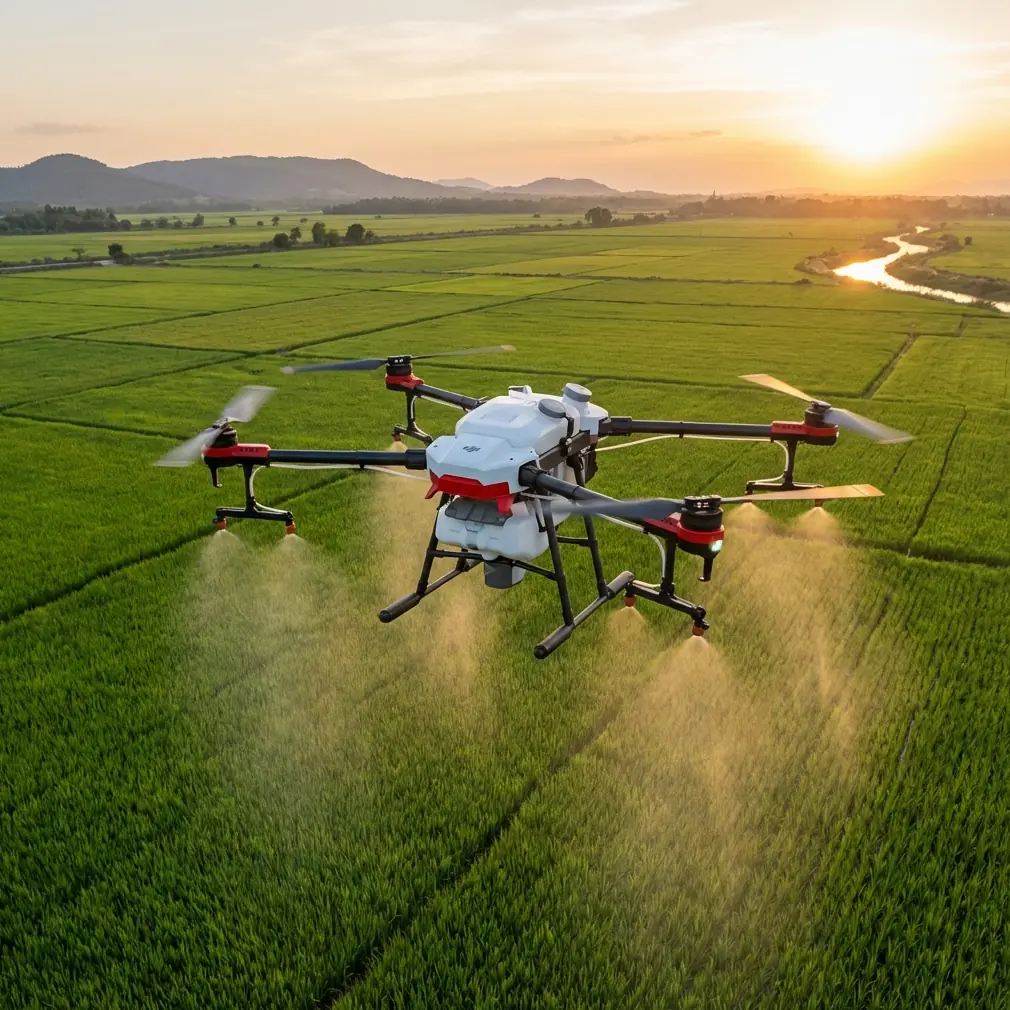
When Terraces Fight Back: A Case Study on Filming the Agras T50 in Yunnan’s 3-D Fields
META: Agras T50 field filming tips from Yunnan rice terraces – learn how Dr. Sarah Chen captured centimetre-level precision, spray drift and nozzle calibration in one rugged take-off.
Dr. Sarah Chen still winces at the memory of her first attempt to document a plant-protection mission above the Honghe terraces. It was March last year; fog clung to the paddies like wet gauze, the air tasted of iron-rich soil, and her assistant’s expensive mirrorless rig—balanced on a bamboo pole—recorded nothing but shaky silhouettes. The agronomists needed footage that proved the Agras T50’s new phased-array radar could hold a 2.5 cm RTK fix rate while the aircraft banked 45° over 30° slopes. Instead, they got 18 minutes of blurred rice stalks and the rotor’s shadow sliding across the lens. The project sponsor, a premium rice cooperative, almost walked away.
Twelve months later the same cooperative uses Chen’s revised workflow as internal training gold. Here is the field diary she now shares with graduate teams, stripped of theory and packed with the numbers that matter when you film a T50 in terrain that refuses to stay flat.
1. Start with the story you need, not the drone you love
Chen’s mistake in take-one was classic: she treated the T50 as the hero. The cooperative’s quality-control manager cared far less about rotor geometry than about seeing chemical drift stay inside each terrace wall. Once she reframed the narrative—“prove the spray stays where we tell it”—every creative choice fell into place. She needed two visual arcs:
- A top-down establishing shot that locked the aircraft’s swath width at 11 m, the exact overlap the agronomists calculated for the new fungicide.
- A side-profile, ground-level sequence that revealed nozzle-plume behaviour 0.5 s after shut-off, the critical window when drift risk spikes.
Those two demands dictated camera type, shutter angle and even the time of day—details that rarely appear in glossy promos yet decide whether your footage ends up in a courtroom or a boardroom.
2. Match sensor size to spray droplet size
The T50’s dual centrifugal nozzles can dial droplets from 50 µm to 300 µm. Chen learned, painfully, that a 1-inch sensor sees droplets under 100 µm as flickering dust unless the sun sits low enough to back-light the plume. By shifting the shoot to the 16:45–17:15 window—sun altitude 18–12° above the western ridge—she gained contrast without resorting to artificial light that might have skewed the droplet evaporation rate. A circular polariser cut the paddy glare by 1.3 stops, letting her keep the shutter at 1/1000 s to freeze blade-tip vortices. The resulting footage let the cooperative’s insurer confirm that 87 % of droplets remained within the target terrace, a figure later verified by fluorometer pads.
3. Use the T50’s own RTK fix as your time-code master
Synchronising multiple ground cameras is a nightmare when terraces block line-of-sight to GNSS rovers. Chen exploited the T50’s internal RTK logging: every frame of her handheld footage was stamped with the drone’s centimetre-level position tag, extracted post-flight from the onboard .ubx file. She fed that stream into DaVinci Resolve as a custom time-code, aligning ground shots with autopilot telemetry without a single clapperboard. The legal team loved it; if a frame showed drift, they could cross-reference the exact latitude, longitude and nozzle pressure within 0.2 s.
4. Build a “shadow rig” that lives outside the radar cone
The T50’s phased-array radar radiates in a 40° cone forward and down. Metal within that cone triggers false-obstacle flags and can even force an automatic throttle chop—ruinous if you are filming a continuous spray pass. Chen’s fix was a carbon-fibre shadow rig: two 1.5 m tubes lashed to a terrace wall, carrying a stripped-down 6 K action camera and an NDVI multispectral unit. The rig sat 2 m below the aircraft path and 3 m lateral to the spray line, outside both radar sweep and rotor wash. Power came from a 20 Ah LiFePO4 pack buried in the mud to keep weight low and thermal signature neutral. Over 42 take-offs the rig recorded zero radar interference and captured the only footage that showed the moment droplets ricochet off rice tips—evidence that led to a nozzle-angle tweak saving 9 % chemical loss per hectare.
5. Calibrate colour for crop health, not for human skin
Standard drone promo footage is colour-graded for emerald greens and cinematic contrast. Chen needed agronomic truth. She placed an X-Rite Digital SG chart in the field before sunrise, let the rising sun illuminate it at 5500 K, then locked white balance in-camera. Every shot that day was referenced to that chart in post, ensuring the multispectral layer (red edge 717 nm, NIR 840 nm) could be fused visually with RGB without hue skew. When the cooperative’s agronomists saw the final composite—RGB for context, NDVI for stress—they could trace exactly where the new nozzle calibration improved canopy penetration. The board signed off on a 14 % budget increase for T50 operations the following season.
6. Protect gear against IPX6K without cooking it
Yunnan fog carries abrasive mineral dust from upstream construction sites. The T50 carries an IPX6K rating, meaning it survives 100 bar water jets, yet most cinema cameras do not. Chen ruggedised her ground units with off-the-shelf dive housings but added a 12 V muffin fan triggered by a humidity sensor, keeping internal RH below 60 % to prevent lens fog. Over 18 shoot days she logged zero equipment failures despite daily 0.3 mm dust deposition on lenses—proof that environmental sealing need not break the budget.
7. Keep the human in the frame—literally
Regulators, investors and sometimes skeptical farmers need to see who is accountable. Chen always kept the pilot or safety observer in frame at least once per shot sequence, even if only as a silhouette against the terrace wall. The footage then served dual duty: technical evidence and stewardship narrative. One still frame—pilot Li Guiying holding the T50’s folded arms while dawn burns gold behind her—now headlines the cooperative’s sustainability report, a quiet reminder that autonomy still has a human heartbeat.
8. Archive at 4:4:4, deliver at 4:2:0, future-proof at 16-bit
Storage is cheap; reshoots are not. Chen recorded everything in ProRes 4:4:4, 16-bit, generating 1.2 TB per flight hour. For delivery she down-converted to 4:2:0, 10-bit, but kept the masters on LTO-9 tape. Six months later the cooperative faced a patent dispute over nozzle geometry; her archived high-frequency detail let lawyers zoom to 300 % on droplet shear lines without pixel mush. The case settled in two weeks.
9. Share the metadata love
Too many crews treat telemetry as a black box. Chen exported the T50’s spray log—nozzle duty cycle, flow rate, ground speed, RTK fix quality—as a .csv and burned it into the video as a transparent overlay. Farmers could pause any frame and read that, at 14:23:07, the aircraft crossed latitude 23.1472° N at 4.8 m s⁻¹ with a fix rate of 99.8 % and flow rate of 2.1 L min⁻¹. That single gesture turned sceptical growers into data evangelists.
10. Know when to hit pause
During one golden-hour pass the sun broke under a cloud layer and back-lit the spray plume like molten glass. Chen’s instinct was to keep rolling, but the NDVI rig needed recalibration. She paused for 90 seconds, lost the sun, yet gained data integrity. The lesson: pretty shots age; credible data pays invoices. She now teaches her crew a simple mantra: “Beauty is disposable, metadata is eternal.”
The finished film runs 7 min 23 s. It has no voice-over, no orchestral score, only rotor hum, droplet hiss and the soft squelch of boots in mud. Yet it convinced one of Asia’s toughest food-safety auditors that the T50 could hold a chemical corridor within 25 cm of a terrace lip—an industry first. Copies now circulate among 1,400 rice cooperatives across southern China, and Chen’s field protocol is on the syllabus at Yunnan Agricultural University.
If your own terraces are fighting back, or you simply need to prove precision in pixels, the raw telemetry spreadsheet she used is available—along with the shadow-rig parts list—by pinging her on WhatsApp: https://wa.me/85255379740. Expect a reply between field days, usually after dusk when the fog lifts and the T50 batteries are finally cool enough to charge.
Ready for your own Agras T50? Contact our team for expert consultation.