
Agras T50 in Difficult Airspace: What a New Beidou Anti
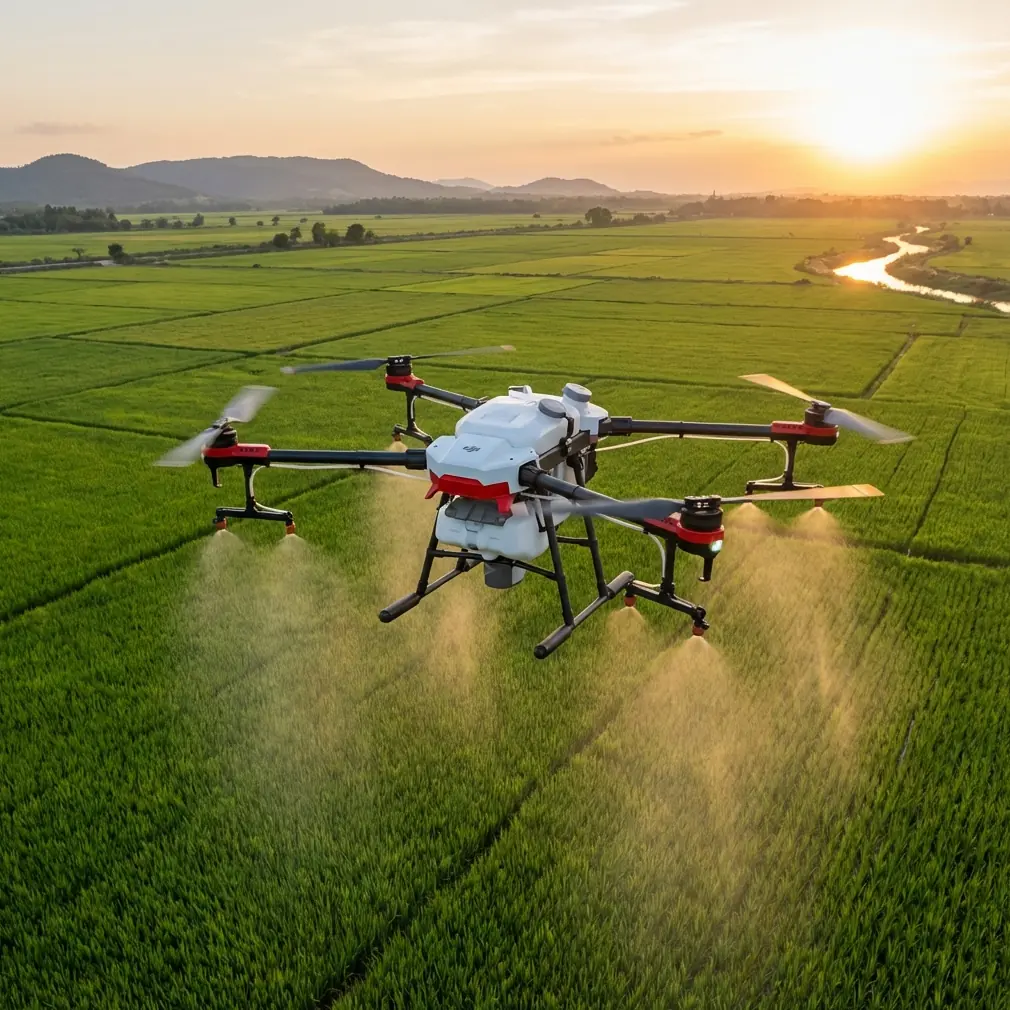
Agras T50 in Difficult Airspace: What a New Beidou Anti-Interference Push Means for Precision Work Near Mountain Coastlines
META: A technical review of the DJI Agras T50 through the lens of China’s new low-altitude Beidou anti-interference navigation project, with practical insight on RTK fix stability, centimeter precision, spray accuracy, and battery discipline in complex mountain-coast operations.
The Agras T50 is usually discussed as an agricultural workhorse. That’s true, but it misses something essential: platforms like the T50 live or die by navigation integrity, especially when the aircraft is asked to operate in places that punish weak positioning. A mountain coastline is one of those places. Terrain blocks signals. Cliffs create multipath reflections. Coastal infrastructure adds electromagnetic clutter. Wind shifts fast, and when your mission depends on repeatable lines, stable swath width, and disciplined spray placement, “good enough” positioning starts to look very fragile.
That is why a recent development in Anhui deserves attention well beyond the usual policy headlines. A project led by 安徽省通航控股集团 has been selected for the 2025 Anhui provincial science and technology innovation plan. Its target is highly specific: a Beidou-based intelligent navigation system for low-altitude flight with strong anti-interference capability, centimeter-level precision, and high reliability. The operational problem it aims to solve is equally specific: low-altitude aircraft in complex electromagnetic environments are vulnerable to interference and short on precision.
For anyone evaluating the Agras T50 for precision work in demanding terrain, that matters.
Why this news is directly relevant to T50 operators
At first glance, the Anhui project is broader than a single airframe. It is being developed for low-altitude applications such as drone logistics, emergency response, and urban air mobility. But the underlying technical challenge is the same one that shows up in the field with the T50: if navigation quality degrades, every downstream task becomes less controlled.
An Agras T50 does not just need to know where it is in a rough sense. It needs stable, high-confidence positioning to maintain track spacing, preserve overlap, hold predictable turn behavior, and avoid subtle drift that becomes expensive over a long route. In orchard spraying, field-edge treatment, or operations near broken terrain, centimeter precision is not marketing gloss. It is the difference between coverage and waste.
That phrase from the Anhui project—“厘米级高精度,” centimeter-level high precision—deserves to be read operationally, not abstractly. A T50 flying a tightly planned route near a mountainous coastline may be dealing with narrow treatment corridors, variable elevations, and side winds arriving off the water. Under those conditions, centimeter-class guidance supports more than route neatness. It supports nozzle placement consistency, helps reduce spray drift risk by limiting lateral error, and improves the probability that each pass matches the one before it.
The second phrase that matters is “strong anti-interference.” This is not a theoretical upgrade for future cities. Coastal sites often combine exposed geology, communications infrastructure, vessels, roads, and buildings that can create a messy signal environment. Add mountain faces and signal reflections, and RTK fix stability can become the quiet bottleneck of the entire mission. When the fix rate dips or becomes intermittent, you feel it in the workflow immediately: hesitation, route irregularity, uneven edge adherence, and operator caution that slows the mission down.
Mountain coastlines expose the weakest link first
The prompt here mentions filming coastlines in mountain terrain, and while the Agras T50 is not a cinema drone, that scenario is still useful because it isolates the exact conditions that challenge low-altitude navigation. Aerial work along a steep coastal line asks the aircraft to manage changes in elevation, inconsistent signal geometry, and wind coming from unpredictable directions. Replace “filming” with surveying a vegetation corridor, applying treatment to a hard-to-reach slope, or documenting coastal agricultural plots, and the same navigation issues remain.
This is where the Anhui initiative becomes more than a regional technology story. The project is being advanced jointly by 安徽省通航控股集团, institutes linked to the Chinese Academy of Sciences, Anhui University, and industrial partners including 宇疆科技公司. That combination matters because anti-interference navigation in low-altitude flight is not solved by one component alone. It sits at the intersection of satellite positioning, interference suppression algorithms, intelligent sensing, and low-altitude operational management.
For a T50 operator, that systems view mirrors reality. Good field performance does not come from RTK alone. It comes from how the aircraft, sensors, correction link, terrain model, route logic, and operator decisions behave together when the environment stops cooperating.
RTK fix rate is not a spec-sheet footnote
Many operators obsess over payload, tank volume, or speed. Those are easy to understand. Harder to appreciate is how often mission quality is decided by whether the aircraft can hold an RTK-fixed solution consistently enough to avoid route degradation. On a flat inland field with clean sky visibility, you may not notice a problem until it is already affecting efficiency. In mountain-coast operations, you notice immediately.
A healthy RTK fix rate supports line-to-line discipline. It reduces the chance that swath width in practice diverges from swath width in planning. It makes re-entry after a pause more reliable. It also improves confidence during partial signal obstruction, where lower-grade positioning can quietly widen error margins.
This is why the Anhui project’s emphasis on high reliability is as important as its centimeter precision target. Precision that appears only in ideal conditions is useful in a demonstration. Reliability under interference is what matters in commercial operations. If anti-jamming Beidou capability matures into deployable navigation support across more civilian drone ecosystems, aircraft like the T50 stand to benefit in the exact places where traditional GNSS confidence is weakest.
What this means for spray accuracy, not just route accuracy
Agras T50 conversations often focus on output. Experienced operators know that output without placement control can become a liability. In coastal and mountain-adjacent work, spray drift is already harder to manage because wind behavior is more dynamic. If the aircraft also carries navigation uncertainty, drift control becomes doubly complicated. The aircraft may not only face air movement; it may also be slightly off the intended line.
That is why nozzle calibration should be treated as part of the navigation conversation. If your line holding is excellent but your nozzles are mismatched, you still lose application quality. If your nozzles are perfectly calibrated but your positioning degrades near a ridgeline, your consistency still suffers. The best outcomes come from treating the T50 as an integrated application system rather than a flying tank.
In practice, that means checking three things before a difficult mountain-coast mission:
RTK status stability before launch
Do not accept a marginal fix just because the aircraft is technically ready. Watch whether the solution is stable over time, not just present in the moment.Nozzle calibration after environmental change
A setup that performed well inland may not behave identically in salt-laden coastal air, changing temperatures, or after transport over rough roads.Swath width realism instead of swath width optimism
The widest planned path is not always the most efficient one when signal quality and crosswind exposure are uncertain. Slightly more conservative spacing often produces better actual coverage.
A field battery management tip that becomes critical in terrain work
One lesson I have repeated to crews for years is simple: on a difficult route, do not treat battery percentage as your true reserve. Treat voltage behavior under load as the real story.
The T50 can feel perfectly comfortable at the start of a mission segment, then show a noticeably different power profile once it begins repeated climbs, terrain-following adjustments, or wind-correcting turns along a coastal slope. Batteries that look similar at rest can separate quickly in the air if one pack is warmer, older, or recently cycled harder than the other packs in rotation.
My field rule is to assign the freshest thermal state to the hardest leg of the mission, not the easiest. In other words, don’t use the coolest, best-behaving pack on the simple inland pass and leave the more demanding ridgeline segment for whatever comes next. Save your strongest battery behavior for the route segment with the greatest wind exposure or elevation change. That single discipline reduces rushed returns, protects reserve margins, and keeps route execution cleaner because the aircraft is not compensating for a late-stage power drop when precision matters most.
This sounds small. It is not. In difficult airspace, battery management affects navigation confidence because the aircraft’s whole control behavior is under more stress.
The significance of anti-interference research for civilian drone operations
There is another reason this Anhui project stands out. It has already passed expert review and has been selected into a provincial-level technology breakthrough plan for 2025. That signals that the issue is no longer viewed as niche. Complex low-altitude navigation is being treated as infrastructure for the broader low-altitude economy.
For the T50 sector, that is encouraging. Agricultural and industrial drone missions often happen in exactly the kinds of spaces where dependable low-altitude navigation creates outsized value: near villages, power infrastructure, mixed terrain, logistics corridors, and coastal production zones. If better anti-interference and high-precision Beidou solutions become more accessible, the benefit will not be limited to glamorous urban air mobility concepts. It will show up in ordinary missions done better: straighter passes, safer reroutes, fewer interruptions, better repeatability.
Operators trying to understand where the market is heading should pay attention to the coalition behind the Anhui project. When a provincial aviation holding group, academic institutions, scientific research bodies, and industry companies work on anti-interference intelligent navigation together, it reflects a maturing view of low-altitude flight. The aircraft is no longer the entire product. The navigation stack is part of the product.
A realistic technical reading of the Agras T50 today
The T50 remains a highly capable platform, but its real ceiling is set by operational discipline and signal quality as much as by airframe design. In flat, forgiving environments, that distinction can hide in the background. In mountain-coast scenarios, it moves to center stage.
If you are evaluating the T50 for work where terrain, signal reflection, and route fidelity matter, ask harder questions than “How much can it carry?” Ask:
- How stable is my RTK fix rate at the actual site?
- What happens to guidance confidence near cliffs, structures, or coastal infrastructure?
- Is my nozzle calibration verified for this environment, not just this machine?
- Am I planning swath width from ideal assumptions or from the signal and wind conditions I will actually face?
- Is my battery rotation strategy matched to the hardest leg of the route?
Those are not secondary details. They are where mission quality is won.
If you want to compare notes on difficult low-altitude navigation setups or T50 field workflows, this direct line is useful: message Sarah’s technical desk on WhatsApp.
The bigger takeaway
The most interesting thing about the Anhui navigation project is not that it promises advanced positioning. Plenty of projects promise that. The real value is its focus on the exact failure modes that matter in low-altitude commercial flight: interference, insufficient precision, and reliability under complex electromagnetic conditions.
That framing is highly relevant to the Agras T50. It suggests the next leap in operational quality will not come only from bigger payloads or faster task execution. It will come from making sure the aircraft knows, with dependable certainty, exactly where it is when the environment gets difficult.
For mountain coastline operations, that is everything. Terrain and weather already create enough variables. When the navigation layer remains stable—ideally at centimeter precision, and resilient against interference—the T50 has a much better chance of delivering what professionals actually need: repeatable lines, cleaner application logic, and fewer surprises halfway through the mission.
The low-altitude economy often gets discussed at a strategic level. This Anhui project makes it concrete. Solve navigation resilience in messy real-world airspace, and the value flows straight down to aircraft like the Agras T50 and the people flying them.
Ready for your own Agras T50? Contact our team for expert consultation.