
How I’d Use the Agras T50 to Support Remote Solar Farm Opera
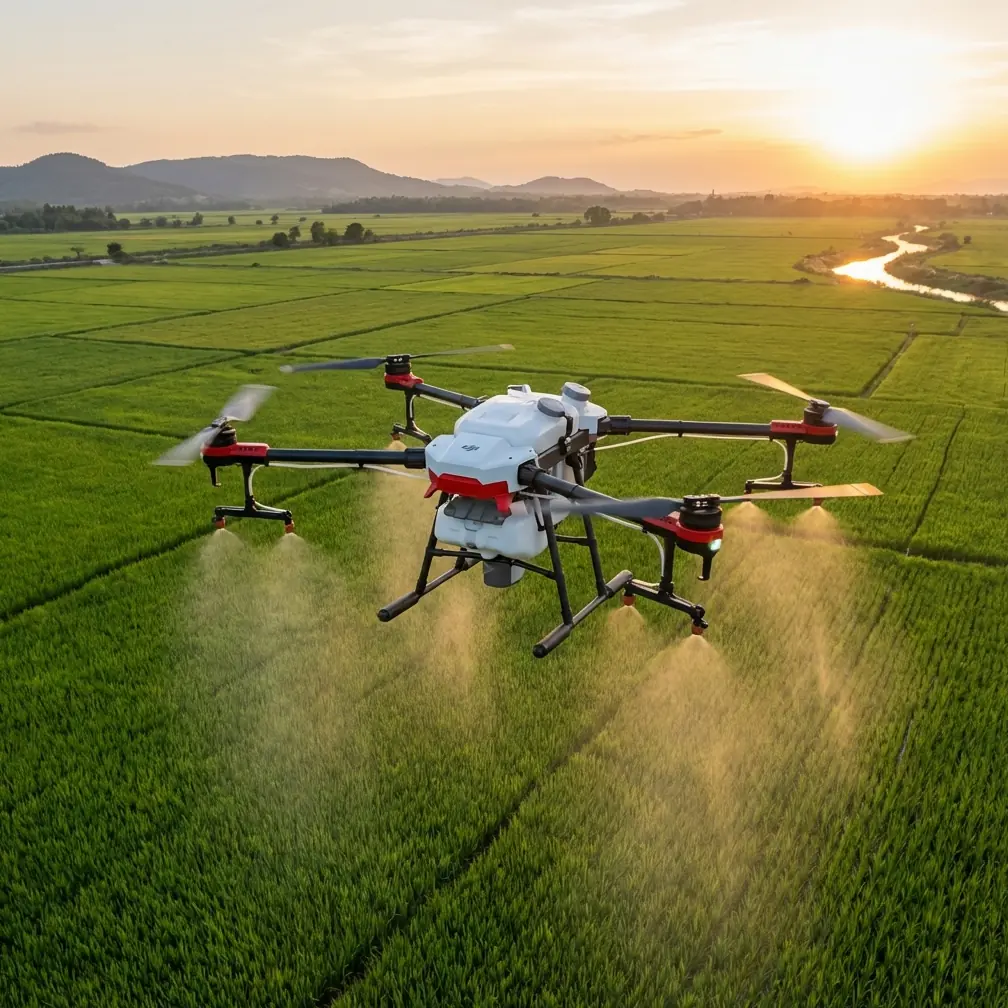
How I’d Use the Agras T50 to Support Remote Solar Farm Operations Without Creating Maintenance Headaches
META: A practical expert guide to using the Agras T50 around remote solar farms, with real operational lessons on battery care, spray-system cleaning, observer coordination, and training discipline.
Remote solar farms have a way of exposing every weakness in an operation.
Distance amplifies delays. Dust gets into everything. A small maintenance mistake made at sunset becomes a lost work window the next morning. That is why, when people ask whether the Agras T50 fits work around remote solar assets, I rarely begin with payload talk or brochure-level specifications. I begin with process.
The real question is not whether the aircraft can fly. It is whether a crew can keep it productive, safe, and repeatable when support infrastructure is thin and every trip back to base is expensive.
That is where the T50 becomes interesting.
Although the Agras T50 is usually discussed in an agricultural context, the reference material behind this article points to something more valuable than a feature sheet: a disciplined way of operating drones. One source comes from a youth drone education program built by a Shenzhen company tied to UAV R&D and formal pilot training. Another focuses on agricultural plant-protection workflow, especially cleaning, battery handling, and observer coordination. Put together, they describe the habits that matter most in remote field operations. For solar farm support, those habits are often the difference between a useful aircraft and an unreliable one.
The lesson remote solar sites teach fast
I have seen teams arrive at a remote site with a capable aircraft and still lose the day.
Not because the drone lacked power. Not because GNSS failed. Not because the mission planning was poor. The weak point was simpler: the spray circuit had residue from the previous task, battery health had not been checked at the cell level, and the pilot was trying to manage line-of-sight limitations without strong observer support.
A machine like the Agras T50 can absolutely reduce labor in wide, repetitive corridors and difficult-access zones around utility-scale solar farms. Think vegetation management around fence lines, service roads, drainage margins, and non-panel exclusion areas where ground equipment is slow or impractical. But in remote environments, efficiency comes from routine precision, not just aircraft capability.
The source material is blunt about this. At the end of the workday, the aircraft and the entire spray system should be cleaned immediately. That includes the pump, nozzles, piping, and metal structures that may be exposed to chemical residue. Why does that matter for a T50 working around remote solar fields? Because residue is not just a cleanliness issue. It can corrode components, restrict flow, and alter the next day’s application rate. Once flow changes, nozzle calibration is no longer trustworthy, swath consistency suffers, and spray drift risk rises because the atomization profile is no longer what the operator expects.
That chain reaction is easy to underestimate until coverage gaps start appearing between array rows or along perimeter strips.
Why post-mission cleaning matters more than people think
A remote solar farm does not forgive deferred maintenance.
The source text specifically warns that some formulations are viscous enough to clog pumps and nozzles if they are not flushed promptly with clean water. That single detail has broad operational significance. On an Agras T50, clogged flow paths do not merely reduce output. They distort the mission itself. A blocked nozzle changes droplet distribution, creates asymmetry in the spray pattern, and undermines planned swath width. If one side of the aircraft is underperforming, your map may say the job is complete while the ground result says otherwise.
For solar-farm-adjacent vegetation work, that is not a trivial defect. Uneven application can leave regrowth pockets in access lanes or around infrastructure. Then crews return earlier than planned, which defeats the productivity advantage of using the aircraft in the first place.
My rule for remote deployments is simple: if the T50 lands after a spray task, the cleaning sequence starts before anyone starts packing vehicles. The aircraft body should be washed down as needed, but the critical point is the fluid system. Flush first. Inspect nozzles. Confirm free flow. Check for residue in the pump and line interfaces. Only then do you close the day.
That discipline is more valuable than any marketing claim.
The battery routine that protects tomorrow’s mission
The second reference document includes one of the most practical battery guidelines operators often skip: check whether the voltage difference between two batteries, and between individual cells, is less than 0.2V before use.
That number matters.
For an aircraft operating in a remote solar installation, battery inconsistency is a mission-risk multiplier. When a high-capacity platform is flown over long, repetitive segments, power predictability matters as much as raw endurance. A pack with excessive cell imbalance may still appear usable, but under load it can behave unevenly, trigger conservative system protections, or reduce confidence in mission timing. On a remote site, that means more aborted sorties, more interrupted task blocks, and more conservative dispatch decisions by the pilot.
The source also states that if cell voltage differences become too large, the battery should be balanced with small-current charging before normal use. Again, this is not a minor workshop note. It is the kind of field protocol that keeps a T50 deployment stable over a season.
The preservation guidance is equally relevant: if there is no near-term task, batteries should be stored at 3.85V. During the off-season, they should go through 2–3 charging cycles per month. Those are not abstract best practices. For remote solar service contractors, they are lifecycle controls. A T50 may not be flying every day outside peak vegetation periods, so battery neglect often happens during the quiet months, not the busy ones. By the time the next contract window opens, the team is trying to work with degraded packs and wondering why field performance feels inconsistent.
Healthy batteries make operations calmer. Crews become more willing to commit to larger blocks, mission planning improves, and RTK-dependent route work becomes easier to trust because the aircraft’s energy behavior is more predictable from launch to recovery.
Observer and pilot coordination is not optional on sprawling sites
One line from the source should be printed on every field checklist: the coordination between observer and pilot directly affects aircraft safety.
That is especially true at remote solar farms.
These sites can look simple from a distance—rows, roads, fences, repeat. In reality, they are visually deceptive. Glare shifts throughout the day. Elevation changes can hide the aircraft. Service structures, cables, drainage features, and peripheral vegetation create obstacles exactly where a pilot’s visual confidence may already be reduced by distance. The source material notes that the observer should continuously report aircraft status and position when it moves beyond the pilot’s best visual range, while also helping avoid obstacles and preserve application coverage.
That is a remarkably practical description of what good field teamwork looks like.
With the Agras T50, this matters because consistent low-altitude work around large assets depends on stable crew communication. The observer is not merely a compliance formality. The observer protects coverage integrity. If the aircraft deviates to avoid a hazard without coordinated awareness, missed strips can appear. If the pilot hesitates because the aircraft is harder to see across reflective terrain, efficiency drops. If no one is actively confirming aircraft position relative to access roads, edge boundaries, and array-adjacent zones, the operation becomes less precise than the hardware is capable of delivering.
In other words, centimeter precision is only useful if the human system around the drone is equally disciplined.
What youth drone education surprisingly gets right about the T50 mindset
At first glance, a youth UAV education slide deck might seem unrelated to an Agras T50 article. I think the opposite.
The strongest operations I have seen are built on the exact learning habits described in that material: hands-on disassembly, mechanical assembly, circuit soldering, wiring design, and computer-based flight data analysis. The document argues that these activities build tool familiarity, practical ability, and data literacy. For a T50 crew working in remote commercial environments, those are not classroom niceties. They are field advantages.
An operator who understands how systems fit together treats inspections differently. A technician who has worked through wiring logic is faster at isolating faults. A pilot who is comfortable analyzing flight data does not shrug off anomalies in application behavior or route performance. These teams catch issues early.
The same document also mentions that the parent company behind the program had AOPA-China-recognized civil drone pilot training qualifications in Shenzhen and had developed UAV technology with more than 40 patents. Strip away the institutional framing and the takeaway is clear: serious drone work benefits from structured training culture, not improvisation.
That is the operational significance for Agras T50 users. The aircraft performs best in organizations that train methodically, document procedures, and treat fieldcraft as a technical discipline.
A practical T50 workflow for remote solar farm delivery
If I were setting up an Agras T50 workflow for remote solar support, I would build it around five habits.
1. Start with terrain and corridor logic
Before mission execution, break the site into repeatable blocks: perimeter lanes, drainage edges, service roads, non-panel vegetation zones, and setback areas. The T50 is most useful where a pattern can be repeated consistently. Tight, fragmented micro-zones create more handling complexity and increase spray drift exposure.
2. Confirm spray-system integrity before the first sortie
Do not assume yesterday’s cleanout was enough. Inspect nozzles, lines, and pump response. If the previous formulation had higher viscosity, verify that flow is even across the system. This is where nozzle calibration earns its keep. A remote site is the wrong place to discover that one part of the distribution system is partially restricted.
3. Treat battery balance as a go/no-go item
Before launch, confirm adequate charge and verify that inter-pack and cell-level voltage differences remain within the 0.2V threshold referenced in the source. This is one of the easiest ways to protect mission continuity. On large sites, consistency is operational currency.
4. Assign the observer real authority
The observer should not just “watch.” The observer should call aircraft position, identify obstacles beyond easy pilot sight, and help preserve complete spray coverage. This is especially valuable when long rows, glare, or topography reduce visual confidence.
5. End the day with next-day readiness
Clean the aircraft and flush the spray system immediately after operations. If the T50 will be idle, move batteries toward the 3.85V storage target. During low-activity periods, maintain the 2–3 monthly charge cycles noted in the source. That is how you preserve fleet readiness without expensive surprises.
Where the T50 really helps
For remote solar projects, the Agras T50 makes the most sense when labor access is inefficient, site geometry is broad, and repeatable treatment zones justify an aircraft-based workflow. Its value shows up not only in acres covered, but in reducing vehicle movement through difficult terrain, shortening turnaround on dispersed work areas, and keeping treatment patterns more consistent than ad hoc ground methods.
But I would be careful with one assumption: buying a capable aircraft does not solve field execution by itself.
The source materials make that clear in a way many product pages do not. The high-value practices are old-fashioned and technical at the same time: train seriously, understand the machine, clean immediately, monitor batteries correctly, and keep the observer-pilot relationship tight.
That is the difference between operating an Agras T50 and actually delivering with it.
If you are planning a remote solar-farm workflow and want to compare task design, maintenance routines, or crew setup, you can message our field team here and discuss the practical side before deployment.
The T50 is a strong platform. Yet on remote sites, the aircraft is only half the system. The other half is discipline. The references behind this piece point to exactly that: a culture of training and a culture of maintenance. Put them together, and the drone stops being a promising tool and starts becoming a reliable one.
Ready for your own Agras T50? Contact our team for expert consultation.