
Agras T50 in Windy Corridor Operations: What a Highway Case
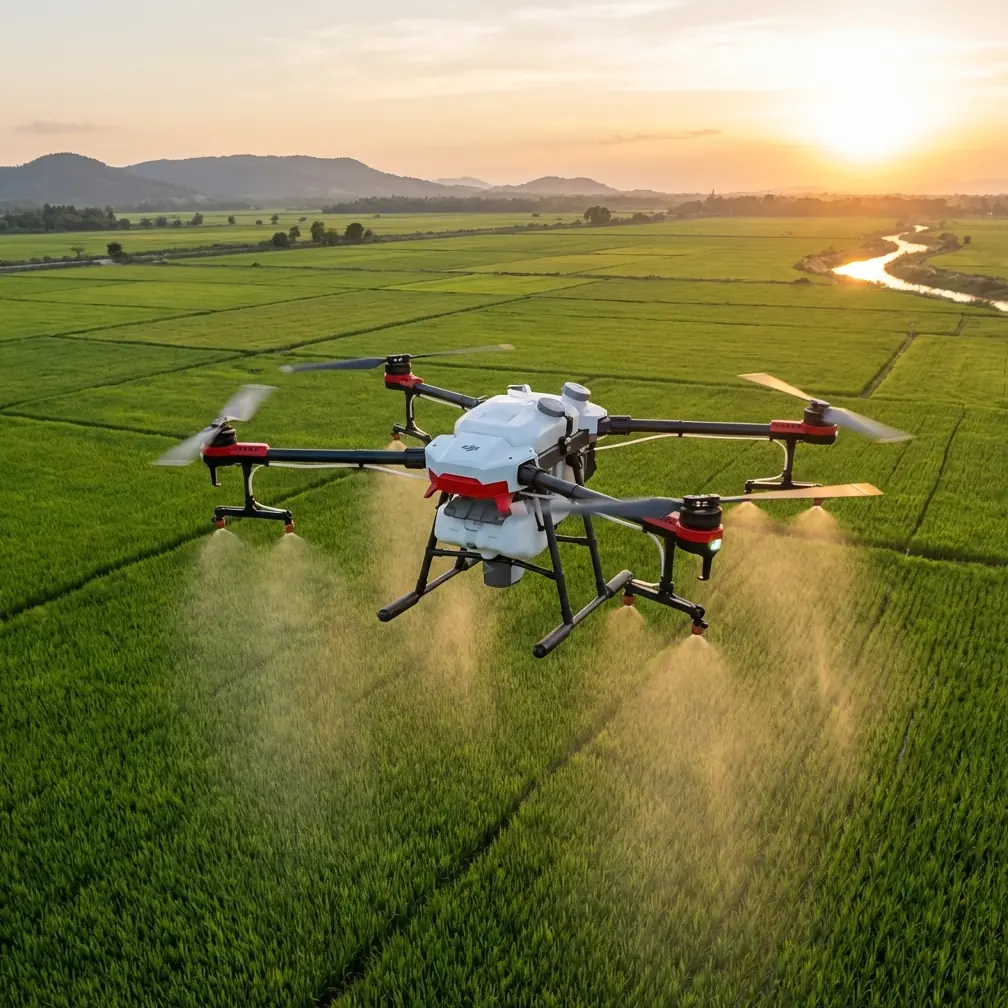
Agras T50 in Windy Corridor Operations: What a Highway Case Reveals About Altitude, Data Load, and Safe Decision-Making
META: A field-focused Agras T50 case study on windy highway-adjacent operations, covering optimal flight altitude, spray drift control, sensor strategy, data transmission priorities, and why disciplined airspace awareness matters.
The Agras T50 is often discussed as if performance begins and ends with payload, flow rate, or acreage per hour. That misses the real operating question. In a difficult environment—especially along highways where wind behavior is messy and airspace awareness matters—results come from how well the aircraft, sensor stack, pilot workflow, and mission design fit together.
That is where this case-study lens becomes useful.
Let’s frame a practical scenario: a team is using an Agras T50 for agricultural work on fields bordering a major highway during windy conditions. The challenge is not simply “can the drone fly?” Of course it can. The better question is how to preserve application quality and operational safety when crosswinds, vehicle-induced turbulence, visual distractions, and compressed work windows all stack up at once.
The most valuable insight in that setting is flight altitude discipline.
Why altitude becomes the make-or-break variable
With the Agras T50, windy operations near highways punish excessive height. The higher the aircraft flies above the canopy, the longer droplets remain exposed to crosswind and turbulence. That increases spray drift, widens inconsistency across the swath, and makes nozzle calibration less meaningful because droplets no longer land where the application model assumes they will.
In this kind of corridor work, the optimal flight altitude is usually the lowest height that still maintains stable terrain clearance, even spray overlap, and obstacle safety. Not low for the sake of aggression—low for the sake of control.
That distinction matters.
A highway edge is not a normal open field boundary. Passing traffic creates intermittent turbulence. Heat from pavement can contribute to unstable low-level air movement. Embankments, tree lines, sign structures, and drainage cuts can change local airflow over very short distances. If a pilot sets altitude too conservatively high, thinking it will create a safety buffer, the result can be the opposite on the application side: more drift, more off-target deposition, and less predictable swath width.
For the T50, the operational target in wind is not maximum clearance. It is minimum effective exposure.
The hidden lesson from older agricultural UAV research
One of the reference documents, a Chinese technical discussion on farmland information acquisition, makes a point that is still highly relevant to T50 operations today: different agricultural information types often require different sensing approaches. Soil conditions may rely on spectral sensing, weed identification may use shape-feature sensing, and crop growth monitoring may depend on multi-temporal imaging. The document argues that the real breakthrough is integrating multiple sensing functions into a more unified onboard package so operators save airborne space and weight while improving efficiency and lowering acquisition cost.
That sounds academic at first glance. In practice, it goes directly to how a T50 should be configured and flown in demanding field conditions.
Every extra device, bracket, battery burden, or loosely justified payload decision affects aircraft efficiency. In windy highway-adjacent missions, that matters even more. You are managing not just application accuracy, but also stability margins, battery planning, and real-time pilot workload. A cleaner airborne setup generally gives the operator more useful performance than a cluttered “just in case” configuration.
The same document also notes that UAVs need to handle several information streams at once: flight attitude data, route-capture imagery, and sensor-acquired information. Just as important, it distinguishes between data that must be transmitted immediately and data that can be stored onboard. Flight information needs timely transmission for control and adjustment; crop-growth data, where real-time response is less critical, can be stored on a large-capacity card.
That principle is gold for Agras T50 operations.
In a windy corridor mission, your highest priority data stream is not every possible live visual layer. It is the information that preserves aircraft control and mission integrity: attitude status, positioning quality, route adherence, and application behavior. If operators overload themselves chasing too much live information at once, they can actually degrade decision quality in the moment that matters.
RTK fix rate and centimeter precision are only useful if the mission design respects the wind
People love the phrase “centimeter precision.” They should. When RTK fix rate is stable, the T50 can hold lines and repeat paths with a level of consistency that ground rigs struggle to match in awkward field geometry.
But precision on paper does not cancel atmospheric behavior.
A stable RTK solution helps the aircraft know exactly where it is. It does not guarantee the droplets behave the same way. That is why altitude, nozzle calibration, and swath width have to be treated as one system. If the pilot trusts precision positioning while allowing unnecessary spray exposure above the canopy, the aircraft may fly the line perfectly and still deliver a poor application.
For windy highway-edge work, the better mindset is this:
- RTK supports path accuracy.
- Nozzle calibration supports droplet consistency.
- Altitude controls drift exposure.
- Swath width should be adjusted to what the air will actually allow, not what the brochure or ideal-condition map suggests.
This is one reason experienced operators often narrow expectations before they narrow settings. They accept that a windy day may require a more conservative swath width or slower progress if the goal is reliable deposition.
A practical altitude strategy for the Agras T50 near highways
For this scenario, the best altitude strategy is stepped rather than fixed.
Start with a low application height relative to crop canopy, then validate behavior along the first working passes. Watch for three things:
Droplet behavior at the downwind edge
If the pattern visibly feathers or carries, the aircraft is likely too high for that wind condition or the droplet spectrum is too fine for the corridor.Aircraft stability through gust pockets
If the T50 is constantly correcting over pavement-adjacent turbulence, a tiny altitude adjustment may smooth control—but only if it does not materially increase drift.Effective swath rather than theoretical swath
Wind can compress one side of the pattern and stretch the other. A narrower effective swath is often the honest answer.
The “optimal” altitude is therefore the point where the aircraft remains stable, the pattern remains compact, and the route remains repeatable. On windy highway boundaries, that usually means resisting the instinct to climb unless terrain or obstacles truly demand it.
Why display hardware and field visibility still matter more than many admit
The second reference document, an ArcGIS-based crop survey solution, is not about the T50 specifically, but it offers a practical field reminder many operators learn the hard way: the control screen is part of the aircraft system.
That document notes that a Mavic Pro setup had a theoretical flight time of 27 minutes, a 12-megapixel camera, a theoretical control distance of 5 kilometers, and a total kit weight of about 2 kilograms with three batteries, remote controller, and bag. More relevant than those platform specs, though, is the field-device discussion. It states that iPad Air and iPad Air 2 devices were measured at more than 6 hours of continuous work time, while some smaller iPhones became difficult to read in bright outdoor light and could dim after 10-plus minutes at maximum brightness because of overheating.
Why does that matter in an Agras T50 highway case study?
Because bright roadside conditions and long work sessions create exactly the kind of visual fatigue and interface friction that lead to avoidable mistakes. A screen that washes out in strong light, or throttles brightness when the operator needs to monitor route and warning data, quietly increases risk. This is not a comfort issue. It is a mission reliability issue.
If your T50 operation depends on route confirmation, RTK status checks, wind assessment, and boundary awareness near a transport corridor, then your display choice and shading setup are operational controls, not accessories.
Safety is not abstract when other aircraft are involved
One news reference describes a drone being flown close to two emergency service helicopters during a rescue in the Lake District. Rescuers called the act irresponsible and said it endangered the mission.
That incident was not agricultural, but the lesson transfers directly.
Any drone operator working around open rural corridors, roads, or large visible incidents has to understand that manned aircraft can enter the picture quickly and for reasons unrelated to the field mission. A highway nearby raises the chance of emergency response activity. If an accident happens, helicopters may arrive with little notice. At that point, productivity no longer matters. The airspace priority changes instantly.
For Agras T50 operators, this means windy highway work is not just about spray drift and route geometry. It is also about disciplined airspace scanning and immediate yield-to-manned-aircraft behavior. If there is any ambiguity, land and clear the area. The penalty for hesitation is not theoretical. We have a real-world example of a drone operation endangering emergency aviation.
That is why professional operators build interruption logic into the mission before takeoff. Who is watching the broader airspace? What is the abort point? Where is the fastest safe landing zone? How will the team react if a helicopter appears while a pass is in progress?
These are not dramatic extras. They are baseline planning.
Multispectral thinking is useful even when the mission is application-first
The research source also reminds us that crop-growth monitoring and other agronomic observations often rely on specialized collection methods, including multi-temporal imagery and spectral approaches. For T50 users, that opens a broader operating philosophy: application missions should not be separated mentally from information missions.
Even if the T50 sortie is mainly for spraying, the value of the operation improves when the operator understands what field signals should drive the next mission. Was the windy highway margin showing uneven vigor before treatment? Is there a pattern suggesting compaction, drainage stress, or weed pressure? Could a multispectral follow-up or a separate mapping pass tighten future application zones?
The point is not to force every aircraft into every role. It is to connect action with measurement. The older research was right: integrated sensing and efficient information handling are central to effective low-altitude agricultural systems. The T50 belongs in that conversation not only as a workhorse, but as one piece of a coordinated farm data loop.
What experienced T50 teams do differently in windy highway work
The strongest teams simplify.
They avoid carrying unnecessary onboard complexity.
They prioritize control-critical data over “nice to have” live feeds.
They choose display hardware that remains usable in harsh light.
They calibrate nozzles with actual weather behavior in mind.
They treat swath width as a field decision, not a fixed assumption.
And they keep altitude tight enough to protect deposition quality without compromising safe clearance.
That is the operational center of gravity.
If you are refining your own Agras T50 workflow for exposed corridor fields, it helps to compare notes with crews who routinely work in these conditions. If you want to discuss setup logic, field-device choices, or altitude tuning for drift control, you can message a T50 operations specialist here.
The real takeaway
The Agras T50 earns its reputation when the operator stops thinking in isolated specifications and starts thinking in systems. Windy highway-edge operations expose every weak assumption. Fly too high and spray drift expands. Trust precision positioning alone and deposition still suffers. Ignore screen visibility and route awareness degrades. Treat nearby airspace casually and a routine farm mission can become a serious hazard.
The upside is that these problems are manageable.
The reference material points to the same answer from two different directions. One source emphasizes integrated sensing, disciplined information transmission, and the need to conserve airborne space and weight. Another highlights the very practical field realities of mobile-device usability, daylight readability, and endurance. Add the safety lesson from the helicopter incident, and a clear pattern emerges: successful UAV work is not about one heroic specification. It is about matching the aircraft, information flow, operator interface, and airspace discipline to the actual job.
For the Agras T50 in windy highway environments, the best altitude is usually not the highest safe number. It is the lowest stable, effective height that preserves pattern integrity, respects obstacles, and minimizes drift exposure. That single decision often has more impact on real-world results than any headline spec.
Ready for your own Agras T50? Contact our team for expert consultation.