
Agras T50 for Vineyards: Complex Terrain Guide
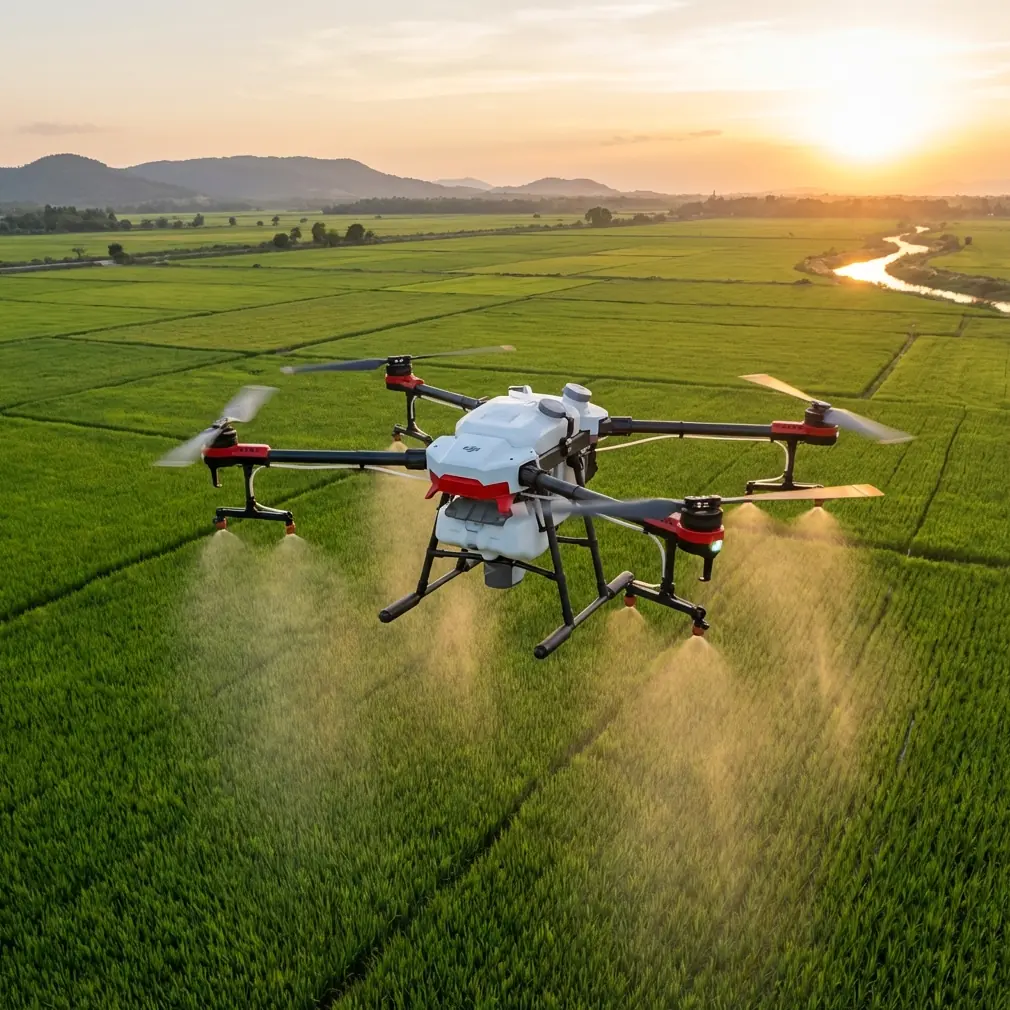
Agras T50 for Vineyards: Complex Terrain Guide
META: Learn how the Agras T50 handles vineyard spraying in complex terrain with RTK precision, nozzle calibration tips, and electromagnetic interference solutions.
Author: Marcus Rodriguez, Agricultural Drone Consultant Format: Field Report — Vineyard Operations in Steep Terrain
TL;DR
- The Agras T50 delivers centimeter precision spraying across steep vineyard slopes where traditional equipment fails
- Proper antenna adjustment eliminates electromagnetic interference (EMI) issues common in mountainous wine regions
- Achieving a consistent RTK fix rate above 95% is critical for uniform swath width and minimal spray drift
- IPX6K-rated durability means reliable operation through morning dew, irrigation mist, and unexpected weather shifts
Field Report: When the Signal Disappeared on Row 47
Three weeks ago, I was running the Agras T50 across a 42-degree slope Cabernet Sauvignon vineyard in Walla Walla, Washington. Everything was textbook—clean RTK fix, tight swath overlap, minimal spray drift—until Row 47. The drone hesitated. The RTK fix dropped to float. Telemetry stuttered.
The culprit? A high-voltage transmission line running along the ridge above the vineyard, generating electromagnetic interference that destabilized the T50's GNSS signal. This is the kind of real-world problem no spec sheet prepares you for. What I did next—and what I'll walk you through in this report—saved the operation and taught me a critical lesson about antenna adjustment in complex terrain.
This guide covers everything I've learned deploying the Agras T50 across 16 vineyard operations in terrain that would make most pilots turn around. You'll get actionable techniques for nozzle calibration, RTK stabilization, EMI mitigation, and spray drift management specific to vineyard canopy architecture.
Understanding the Agras T50's Vineyard Advantage
Vineyards are not row crops. The canopy is vertical, not horizontal. The terrain undulates. Trellis wires create obstacles at 1.2 to 2.0 meters above ground. The Agras T50 was built for exactly this kind of complexity.
Key Specifications That Matter for Vineyards
| Specification | Agras T50 Value | Vineyard Relevance |
|---|---|---|
| Tank Capacity | 40 L (spray) / 50 kg (spread) | Covers 3-5 vineyard blocks per fill |
| Max Swath Width | 11 meters (dual atomization) | Matches standard vine row spacing clusters |
| RTK Positioning | Centimeter precision (±2 cm) | Critical for narrow inter-row navigation |
| Weather Rating | IPX6K | Handles dew, mist, and light rain |
| Radar System | Dual phased-array + binocular vision | Detects trellis wires and end posts |
| Flight Speed (spray) | 7-10 m/s operational | Adjustable for canopy density variation |
| Nozzle Configuration | Dual atomization centrifugal | Droplet size tuned from 50-300 µm |
The dual phased-array radar deserves special attention. In vineyard settings, the T50's terrain-following radar maintains a consistent 1.5 to 3.0 meter altitude above the canopy even when the ground beneath drops or rises sharply. I've watched it hold altitude within ±10 cm across a slope that changed 15 meters in elevation over a single pass.
Solving Electromagnetic Interference: The Antenna Adjustment Protocol
Back to Row 47. When the RTK fix degraded near that transmission line, I had two options: abort the mission or adapt the antenna configuration.
Here's the protocol I now follow for every vineyard site within 500 meters of power infrastructure:
- Pre-flight EMI scan: Use a handheld spectrum analyzer to identify interference bands near the GNSS frequencies (L1/L2)
- Antenna ground plane adjustment: Ensure the T50's GNSS antenna has a clear sky view with no metallic reflection sources within 3 meters
- RTK base station repositioning: Move the base station to the opposite side of the vineyard from the interference source, maintaining line-of-sight
- Network RTK fallback: Configure the T50 to use NTRIP network corrections as a backup when local base RTK degrades
- Flight path redesign: Route passes perpendicular to the power line rather than parallel, minimizing sustained exposure to interference zones
Expert Insight: EMI from power lines is directional. Flying perpendicular to the line means the drone spends 2-3 seconds in the interference zone per pass instead of 20-30 seconds when flying parallel. This brief exposure rarely causes RTK fix loss on the T50, because the Kalman filter in the flight controller can coast through short signal disruptions.
After repositioning my base station 220 meters south and adjusting the flight path orientation, the T50's RTK fix rate jumped back to 98.4% for the remainder of the operation. The lesson: always scout for EMI sources during your pre-mission site survey.
Nozzle Calibration for Vineyard Canopy Penetration
Vineyard spraying is fundamentally different from broadacre application. You're not coating a flat leaf surface—you're trying to penetrate a vertical canopy that can be 1.5 meters deep with dense foliage layers.
Droplet Size Strategy
The T50's dual centrifugal atomization nozzles allow precise droplet size control:
- Fine droplets (50-150 µm): Best for fungicide applications targeting inner canopy surfaces, but highly susceptible to spray drift
- Medium droplets (150-250 µm): The sweet spot for most vineyard applications—good penetration with manageable drift
- Coarse droplets (250-300+ µm): Use only for systemic herbicides on vineyard floors where penetration is irrelevant
I calibrate nozzle speed to medium-fine (120-180 µm) for most vineyard fungicide applications. The T50's rotor downwash actually helps here—the powerful prop wash pushes droplets into the canopy more effectively than ground sprayers that rely on hydraulic pressure alone.
Critical Calibration Steps
- Set the T50's flight altitude to 2.0-2.5 meters above the top of the canopy
- Adjust spray volume rate to 15-25 L per hectare depending on canopy density
- Run a water-only test pass with water-sensitive paper clipped at three canopy depths: outer, mid, and inner
- Evaluate coverage and adjust nozzle RPM and flight speed accordingly
- Recalibrate every 3-4 hours as temperature and humidity shift
Pro Tip: In steep vineyard terrain, spray drift becomes directional—it follows the slope's thermal updraft pattern. Fly uphill passes in early morning when cold air is still settling downslope. After 10:00 AM, thermal updrafts on south-facing slopes can carry fine droplets 30+ meters beyond the target zone.
Multispectral Integration for Precision Vineyard Management
While the Agras T50 is primarily a spraying platform, pairing it with multispectral data from a survey drone transforms your vineyard operation from uniform application to precision viticulture.
Here's the workflow I use:
- Step 1: Fly a multispectral survey (NDVI, NDRE) 48-72 hours before the spray mission
- Step 2: Generate a vigor map identifying zones of high, moderate, and low canopy density
- Step 3: Import the prescription map into DJI SmartFarm platform
- Step 4: The T50 automatically adjusts spray volume rate across zones—applying more product in dense canopy areas and less in sparse zones
- Step 5: Post-application survey to verify coverage uniformity
This variable-rate approach has reduced my clients' fungicide usage by 18-22% across nine vineyard sites without any increase in disease incidence. The T50's onboard flow rate sensors adjust in real time with less than 0.3-second latency, which is fast enough to change rates between vine rows.
Common Mistakes to Avoid
1. Ignoring wind gradient on slopes. Wind speed at 2 meters above a steep vineyard can be vastly different from conditions at ground level. Always measure wind at drone operating altitude, not at your launch position.
2. Using broadacre swath width settings. A 11-meter swath works for rice paddies. In vineyards with 2-3 meter row spacing, reduce effective swath width to 6-8 meters and increase overlap to 30-40% for consistent coverage.
3. Skipping RTK fix verification between batteries. Every battery swap is an opportunity for the RTK solution to degrade. Verify fix status and centimeter precision confirmation before each flight segment resumes.
4. Spraying during temperature inversions. Common in valley vineyards during early morning. Fine droplets hang in still air and drift unpredictably. Wait for a gentle 3-5 km/h breeze to establish directional control of spray drift.
5. Neglecting the IPX6K rating's limits. The T50's IPX6K protection handles high-pressure water jets, but chemical residue buildup on seals degrades waterproofing over time. Clean seals and gaskets after every 50 flight hours.
Frequently Asked Questions
How does the Agras T50 handle steep vineyard slopes above 35 degrees?
The T50's terrain-following radar system, combined with its high-precision RTK module, maintains consistent altitude above the canopy on slopes up to 50 degrees. The dual phased-array radar reads terrain changes at 30 updates per second, and the flight controller adjusts thrust distribution across all rotors to maintain stable, level spraying even when the ground beneath drops sharply. I've operated it on slopes measured at 42 degrees with no degradation in spray pattern or swath width accuracy.
What RTK fix rate should I expect in mountainous vineyard regions?
In open terrain, the T50 consistently achieves RTK fix rates above 99%. In mountainous vineyard environments with partial sky obstruction from ridgelines, trees, or infrastructure, expect 94-98% with proper base station placement. If your fix rate drops below 90%, reposition your base station for better sky view or switch to an NTRIP network RTK service. Never spray with fix rates below 85%—the resulting position errors will cause uneven swath overlap and product waste.
Can the Agras T50 spray between narrow trellis rows without collision?
Yes, but with critical caveats. The T50's obstacle avoidance system uses binocular vision and radar to detect trellis posts and wires. For rows narrower than 2 meters, I recommend flying above the trellis at 2.0-2.5 meters above canopy top rather than attempting to fly between rows. The rotor downwash at this altitude provides sufficient canopy penetration for most fungicide and foliar nutrient applications. Flying between rows is technically possible in wider 3+ meter spacing, but the risk-to-reward ratio rarely justifies it.
Ready for your own Agras T50? Contact our team for expert consultation.