
Agras T50 in High-Altitude Fields: A Field Report
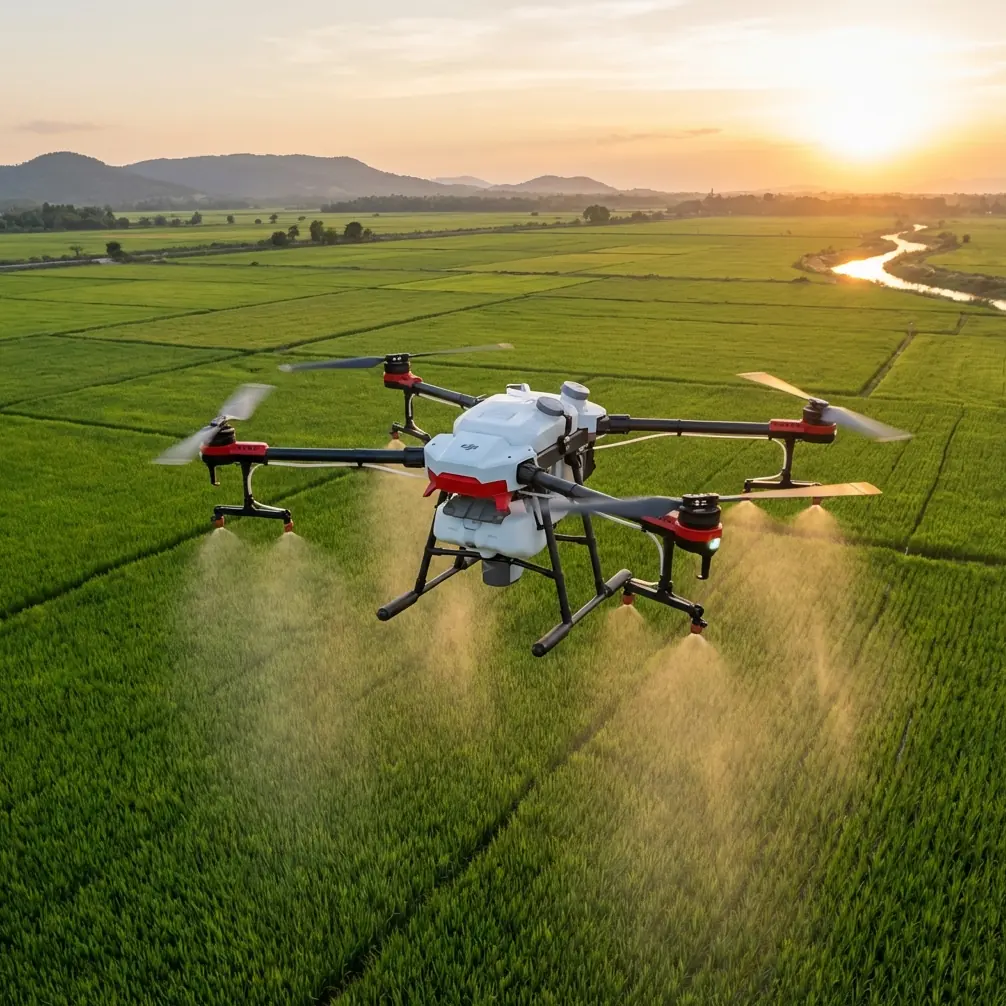
Agras T50 in High-Altitude Fields: A Field Report on Precision, Drift Control, and the Maintenance Gap
META: Field report on using the DJI Agras T50 in high-altitude fields, with practical insight on spray drift, nozzle calibration, RTK precision, swath management, and why maintenance training matters as much as flight performance.
High-altitude spraying exposes every weak point in an agricultural drone operation. Thin air changes lift behavior. Wind is rarely stable. Terrain pushes the aircraft into constant micro-adjustments. A wide, flat field at low elevation can make almost any platform look competent. A mountain-edge plot does the opposite. It reveals whether the aircraft, the workflow, and the support system are actually ready for real farm work.
That is why the Agras T50 deserves to be discussed through a field lens rather than a brochure lens.
I spent time evaluating how this class of aircraft fits the reality of upland agriculture, where field access is poor, spray drift can erase margins, and a missed treatment window can do more damage than an obvious equipment failure. The conversation around the T50 often centers on output. That matters, of course. But for high-altitude fields, the bigger question is whether the machine can hold a clean line, maintain a stable swath width, and stay serviceable over a long season.
Those three issues—precision, consistency, and maintainability—are tightly connected.
What changes in high-altitude work
When you move into elevated terrain, the pilot stops managing only the crop task and starts managing the atmosphere. Rotor response feels different. Wind shear shows up where the slope breaks. Drift risk rises fast if nozzle calibration is treated as a one-time setup instead of a living part of the job. Even with centimeter precision from an RTK-enabled workflow, the application result can still be poor if droplet behavior is not matched to the site.
That sounds obvious until you watch an aircraft track beautifully over a steep field while the actual deposition pattern tells a very different story.
On one flight near a terraced block, the aircraft’s sensing system had to slow and adjust after a pair of egrets lifted from irrigation grass at the edge of the plot. That moment had nothing to do with marketing claims and everything to do with operational value. In real agricultural environments, wildlife, workers, poles, uneven canopy edges, and shifting winds all compete for attention at once. A capable sensing stack is not just about avoiding a collision. It protects route integrity. If the aircraft can react without turning the entire pass into a mess, the operator keeps better coverage and avoids over-application on recovery.
That is the kind of detail growers remember.
The T50 story is not just about flying. It is about keeping aircraft working.
One reference point outside crop spraying may seem unrelated at first, but it gets to the heart of what serious operators should care about. On March 25, Guangdong Huitian Aerospace Technology and Guangzhou Civil Aviation College signed a school-enterprise cooperation agreement and unveiled a joint “industry academy” focused on electric aviation maintenance talent. Their cooperation covers customized training, shared practical training platforms, two-way faculty exchange, and joint research into industry standards.
Why bring that up in a discussion about the Agras T50?
Because the report identifies something many drone fleets already feel: the shortage of skilled maintenance personnel is becoming a bottleneck for high-quality development. Huitian’s stated goal was to prepare core technical maintenance talent in advance for continued airworthiness and after-sales support once products are delivered. That logic applies directly to agricultural drone fleets.
A high-altitude spraying program does not fail only when an aircraft crashes. It fails when a pump output drifts out of tolerance, when a motor response becomes inconsistent, when frame wear is ignored, or when field downtime stretches because nobody on the team can diagnose the issue quickly. The best aircraft in the valley is still just parked hardware if the operator lacks a maintenance pipeline.
This is where the T50 conversation needs more maturity. Farmers and service providers should evaluate not only payload, route automation, or IP ratings like IPX6K-style weather resistance, but also the support ecosystem behind the aircraft. Who handles calibration checks? Who logs component fatigue? Who confirms that the spray system is delivering the intended volume across changing elevations? Who can restore service fast during peak disease pressure?
The industry is starting to answer that question the right way: with structured training, practice platforms, and maintenance standards—not guesswork.
Precision in the field is a choreography problem
Another reference, this time from an educational drone programming document, offers a useful operational analogy. In a multi-drone training sequence, three drones take off simultaneously, hover for 5 seconds, and then land in sequence. The guide notes that spacing should be at least 30 centimeters to reduce collision risk. It also describes a search-and-connect process for 3 drones that takes a little over 30 seconds, after which successful connection is confirmed when the LED turns green, the propellers begin rotating, and the display shows each unit’s number.
That is a classroom example, not an agricultural one. Still, the principle carries over beautifully.
Complex UAV work depends on synchronization. In spraying, that means the aircraft, terrain model, flow rate, route timing, and obstacle response must all stay aligned. If one element drifts, the job drifts with it. The T50 in high-altitude fields is not merely “flying a mission.” It is executing a sequence where each system has to begin, respond, and finish at the correct moment.
The training document also explains a synchronized instruction block: multiple flight actions start at the same time, and the wait time should be set with the duration of those actions in mind. If the action completes, the synchronization ends automatically. Replace that programming lesson with a real field operation and the analogy becomes clear. Your route speed, droplet size, boom behavior, and terrain following must be timed to one another. If speed is set for throughput but nozzle calibration reflects a different condition, uniformity breaks. If RTK fix rate is strong but obstacle response triggers repeated slowdowns on one edge of the field, your effective application per hectare can shift unless the operator compensates intelligently.
That is why experienced teams treat mission setup as system choreography rather than menu tapping.
RTK fix rate matters, but only when the rest of the chain is disciplined
There is a temptation in precision agriculture to treat centimeter precision as the final answer. In mountain fields, it is only part of the answer. A strong RTK fix rate helps the T50 hold line spacing, maintain repeatable entry and exit paths, and reduce overlap in irregular plots. Those benefits are real. In narrow terraces or fragmented blocks, they can be the difference between a professional result and a patchwork one.
But field accuracy is not the same as agronomic accuracy.
A drone can hit its planned path with excellent positional precision while still delivering an inconsistent spray pattern due to wind exposure, incorrect nozzle selection, or poor maintenance of the liquid delivery system. I have seen operators celebrate clean map traces while overlooking drift on the downwind edge. In high-altitude work, the confidence that comes from precise positioning must be paired with disciplined nozzle calibration and regular validation of actual deposition.
This is also where multispectral planning can play a useful supporting role—not as a fashionable add-on, but as a decision layer. If stress zones are identified accurately before treatment, the T50 can be deployed with more selective logic, reducing unnecessary passes and helping the operator narrow treatment windows. In steep areas, that can save battery cycles, reduce exposure to variable gusts, and lower the chance of compounding drift through repeated operations.
Swath width is not a fixed promise in mountain agriculture
People like clean numbers. Field reality does not.
In broadacre marketing language, swath width sounds stable and transferable. In a high-altitude field report, it should be discussed as a managed variable. On paper, you can assign a target. In practice, canopy height variation, crosswind behavior, approach angle, and slope-induced changes in aircraft attitude can all alter the effective result.
That means operators using the T50 in elevated fields need to validate swath width in site conditions, not assume it from prior jobs at lower altitude. This is one of the fastest ways to tighten application quality. Start by confirming actual deposition pattern in representative sections, especially along exposed edges and slope transitions. Then tune route spacing and flow logic accordingly. Without that step, overlaps creep in, skip zones appear, and the aircraft’s technical strengths get blamed for what is really a planning failure.
The same mindset applies to spray drift. Drift is not merely a weather issue. It is a systems issue. Airframe stability, droplet spectrum, route height, slope position, and operator judgment all contribute. The T50 gives a capable platform, but platform capability does not erase responsibility. High-altitude operators need a workflow that assumes drift risk is dynamic from pass to pass.
The hidden value of motor behavior and response consistency
A small technical reference on BLHeli firmware for brushless ESCs offers another useful lens. It notes support for rapid throttle response in multirotor applications and describes damped light braking as enabling very fast motor retardation with active freewheeling. No, the T50 operator is not out in the field manually tuning hobby ESC firmware. That is not the point.
The point is that multirotor performance depends heavily on how quickly and smoothly motors respond to command changes. In high-altitude agricultural work, where the aircraft is constantly correcting for wind and terrain, response consistency matters more than most users realize. Stable control is built on countless tiny adjustments. If power delivery or drivetrain behavior becomes uneven over time, route quality degrades before failure becomes obvious.
That circles back to maintenance again. The machine that feels “a little different” in gusty conditions may not have a dramatic fault code. It may simply be losing the sharpness and predictability that precision application depends on. Skilled technicians catch that early. Untrained teams often do not.
What serious T50 operators should watch in upland operations
If the mission is capturing and treating high-altitude fields efficiently, the strongest T50 operations usually share the same habits:
- They validate nozzle calibration regularly rather than assuming factory settings remain correct under all conditions.
- They monitor RTK reliability as an operational input, not a vanity metric.
- They test effective swath width in the actual terrain and weather band where work will occur.
- They treat drift control as a live decision process.
- They plan for maintenance capacity before peak season starts.
That last point deserves emphasis. The March 25 cooperation agreement in civil aviation training is a sign of where the broader electric aircraft sector is heading: practical training, standard building, and long-term service readiness. Agricultural drone companies, co-ops, and large farms should read that signal carefully. The next divide in this market will not be between those who own capable aircraft and those who do not. It will be between those who can keep fleets airworthy and agronomically accurate, and those who cannot.
If you are building a T50 program for mountain or highland fields and want to compare route setup, calibration workflow, or field support logic, you can message a specialist here.
My take after watching these operations up close
The Agras T50 makes sense in high-altitude agriculture when it is treated as part of a disciplined operating system. Not a miracle tool. Not a one-spec answer. A system.
Its real value appears when centimeter-level positioning is matched with thoughtful route design, when obstacle sensing protects coverage rather than interrupting it, when nozzle calibration is taken seriously, and when maintenance is organized with the same rigor as flight planning. That is how you get repeatable results in places where terrain and wind are determined to expose shortcuts.
The most revealing part of this whole discussion is that the supporting references—maintenance training partnerships, synchronized drone instruction logic, and motor response fundamentals—are not side notes at all. They point to the same truth. Drone agriculture at a high level is no longer about whether the aircraft can get off the ground. It is about whether the entire operation can stay precise, coordinated, and serviceable under pressure.
That is the standard the T50 should be judged against.
Ready for your own Agras T50? Contact our team for expert consultation.