
Agras T50 Near Salt, Dust, and Signal Noise
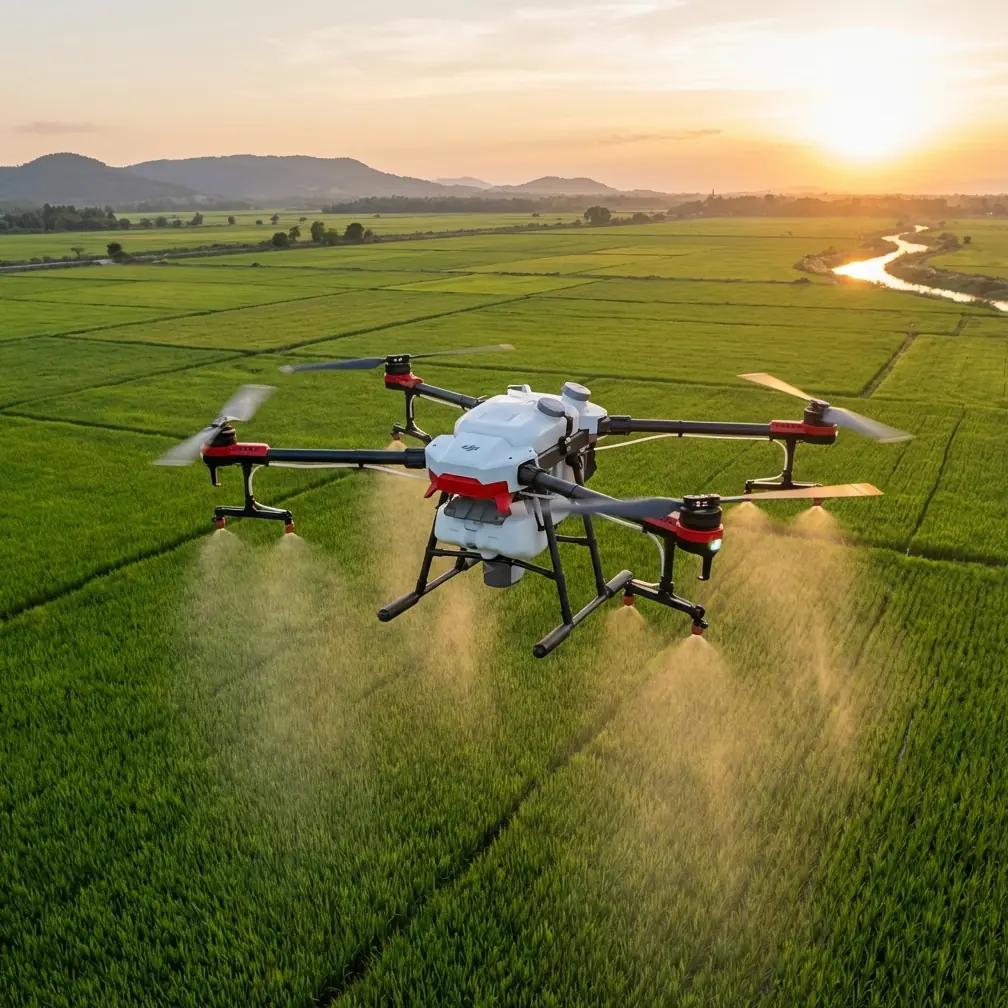
Agras T50 Near Salt, Dust, and Signal Noise: What Actually Matters on Coastal Workdays
META: A field-focused Agras T50 article on coastal operations, spray drift control, sensor limits, RTK stability, and why battery supply-chain moves in South Korea matter for serious UAV operators.
Coastal work looks simple from a distance. Long edges, open sky, fewer obstacles than an inland orchard. The reality is rougher. Dust hangs in the air, salt settles on equipment, crosswinds push droplets sideways, and RF conditions can turn unstable around metal roofs, utility infrastructure, and dense equipment yards. If you are thinking about the Agras T50 for demanding shoreline-adjacent operations, that is the environment worth discussing, not the brochure version.
The most useful way to think about the T50 in these conditions is not as a single aircraft, but as part of a working system: airframe, battery ecosystem, positioning reliability, nozzle setup, operator judgment, and the training culture behind the team using it.
That last point gets neglected. It should not.
Coastal conditions expose every weak assumption
The phrase “capturing coastlines” often sounds like a camera mission. In practice, many coastal operators are dealing with mixed tasks: vegetation management, land-edge treatment, access-road spraying, facility perimeter work, and site documentation in areas where wind and airborne particulates interfere with clean execution. An Agras T50 may be deployed because it can cover ground efficiently, but efficiency collapses if the operator treats the shoreline like a calm inland field.
Spray drift is the first problem. Along a coast, the wind rarely behaves as a single steady stream. It shears, curls around embankments, and changes near dunes, seawalls, drainage channels, and storage buildings. That means swath width is never just a number from a setup menu. It becomes a live decision. A wide pattern may look attractive for throughput, but if droplets begin walking laterally in side gusts, the operator pays for it twice: missed target area and contamination outside the intended zone.
This is where nozzle calibration stops being routine paperwork and becomes operational control. On a coastal site, calibration should be tied to actual conditions that morning, not assumptions from the last job. Flow rate, droplet size behavior, flight speed, and altitude all interact with drift risk. If your goal is precise application, centimeter precision in pathing does not rescue poor liquid behavior. The line can be perfect while the spray is wrong.
That distinction matters with the T50 because high-capacity agricultural drones are often judged by area coverage alone. Serious operators judge them by placement quality.
Sensor awareness still has hard limits
One of the more revealing reference points in the source material comes from an educational drone document discussing autonomous flight. It notes that drones rely on visual sensing, supported by ultrasonic and infrared sensors, to improve obstacle detection and avoidance, yet the effective recognition distance is often limited to about 15 meters. That number comes from an instructional context rather than an Agras T50 specification, but operationally it is a healthy reminder: sensor-assisted autonomy is not magic, especially in cluttered or visually confusing spaces.
Why does that matter on the coast?
Because coastal edges often create low-contrast obstacles and deceptive backgrounds. Fencing wire, nets, poles, scrub, irregular terrain breaks, and reflective surfaces can all interfere with clean perception. Dust and salt film only add to the challenge. An operator who assumes the aircraft “sees everything” is already behind the mission.
On T50 jobs near coastlines, I advise teams to think in layers:
- Primary path discipline: keep routes clean and predictable.
- Obstacle expectation: assume there is something not being interpreted perfectly.
- Manual takeover readiness: autonomy assists the mission; it does not replace situational command.
The educational source also frames safety in a way many commercial teams would benefit from revisiting: the point of programming and redundant logic is to protect the aircraft and the people below it. That is not academic theory. Along populated shoreline roads, resort perimeters, tea plots, and coastal farms, a heavy aircraft operating low and loaded leaves no room for casual assumptions.
The RTK question is really a trust question
Many operators discussing the Agras T50 want to know about RTK fix rate, and for good reason. In a coastal environment, precision matters not only for straight lines but for repeatability along irregular boundaries. If you are running multiple passes near drainage cuts or narrow access strips, centimeter-level positioning improves confidence.
But RTK on its own is not the whole story. Coastal areas often come with electromagnetic clutter: telecom structures, utility corridors, marine equipment, rooftop installations, weather stations, and reflective surfaces that complicate signal quality. When a pilot says, “the machine was drifting,” the underlying issue is often a degraded trust chain between the aircraft, GNSS conditions, and operator interpretation.
This is where antenna adjustment becomes more than a checkbox. If there is electromagnetic interference in the area, do not just reboot and hope. Reassess antenna orientation, confirm line-of-sight quality between control system elements, and avoid standing in positions where nearby metal structures are shadowing or reflecting signal paths. A stable RTK fix rate is partly about satellite geometry and correction data, but fieldcraft still matters. Small changes in controller position or antenna angle can materially improve link stability.
For the T50 operator, the practical takeaway is simple: if the route quality or fix confidence feels inconsistent, stop treating it like a software issue only. Look at the physical environment. Shoreline jobs punish lazy RF habits.
Why a battery deal in South Korea matters to T50 operators elsewhere
At first glance, the news that Amprius Technologies appointed Intralink to expand its presence in South Korea may seem distant from a discussion about the Agras T50. It is not. The partnership is specifically aimed at pursuing deals with OEMs and battery pack makers in South Korea, while targeting the country’s drone, robotics, and mobility sectors.
That matters because battery performance and availability are never isolated technical topics in the UAV industry. They are supply-chain topics, integration topics, and operational reliability topics.
South Korea is one of the markets where advanced electronics manufacturing, battery pack integration, and UAV-related development intersect at a high level. When a battery company moves to deepen local OEM and pack-maker relationships there, it signals a larger industry reality: drone performance is increasingly shaped by who can secure robust battery partnerships and translate cell-level innovation into pack-level reliability.
For Agras T50 operators, especially those running demanding schedules, the significance is indirect but real. Aerial agriculture is one of the most battery-dependent segments in civilian UAV operations. Downtime, charging cycles, thermal behavior, field turnaround, and pack durability all affect mission economics more than most marketing copy admits. The future competitiveness of aircraft like the T50 depends not only on airframe design but on the maturity of the battery ecosystem feeding the sector.
So while the Amprius-Intralink development is not “about” the T50 specifically, it points to an industry direction every T50 fleet manager should watch: battery innovation is moving closer to market-specific business development, not just lab performance headlines. That usually means better alignment between drone manufacturers, pack integrators, and real operational needs.
Dust and salt are maintenance problems before they become performance problems
Readers dealing with dusty coastal areas often focus on ingress protection first, which is fair. Ruggedness matters. An aircraft in this class is expected to tolerate harsh working conditions, and many buyers naturally look for details like IPX6K when evaluating survivability in wet, washdown-heavy, or contamination-prone environments.
Still, a protection rating is not a permission slip to neglect post-flight discipline.
Salt is insidious because it does not always create immediate failure. Instead, it builds residue, affects connectors, encourages corrosion over time, and can contribute to unreliable readings if surfaces or interfaces are not cleaned properly. Dust behaves differently but is just as disruptive. It obscures, insulates heat where you do not want it, and compromises mechanical interfaces gradually rather than dramatically.
On coastal T50 work, good operators create a shortened loop between mission completion and condition check. That loop should include:
- visual inspection of spray system components
- nozzle condition and consistency
- landing gear and frame contamination review
- battery exterior and connector checks
- sensor surface cleaning
- antenna and controller inspection
This is not glamorous work, but it is what keeps the aircraft predictable.
Training culture separates fleets that scale from fleets that stall
One of the reference documents on drone business models describes a club-based approach: bringing together people with shared interests, organizing recurring activities, and building community through regular events and hands-on sessions. In that document, the stated aim is customer development. Stripped of its promotional framing, there is a deeper operational idea here that is highly relevant to the Agras T50 world: communities improve competence.
A T50 operation near coastal sites should not rely on isolated pilot skill alone. It should create repeatable team learning. Regular peer review, short debrief sessions, and scenario-based practice can prevent the same avoidable mistakes from recurring. Even simple workshops around nozzle calibration, drift observation, route planning, and antenna placement under interference can pay for themselves quickly.
This is especially true when crews rotate across sites. The best fleets build something like a professional operators’ club inside the business. Not a hobby circle. A structured learning culture. The reference document mentions recurring group activities and DIY-style participation; in a commercial context, the equivalent is routine technical exchange and practical troubleshooting.
If your team needs a direct channel for field questions on setup and workflow, this Agras T50 support line can be useful during planning or troubleshooting.
The real coastal workflow: reduce variables before takeoff
When I review difficult shoreline missions, the same pattern appears over and over. Problems that look airborne were usually seeded on the ground. The route was accepted without checking the wind corridor. The operator trusted the map edge but did not walk the perimeter. The nozzles were technically installed but not recalibrated for the day’s conditions. The RTK lock was “good enough” until electromagnetic interference made it not good enough. The crew noticed dust accumulation but deferred cleaning to save time.
A stronger T50 workflow does the opposite. It removes uncertainty before lift-off.
Start with the site edge, not the center. Coastal jobs are defined by boundaries. Then check wind behavior where the mission is narrowest or most exposed. Confirm positioning confidence before committing to repetitive passes. Treat swath width as a controllable parameter, not a fixed promise. Recheck nozzle output if conditions have changed. If interference appears, adjust the physical control setup first instead of chasing abstract software explanations.
That is how a platform like the Agras T50 earns its value in demanding environments. Not by being invincible, but by being integrated into a disciplined operating method.
What readers should take away
If you came here looking for a generic Agras T50 overview, the wrong lesson would be that coastal work is just ordinary agricultural flying with a better view. It is not. The combination of dust, salt, crosswind drift, reflective surfaces, and electromagnetic noise creates a workload that exposes bad habits quickly.
Two details from the reference materials are worth carrying into every mission plan.
First, autonomous sensing has limits, and the cited 15-meter recognition distance from the training material is a useful mental guardrail. Even advanced UAV workflows should be built around the assumption that sensing support is finite.
Second, the Amprius move into South Korea through Intralink, with a focus on OEM and battery pack maker deals, tells us that battery strategy is becoming more tightly connected to real drone markets. For operators of aircraft like the Agras T50, that is not background industry gossip. It is part of the larger reliability picture.
The T50 can be a serious tool in coastal operations. But only when precision, maintenance, battery awareness, and fieldcraft are treated as one system.
Ready for your own Agras T50? Contact our team for expert consultation.