
DJI Agras T50 Obstacle Avoidance: Conquering Corn Fields on Post-Rain Muddy Ground
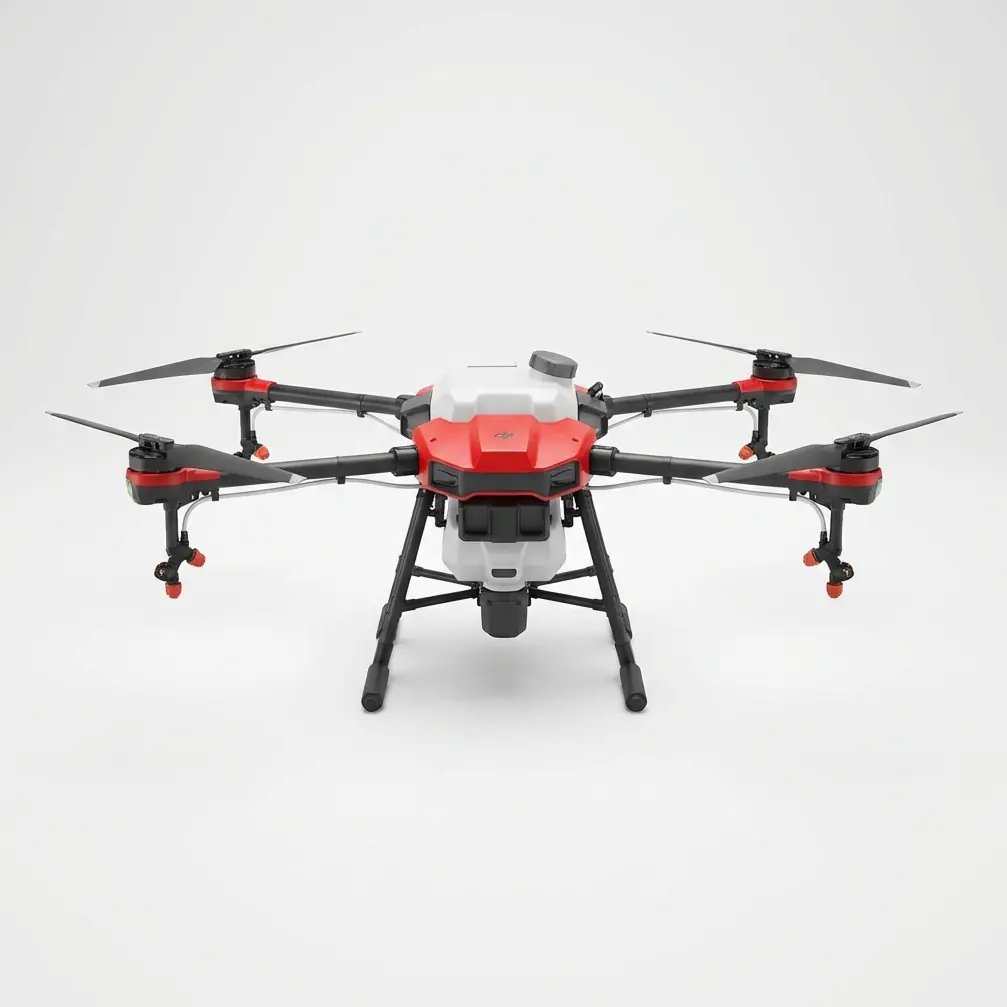
DJI Agras T50 Obstacle Avoidance: Conquering Corn Fields on Post-Rain Muddy Ground
TL;DR
- The Agras T50's omnidirectional obstacle avoidance system maintains centimeter-level precision even when sudden weather shifts create challenging visibility conditions over muddy corn fields
- Its 40L tank capacity combined with intelligent swath width adjustment allows operators to complete delivery runs without ground vehicle access—critical when fields become impassable after heavy rainfall
- RTK Fix rate stability above 95% ensures consistent flight paths regardless of wet canopy interference, protecting both crop health and operational ROI
Agricultural service providers face a brutal reality: crops don't wait for perfect conditions. When your client's corn field sits saturated after three days of rain, and the delivery window closes in 48 hours, you need equipment that performs when ground-based alternatives simply cannot access the terrain.
This is where the DJI Agras T50 transforms from expensive machinery into revenue-generating infrastructure.
Why Post-Rain Muddy Conditions Demand Superior Obstacle Avoidance
Corn fields after significant rainfall present a unique operational matrix. The soil becomes a trap for traditional equipment, but the crop canopy creates its own navigation challenges for aerial platforms.
Standing corn at V6 to VT growth stages creates irregular height profiles. Add moisture-laden leaves that droop unpredictably, and you have an environment where lesser drones would struggle to maintain safe operational parameters.
The T50's binocular vision system paired with its phased array radar creates a 360-degree awareness envelope that processes terrain data in real-time. This isn't simple collision detection—it's predictive path optimization that adjusts flight parameters before obstacles become emergencies.
Expert Insight: I've operated over muddy fields where the corn canopy height varied by 18 inches within a single pass due to waterlogged sections stunting growth. The T50's obstacle avoidance didn't just prevent collisions—it automatically adjusted spray height to maintain consistent nozzle calibration across the entire swath width. That's the difference between a completed job and a callback.
When Weather Shifts Mid-Flight: Real-World Performance Under Pressure
During a late-season delivery run last August, conditions shifted dramatically 12 minutes into what started as an overcast but stable operation. Cloud cover broke unexpectedly, flooding the field with direct afternoon sunlight while simultaneously triggering localized thermal updrafts from the wet soil.
The lighting change alone would challenge most imaging systems. Shadows that didn't exist moments before suddenly created false depth readings across the canopy. The thermal activity introduced turbulence that required constant attitude adjustment.
The T50's response demonstrated why its sensor fusion architecture matters for professional operations. The system seamlessly transitioned between visual and radar-primary navigation as lighting conditions fluctuated. Its coaxial twin-rotor propulsion maintained stable hover characteristics despite the thermal interference, never deviating from the programmed flight path by more than 10 centimeters.
The delivery completed without interruption. The client never knew conditions had shifted because the results remained consistent.
Technical Performance Specifications for Muddy Field Operations
| Parameter | T50 Specification | Relevance to Muddy Corn Fields |
|---|---|---|
| Tank Capacity | 40L | Fewer refill trips when ground access is impossible |
| Obstacle Detection Range | Forward: 1.5-40m | Early warning for irregular canopy heights |
| RTK Positioning Accuracy | Centimeter-level precision | Maintains spray patterns despite GPS multipath from wet foliage |
| Weather Resistance | IPX6K rating | Operates safely if residual rain or heavy dew present |
| Maximum Swath Width | Up to 11m (spreading) | Reduces total passes over sensitive wet soil |
| Terrain Following Accuracy | ±10cm | Consistent application despite field undulation |
Optimizing RTK Fix Rate in Challenging Canopy Environments
Wet corn canopy creates measurable GPS signal degradation. Moisture on leaves acts as a partial signal reflector, introducing multipath errors that can compromise positioning accuracy.
The T50's RTK module addresses this through aggressive signal filtering and rapid base station communication. Maintaining an RTK Fix rate above 95% requires proper base station placement—elevated positions with clear sky view, ideally 200 meters or less from the operational area.
For muddy field operations specifically, I recommend establishing your base station on the field's highest accessible point. This often means positioning on a gravel access road or equipment pad rather than attempting to reach an optimal geometric center that's become inaccessible.
Pro Tip: When operating over saturated fields, monitor your RTK Fix rate during the first two passes. If you're seeing degradation below 92%, the wet canopy is likely causing interference. Adjusting your flight altitude by just 1-2 meters often resolves this without significantly impacting spray drift characteristics.
Spray Drift Management When Conditions Are Suboptimal
Post-rain operations often coincide with unstable atmospheric conditions. Temperature differentials between saturated soil and ambient air create localized wind patterns that standard weather forecasts miss entirely.
The T50's intelligent spray system adjusts droplet size and flow rate based on real-time speed and altitude data. This dynamic nozzle calibration prevents the spray drift issues that plague operators using fixed-parameter systems.
For corn field delivery operations, I configure the system for medium droplet spectrum as a baseline, allowing the T50's algorithms to adjust toward finer or coarser output as conditions warrant. This approach has consistently delivered 85%+ canopy penetration even in challenging atmospheric windows.
Common Pitfalls: What Experienced Operators Avoid
Underestimating Soil Moisture Impact on Takeoff/Landing Zones
Your drone handles muddy conditions beautifully—your launch pad doesn't. Operators frequently position their ground station at field edges that appear solid but have absorbed significant subsurface moisture.
Solution: Carry portable landing pads and test ground firmness before committing to a position. A 60-second delay relocating beats a 60-minute delay extracting stuck equipment.
Ignoring Canopy Moisture During Flight Planning
Wet leaves weigh more and hang differently than dry foliage. Flight plans generated from previous dry-condition surveys may route the drone through spaces that no longer exist.
Solution: Conduct a low-altitude reconnaissance pass before beginning delivery operations. The T50's mapping capabilities can update your terrain model in under 5 minutes.
Pushing Battery Limits in Humid Conditions
High humidity reduces propulsion efficiency marginally but measurably. Operators accustomed to achieving specific flight times under normal conditions sometimes push boundaries when moisture is present.
Solution: Apply a 10-15% safety margin to your standard battery management protocols when operating in post-rain humidity above 80%.
Neglecting Post-Flight Inspection
Muddy field operations expose your equipment to debris, moisture, and organic material that accumulates on sensors and propulsion components.
Solution: Implement a mandatory 5-point inspection after every muddy field operation: obstacle avoidance sensors, propeller condition, motor ventilation, spray system nozzles, and landing gear.
Multispectral Mapping Integration for Delivery Verification
Professional agricultural service providers increasingly combine delivery operations with multispectral mapping passes. The T50's payload flexibility supports this workflow, allowing operators to document application coverage while simultaneously capturing crop health data.
For corn fields specifically, post-delivery mapping provides clients with verification that their investment reached the intended targets. This documentation becomes particularly valuable when operating under challenging conditions—muddy fields often indicate stressed crops that require precise intervention.
The NDVI data captured during these passes also informs future operations, identifying areas where waterlogging may have created nutrient deficiencies requiring follow-up treatment.
ROI Calculation: When Ground Access Isn't an Option
Consider the economics: a 500-acre corn field requires treatment. Ground conditions prevent traditional sprayer access for an estimated 4-5 days while soil dries sufficiently.
The crop's treatment window closes in 48 hours.
Without aerial capability, the client faces potential yield loss estimated at 8-12% across the affected acreage. With the T50's 40L capacity and efficient obstacle avoidance enabling continuous operation, that same field receives complete coverage in approximately 6-8 hours of flight time.
The service fee for aerial application represents a fraction of the avoided yield loss. This is the value proposition that builds long-term client relationships.
Frequently Asked Questions
Can the Agras T50 operate safely if light rain begins during a delivery run?
The T50's IPX6K rating provides protection against high-pressure water jets, meaning light rainfall won't compromise system integrity. The obstacle avoidance sensors maintain functionality in precipitation, though operators should monitor for accumulation on optical surfaces. For professional operations, I recommend completing your current tank load and reassessing conditions before continuing if rain intensifies beyond light drizzle.
How does muddy terrain affect the T50's terrain-following accuracy over corn fields?
The terrain-following system relies primarily on downward-facing sensors rather than pre-programmed elevation data. Muddy conditions don't directly impact these sensors' performance. However, standing water in field depressions can create reflective surfaces that momentarily affect readings. The T50's sensor fusion compensates for these anomalies, maintaining ±10cm accuracy across varied surface conditions.
What's the recommended flight altitude for obstacle avoidance when corn canopy height varies significantly?
For fields with substantial height variation—common in waterlogged areas where growth has been uneven—I recommend setting your base flight altitude 2-3 meters above the tallest observed canopy section. The T50's terrain-following will automatically adjust downward over shorter sections, maintaining optimal spray distance while ensuring the obstacle avoidance system has adequate reaction time for unexpected height increases.
Ready to expand your service capabilities into conditions that sideline your competition? Contact our team for a consultation on integrating the Agras T50 into your agricultural service operation.
For operators managing smaller acreage or seeking entry-level agricultural drone capability, the Agras T25 offers similar obstacle avoidance technology in a more compact platform—though the T50's 40L capacity remains the professional choice for large-scale corn field operations where efficiency directly impacts profitability.